
Some links in this article are affiliate links. We may earn a small commission at no extra cost to you.
Energy grants, rebates, and eligibility rules can change quickly, so always double-check details with the official programme provider before applying or paying for any work.
US home energy grants 2026 changed dramatically at the end of 2025 and most homeowners have not caught up yet.
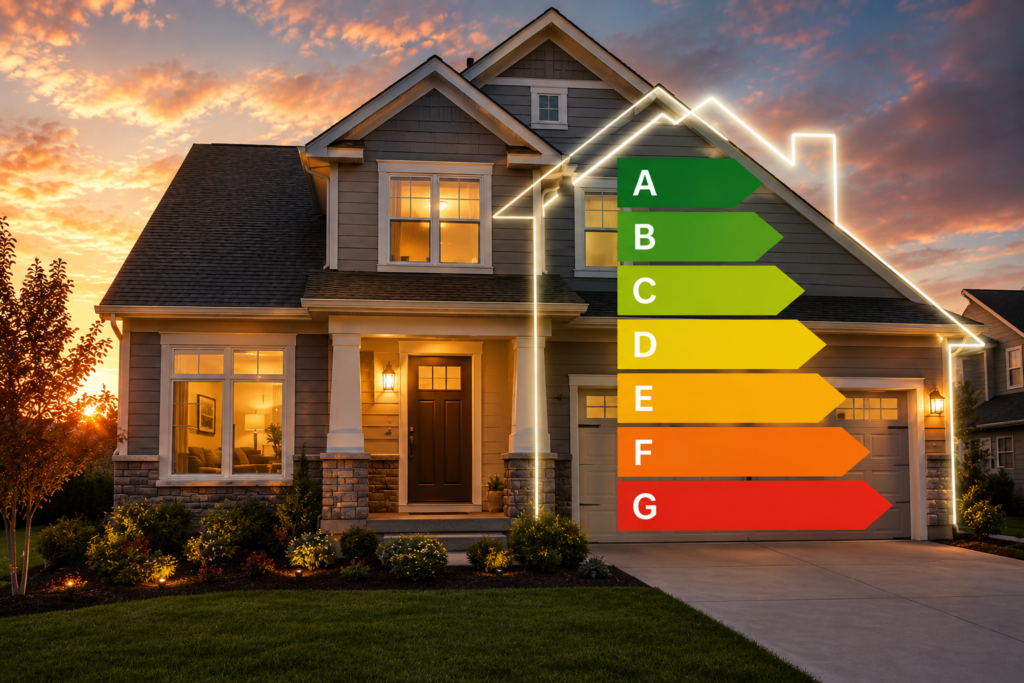
The federal tax credits that millions of Americans used to offset the cost of heat pumps, insulation, windows, and energy audits expired on December 31, 2025. They are not coming back. If you have been planning a home energy upgrade based on something you read a year ago, the picture now looks very different.
But a lot of people still think all the support disappeared with those tax credits. That is not actually what happened.
Billions of dollars are still being rolled out through state energy offices under Inflation Reduction Act rebate programmes. In many states, the savings available now are actually higher than the old federal credits were. Utility rebates are still active, LIHEAP is still open, and the Weatherisation Assistance Programme is still sending crews into qualifying homes at no cost.
If you completed qualifying work before December 31, 2025, you can still claim the old credits on your 2025 tax return. And if you are planning upgrades in 2026, there is still real money available. You just need to know where to look.
📋 Research notes: Information in this guide was checked against official sources including IRS.gov, the US Department of Energy, ENERGY STAR, LIHEAP, and state energy office websites as of May 2026. Programmes and eligibility rules can change quickly, so always double-check details directly with the official provider before applying or paying for any work.
⚠️ Scam warning: LIHEAP does not provide direct grants to individuals and never charges a fee. If you receive a message offering you a LIHEAP grant or asking for payment to access benefits, call the HHS Fraud Hotline at 1-800-447-8477.
🟦 START HERE — Looking for something specific? Jump to: What Changed in 2026 | 2025 Tax Credits | HOMES Rebates | HEAR Rebates | Weatherisation Help | LIHEAP Bill Support | State Rebates | Utility Rebates | Combining Programmes | Smart Thermostats | Best US Smart Thermostats
What Are US Home Energy Grants 2026 and Rebates?
US home energy grants and rebates are programmes from the government or utility companies that help reduce the cost of making your home cheaper to heat and cool, or help cover energy bills when money is tight.
Unlike a tax deduction, which lowers your taxable income, a rebate reduces your cost directly. Some come off the price immediately at checkout. Others arrive later as a cheque, prepaid card, or account credit after you apply.
Most do not need to be paid back. They are not loans.
Quick Answer: Which US Home Energy Grants Are Available Right Now?
➡ HEAR (Home Electrification and Appliance Rebates) covers specific upgrades like heat pumps, wiring, and electrical panels, with rebates of up to $14,000 for qualifying households through state energy offices.
➡ HOMES (Home Owner Managing Energy Savings) offers $2,000 to $8,000 for whole-house energy efficiency projects that achieve major energy savings.
➡ Weatherisation Assistance Programme (WAP) sends crews into qualifying low-income homes and carries out upgrades at no cost. No rebate forms. No paying upfront.
➡ LIHEAP helps low-income households cover heating and cooling bills through local Community Action Agencies.
➡ State programmes are now where much of the money is. Massachusetts, New York, California, and several other states have active programmes worth thousands of dollars.
➡ Utility rebates are still active across most of the US, often offering $25 to $200 for smart thermostats and additional savings on HVAC upgrades.
➡ 25C and 25D federal tax credits expired for new 2026 projects. If you completed qualifying work in 2025, you can still claim those credits on your 2025 tax return before the filing deadline.
What Changed in 2026 for US Home Energy Grants?
Most articles about US home energy grants are still telling readers they can claim thousands in federal tax credits for home upgrades this year. That is no longer true.
The Energy Efficient Home Improvement Credit (Section 25C) and the Residential Clean Energy Credit (Section 25D) both ended on December 31, 2025. The IRS confirmed this after the One Big Beautiful Bill Act was signed into law in July 2025, cutting the original Inflation Reduction Act timeline short by seven years.
The IRS states that:
- the 25C credit no longer applies to property placed in service after December 31, 2025
- the 25D credit no longer applies to qualifying expenditures made after December 31, 2025
There is no reduced version of the credits for 2026. They ended completely for new projects.
If you completed qualifying work in 2025, you can still claim those credits on your 2025 tax return before the filing deadline.
But for new projects in 2026, the landscape has shifted toward state rebate programmes, utility incentives, LIHEAP support, and the Inflation Reduction Act rebate schemes covered below. In many states, those programmes are now worth more than the federal credits they replaced.
💡Did you know? Florida and South Dakota turned down their federal IRA rebate funding entirely. That means households in those states currently do not have access to HOMES or HEAR rebates and must rely on utility rebates or separate state programmes instead.
If You Completed Qualifying Work in 2025, Claim It Now
If you installed qualifying energy upgrades before December 31, 2025, you can still claim the federal credits on your 2025 tax return using IRS Form 5695. The standard filing deadline is April 15, 2026, or October 15 if you filed for an extension.
25C Credits for 2025 Work
| Improvement | Credit Available | Annual Cap |
|---|---|---|
| Heat pumps and heat pump water heaters | 30% | $2,000 |
| Insulation and air sealing | 30% | $1,200 |
| Exterior windows and skylights | 30% | $600 |
| Exterior doors | 30% | $500 total |
| Electrical panel upgrade | 30% | $600 |
| Home energy audit | 30% | $150 |
| Maximum combined annual total | — | $3,200 |
The $2,000 heat pump credit was separate from the standard $1,200 cap. That meant some homeowners could claim the full $3,200 in a single year if they combined upgrades like insulation and a qualifying heat pump installation.
25D Credits for 2025 Work
Solar panels, geothermal systems, battery storage, and residential wind energy systems qualified for a 30% federal credit with no annual cap.
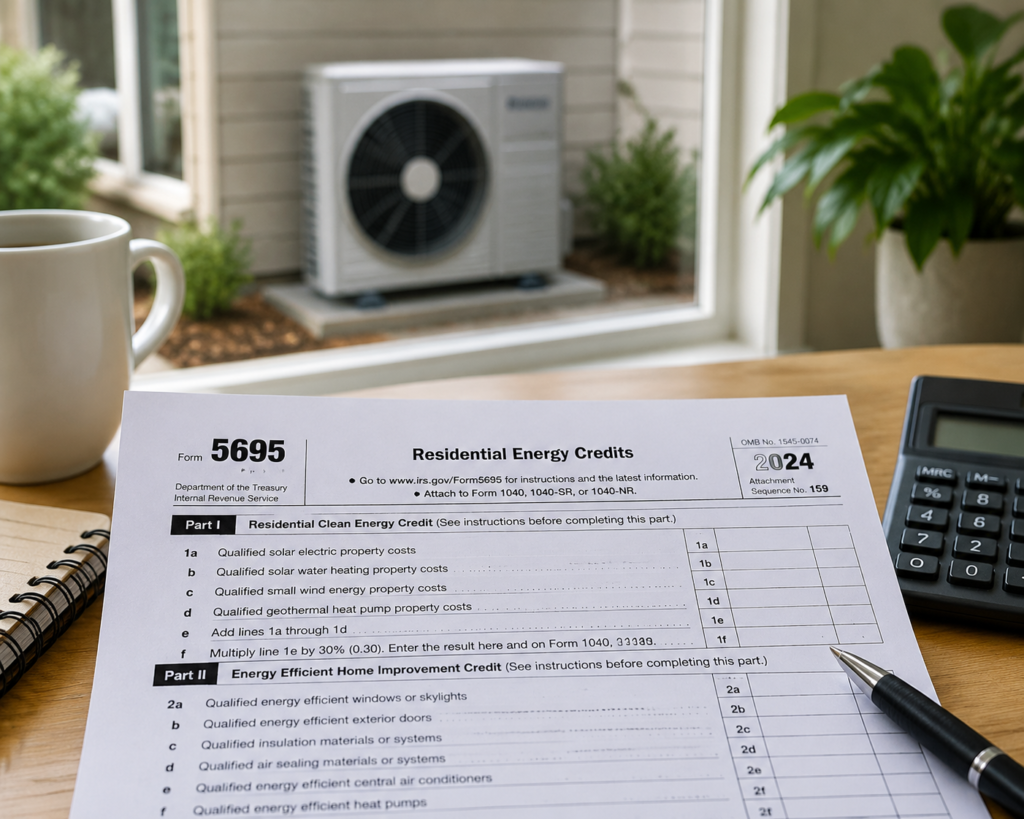
Unlike 25C credits, unused 25D credits can roll forward into future tax years if the full amount cannot be used immediately.
⚠️Important: The 25C credit only reduces the federal tax you owe. It does not generate a refund beyond that amount. For example, if your credit is worth $2,000 but you only owe $1,000 in federal taxes, you only receive $1,000 and the remaining balance is lost.
HOMES Programme: Up to $8,000 for Whole-Home Energy Upgrades
What It Is
The HOMES rebate programme helps households improve overall energy efficiency rather than paying for one specific product. It is funded through the Inflation Reduction Act and run through individual state energy offices.
Instead of focusing on a single upgrade like a heat pump or insulation, HOMES rewards bigger whole-house energy savings.
What It Pays
| Energy Savings Achieved | Standard Households | Under 80% Area Median Income |
|---|---|---|
| 20% to 35% reduction | Up to $2,000 | Up to $4,000 |
| 35% or more reduction | Up to $4,000 | Up to $8,000 |
Households earning below 80% of their area median income (AMI) qualify for the highest rebate amounts. Those earning between 80% and 150% of AMI may still qualify for partial support covering up to 50% of project costs.
Households above 150% of AMI are not eligible for HOMES rebates.
How to Apply
Most households apply through approved contractors who first carry out a home energy assessment to measure expected savings.
You can find your state energy office here.
Programmes are rolling out at different speeds across the US, so check your state’s current availability before planning any work.
💡 Pro tip: DSIRE is one of the best tools for finding state and utility energy programmes in your area. Enter your state and filter by rebate type to see what is currently active near you.
HEAR Programme: Up to $14,000 for Home Electrification Upgrades
What It Is
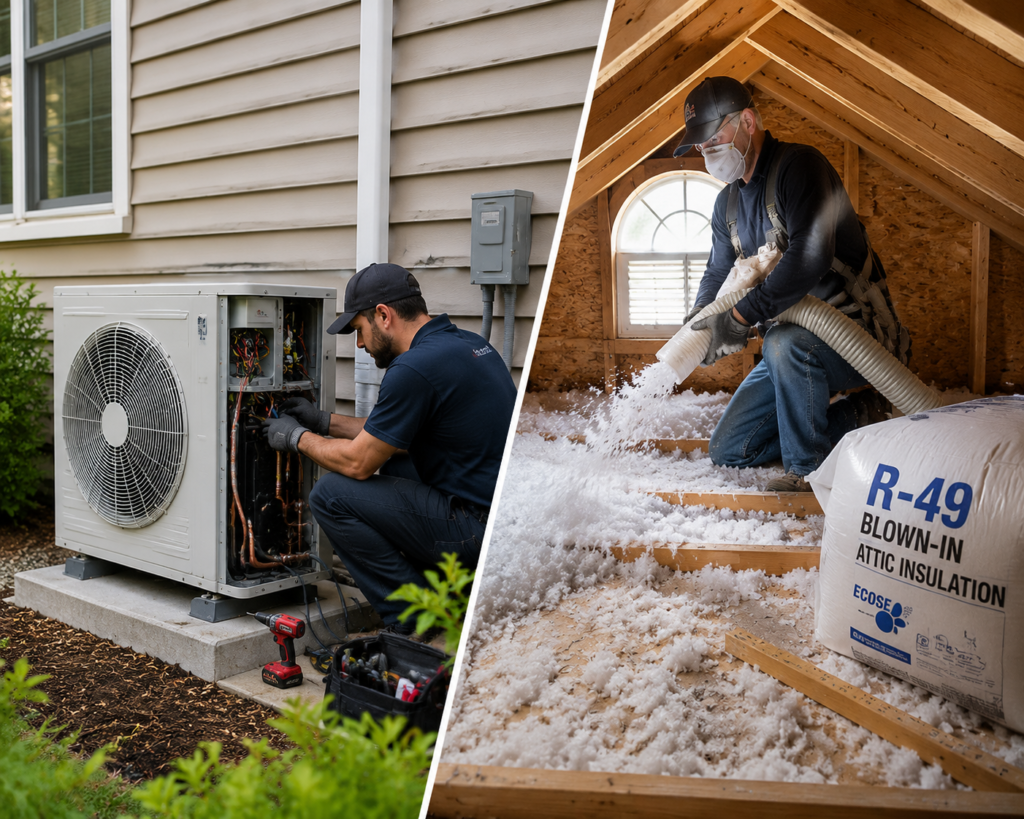
The HEAR programme, also called HEEHRA, helps qualifying households pay for specific electric upgrades like heat pumps, wiring, breaker panels, and efficient appliances.
Unlike HOMES, which focuses on whole-house energy savings, HEAR pays rebates for individual upgrades. The programme is funded through the Inflation Reduction Act and run through state energy offices across the US.
What It Pays
| Upgrade | Maximum Rebate |
|---|---|
| Heat pump heating and cooling system | $8,000 |
| Electrical panel upgrade | $4,000 |
| Wiring upgrades | $2,500 |
| Heat pump water heater | $1,750 |
| Insulation and air sealing | $1,600 per dwelling unit |
| Electric dryer | $840 |
| Electric stove or cooktop | $840 |
| Maximum combined household cap | $14,000 |
One detail many homeowners miss: the insulation cap applies per dwelling unit. That means properties with an attached accessory dwelling unit may potentially qualify for higher combined support.
Who Qualifies
Households earning below 80% of area median income (AMI) qualify for the full rebate amounts.
Those earning between 80% and 150% of AMI may still qualify for partial rebates covering up to 50% of project costs.
Households above 150% of AMI are not eligible for HEAR rebates.
💡 Worth knowing: HEAR and HOMES can sometimes be combined on the same project if they cover different upgrades. For example, households may use HEAR for a heat pump and HOMES for insulation or air sealing. You cannot claim both programmes for the same improvement, but many projects legitimately use both together.
Weatherisation Assistance Programme: Free Upgrades Without Paying Upfront
This one works differently from a rebate. If you qualify, crews actually come out and carry out the work for you at no cost.
The Weatherisation Assistance Programme provides free home energy upgrades for households at or below 200% of the federal poverty guidelines. Households receiving Supplemental Security Income (SSI) are also automatically eligible.
Priority is usually given to older adults, households with a disabled member, families with children, and homes facing especially high energy costs. If any of those apply to your household, mention it during the application process.
Typical improvements include insulation, air sealing, heating system repairs or replacements, and water heater upgrades. An energy auditor usually visits first to inspect the property and decide which improvements will make the biggest difference.
Both homeowners and renters can qualify. If you rent, the programme provider works with your landlord before any work begins.
Find your local provider via this LINK
💡 Did you know? The Department of Energy says the average Weatherisation Assistance upgrade saves households more than $370 per year on energy bills, with many improvements lasting 15 to 20 years.
LIHEAP: Help With Energy Bills Right Now
The Low Income Home Energy Assistance Program (LIHEAP) helps households pay heating and cooling bills, deal with shut-off notices, and in some states cover emergency energy repairs.
In most cases, LIHEAP does not send money directly to you. The payment goes straight to your utility provider on your behalf.
Benefit amounts vary widely by state. For example, Pennsylvania households may receive between $200 and $1,000 toward heating bills, while some New Jersey households can qualify for over $1,200 in bill support plus additional weatherisation help.
Eligibility is income-based. Many states use 150% of the federal poverty level, while others use a percentage of state median income, which can allow higher-income households to qualify.
Both homeowners and renters can apply.
To find your local provider:
Visit Energy Help or call the National Energy Assistance Referral hotline at 1-866-674-6327, weekdays from 9am to 7pm Eastern Time.
⚠️ Apply early. LIHEAP funding runs out in many states before winter ends. Do not wait until your utility bill becomes unmanageable.
State Programme Highlights
For many homeowners in 2026, state and utility programmes are now where the biggest savings are.
Below are a few standout examples currently active across the US. For a full breakdown by state, check dsireusa.org or your state energy office website.
Massachusetts
Mass Save remains one of the strongest energy efficiency programmes in the country and is open to customers of participating utilities regardless of income.
Whole-home heat pump rebates can reach $10,000. Income-qualifying households may also receive insulation support covering 75% to 100% of costs, plus smart thermostat rebates of around $100.
More info:
masssave.com | 1-866-527-7283
New York
New York continues to push heavily into home electrification through NYSERDA.
The Clean Heat programme offers rebates of up to $7,900 for qualifying air source heat pumps, while EmPower+ provides free efficiency upgrades for lower-income households.
More info:
nyserda.ny.gov
California
California’s HEAR rebate programme is now active through the California Public Utilities Commission.
The state also runs one of the broadest LIHEAP programmes in the country, with income limits high enough that many middle-income households still qualify. TECH Clean California currently offers between $500 and $3,000 toward qualifying heat pump installations.
Start here:
energyupgradeca.org
Rhode Island
Rhode Island quietly became one of the most aggressive states for heat pump incentives.
Clean Heat RI offers rebates of up to $11,500 for qualifying systems, among the highest single heat pump rebates currently available in the US.
More info:
rienergyefficiency.com
Texas
Texas does not run a major statewide rebate programme, so utility rebates matter much more here.
Oncor, CenterPoint Energy, and AEP Texas all offer active thermostat and HVAC incentives. AEP Texas also runs a direct-install smart thermostat programme for qualifying households through November 2028.
Find your utility:
dsireusa.org
💡 Not seeing your state here? Check dsireusa.org for the latest local programmes. States including Colorado, Illinois, New Jersey, Washington, Connecticut, Vermont, Maine, and Maryland already have active rebates, with more programmes launching throughout 2026.
Utility Rebates: One of the Easiest Savings Most Households Miss
Utility rebates operate separately from federal and state programmes, which means they can often be combined with other incentives.
Smart thermostat rebates are especially common. Depending on where you live, utility companies may offer anywhere from $25 to $200 back on qualifying models. Some provide instant discounts at checkout, while others send prepaid cards or bill credits after installation.
For example:
- Alabama Power offers rebates of up to $200
- Alliant Energy offers around $100
- Ameren Illinois provides point-of-sale thermostat discounts
- Baltimore Gas and Electric offers rebates of up to $100
And those are just a few examples.
To see what is available at your address, use the ENERGY STAR rebate finder at:
energystar.gov/rebate-finder
Enter your ZIP code and it will show active rebates linked to your local utility provider.
We also break down the biggest US thermostat rebate programmes in detail here:
Your Energy Company Could Pay You to Upgrade Your Thermostat
Combining Programmes: How Households Save the Most Money
This is where many homeowners miss out.
In practice, different rebates and programmes can often be combined on the same project, which is how some households reduce upgrade costs by thousands of dollars.
The general rule is simple:
- programmes covering different upgrades can usually be stacked
- total rebates cannot exceed the actual project cost
- HOMES and HEAR cannot both be claimed for the exact same improvement
But using one programme for a heat pump and another for insulation or air sealing is often completely fine.
Example: Lower-Income Household in Massachusetts
A qualifying household might combine:
- HEAR rebates for a heat pump
- HOMES rebates for insulation and air sealing
- Mass Save incentives for additional efficiency work
- a utility rebate for a smart thermostat
Depending on the project, combined savings could reduce upfront costs dramatically.
Example: Standard Household in New York
A homeowner in New York could potentially combine:
- NYSERDA Clean Heat rebates
- utility HVAC incentives
- a smart thermostat rebate from their energy provider
That combination alone may offset several thousand dollars in upgrade costs.
Example: Mixing 2025 Tax Credits With 2026 Rebates
Some households may still be able to combine:
- 2025 federal tax credits for qualifying work completed before the deadline
- 2026 HEAR rebates for separate upgrades
- utility thermostat rebates
For example, a homeowner who claimed a 2025 heat pump tax credit may still qualify for a separate 2026 rebate on a heat pump water heater.
⚠️ Important: Always tell programme providers about rebates or incentives you have already received. And if you are combining rebates with older federal tax credits, it is worth checking with a tax professional first because the rules can affect how much you are allowed to claim.
How to Find Out What You Actually Qualify For
Most households never check what is available locally, which is why millions of dollars in rebates go unclaimed every year.
The good news is that you can usually find everything available to you in less than 15 minutes.
Step 1: Check DSIRE
Go to dsireusa.org and enter your state. It is one of the best sources for finding active state energy programmes, rebates, and utility incentives in your area.
Step 2: Call Your Utility Company
Call the number on your energy bill and ask:
- Do you offer smart thermostat rebates?
- Do you offer heat pump or insulation rebates?
That one phone call alone can uncover savings most homeowners never even hear about.
Step 3: Use the ENERGY STAR Rebate Finder
Go to energystar.gov/rebate-finder and enter your ZIP code.
It instantly shows active rebates linked to your utility provider, including smart thermostats, HVAC systems, insulation, and other qualifying upgrades.
Where Smart Thermostats Fit Into All of This
Smart thermostats are not usually the main item funded under HEAR or HOMES rebates. But in practice, they connect to almost every upgrade on this page.
A better-insulated home behaves differently after the work is done. It holds heat or cool air for longer, which means your heating and cooling system no longer needs to run the same way it did before. A smart thermostat helps adjust for that automatically.
The same applies to heat pumps. They work best with steady, efficient temperature control rather than constant stop-start cycling from older manual thermostats.
That is why smart controls often show up during whole-home energy assessments and utility rebate programmes, even when they are not the primary upgrade being funded.
On top of that, many utility companies offer separate smart thermostat rebates worth anywhere from $25 to $200, completely independently of other grants or rebates you may already qualify for.
ENERGY STAR estimates the average US household saves around $50 per year after switching to a smart thermostat. Combined with insulation or heat pump upgrades, those savings can add up surprisingly quickly.
Our Smart Thermostat Savings and Payback Calculator gives you a personalised estimate based on your household.
And for a full breakdown of current utility thermostat rebates:
Your Energy Company Could Pay You to Upgrade Your Thermostat
Four Smart Thermostats Actually Worth Considering in 2026
If you are upgrading your heating system, improving insulation, or simply trying to lower energy bills right now, these are four of the strongest smart thermostat options for US homes in 2026. All are ENERGY STAR certified and widely accepted by utility rebate programmes across the country.
ecobee Smart Thermostat Premium
One of the strongest options for heat pump systems and larger homes. Includes a room sensor, strong multi-stage system support, and detailed energy controls without locking core features behind a subscription.
Check the latest price on Amazon
Google Nest Learning Thermostat
Designed for households that want a more hands-off setup. The thermostat learns your routine over time and automatically adjusts schedules based on usage patterns.
Google says households typically save around 10–12% on heating and 15% on cooling.
Check the latest price on Amazon
Honeywell Home T9
Particularly useful for homes with hot or cold spots between rooms. Wireless room sensors help prioritise comfort where people are actually spending time.
Also useful for many dual-fuel and heat pump setups.
See also:
Uneven Room Temperatures
Check the latest price on Amazon
Amazon Smart Thermostat
A solid lower-cost option for households that mainly want rebate eligibility and app-based control without spending hundreds of dollars upfront.
Still ENERGY STAR certified and compatible with many utility rebate programmes.
Check the latest price on Amazon
💡 Before buying: Always check your utility provider’s approved thermostat list first. Some rebate programmes only cover specific models, and buying the wrong version is one of the most common reasons people miss out on rebates.
Full buying guide:
Best Smart Thermostats for Home 2026.
Your Action Plan
You completed qualifying work before December 31, 2025:
File IRS Form 5695 with your 2025 federal tax return before April 15, 2026, or October 15 if you filed for an extension.
Your household income is below 80% of area median income:
You may qualify for the full HEAR rebate amounts and potentially higher HOMES support. Start with your state energy office or check dsireusa.org to see which programmes are already live in your area.
Your household income is between 80% and 150% of area median income:
You may still qualify for partial HEAR rebates covering up to 50% of project costs. Check both your state energy office and your utility provider for additional rebates that can be combined.
Your household income is above 150% of area median income:
HEAR and HOMES are generally not available above this threshold. Your best options are utility rebates and state-level programmes like Mass Save, NYSERDA, or TECH Clean California.
You are struggling to pay heating or cooling bills right now:
Call the LIHEAP hotline at 1-866-674-6327 to find your local Community Action Agency. Apply early because funding in many states runs out before winter ends.
You live in Florida or South Dakota:
HOMES and HEAR are not available in your state. Focus on utility rebates and any state-specific programmes still running. Start with dsireusa.org and your utility provider directly.
You want to start lowering bills immediately without waiting for lengthy applications:
A smart thermostat is one of the fastest upgrades you can make. Most utility companies offer rebates, and the savings compound alongside insulation, heat pumps, and other efficiency improvements. Honest breakdown: Is a Smart Thermostat Worth It in 2026?
Frequently Asked Questions
Are there any federal tax credits for home energy upgrades in 2026?
No. Section 25C and Section 25D both expired for new work after December 31, 2025. If you completed qualifying upgrades in 2025, you can still claim them on your 2025 tax return.
What is the difference between HOMES and HEAR?
HOMES rewards overall household energy savings. HEAR covers specific upgrades like heat pumps, wiring, and electrical panels. Both are income-based and can sometimes be combined for different parts of the same project.
How do I check if my state has launched HOMES or HEAR?
Visit energy.gov/scep or contact your state energy office directly. Rollouts are happening on different timelines across the country.
Can renters qualify for these programmes?
Yes in many cases. LIHEAP and WAP both include renters. HOMES and HEAR eligibility for renters varies by state and may require landlord approval for certain upgrades.
What income limits apply to HOMES and HEAR?
Households below 80% of area median income usually qualify for the highest rebate amounts. Partial support may still be available up to 150% of area median income.
Can I combine utility rebates with HEAR or HOMES?
Often yes. Many utility rebates can be stacked with state or federal programmes as long as the combined support does not exceed the total project cost.
Do smart thermostats qualify for HEAR?
Usually not as a standalone HEAR item. However, many utility companies offer separate smart thermostat rebates, and thermostats are frequently recommended during broader energy efficiency projects.
What happened to the $8.8 billion IRA rebate fund?
The funding still exists. It is now being distributed through state-run HOMES and HEAR programmes across the US.
My state programme is not live yet. Should I wait?
Not always. Utility rebates are already active in many areas, and delaying necessary upgrades purely to wait for a future programme is not always the best financial move.
Sources
- IRS, FAQs for Modification of Sections 25C and 25D under Public Law 119-21
- IRS, Home Energy Tax Credits: irs.gov/credits-deductions/home-energy-tax-credits
- IRS, Form 5695 Instructions
- ENERGY STAR, Certified Smart Thermostats: energystar.gov/productfinder/product/certified-connected-thermostats
- ENERGY STAR, Rebate Finder: energystar.gov/rebate-finder
- US Department of Energy, SCEP Home Energy Rebates
- US Department of Energy, Weatherisation Assistance Programme: energy.gov/scep/wap/how-apply-weatherization-assistance
- US Department of Energy, State Energy Offices: energy.gov/scep/state-energy-offices
- Administration for Children and Families, LIHEAP: acf.gov/ocs/programs/liheap
- LIHEAP NEAR Hotline: 1-866-674-6327
- LIHEAP Clearinghouse, New Jersey: liheapch.acf.gov/profiles/NJ.htm
- LIHEAP Clearinghouse, Wisconsin: liheapch.acf.gov/profiles/Wisconsin.htm
- Pennsylvania LIHEAP: pa.gov/services/dhs/apply-for-liheap
- DSIRE: dsireusa.org
- EnergyHelp.us: energyhelp.us
- HHS Fraud Hotline: 1-800-447-8477
- Mass Save: masssave.com
- NYSERDA: nyserda.ny.gov
- Energize Connecticut: energizect.com
- California Energy Upgrade: energyupgradeca.org
- Rhode Island Energy Efficiency: rienergyefficiency.com
- One Big Beautiful Bill Act (Pub. L. 119-21): congress.gov
- NAHB, Expiring Energy Tax Credits: nahb.org
Reviewed by The Thermo Expert Team
The Thermo Expert Team researches and compares smart thermostats, heating systems, and common HVAC issues to provide clear, practical advice for homeowners. Our goal is to help you understand problems quickly and choose the right solution with confidence. Learn more about us →