
📖 7 min read — Perfect for a coffee break
Our recommendations are based on expert sources, real user feedback, and industry research.
Some links in this guide may earn us a small commission at no extra cost to you.
Is a Smart Thermostat worth it in 2026? Here’s the honest answer.
You are staring at your energy bill again. It is higher than you expected. Again.
Or maybe you have just moved somewhere new and you are wondering whether a smart thermostat actually changes things, or just sounds clever in theory.
Here is the truth: for most people, yes. But not everyone.
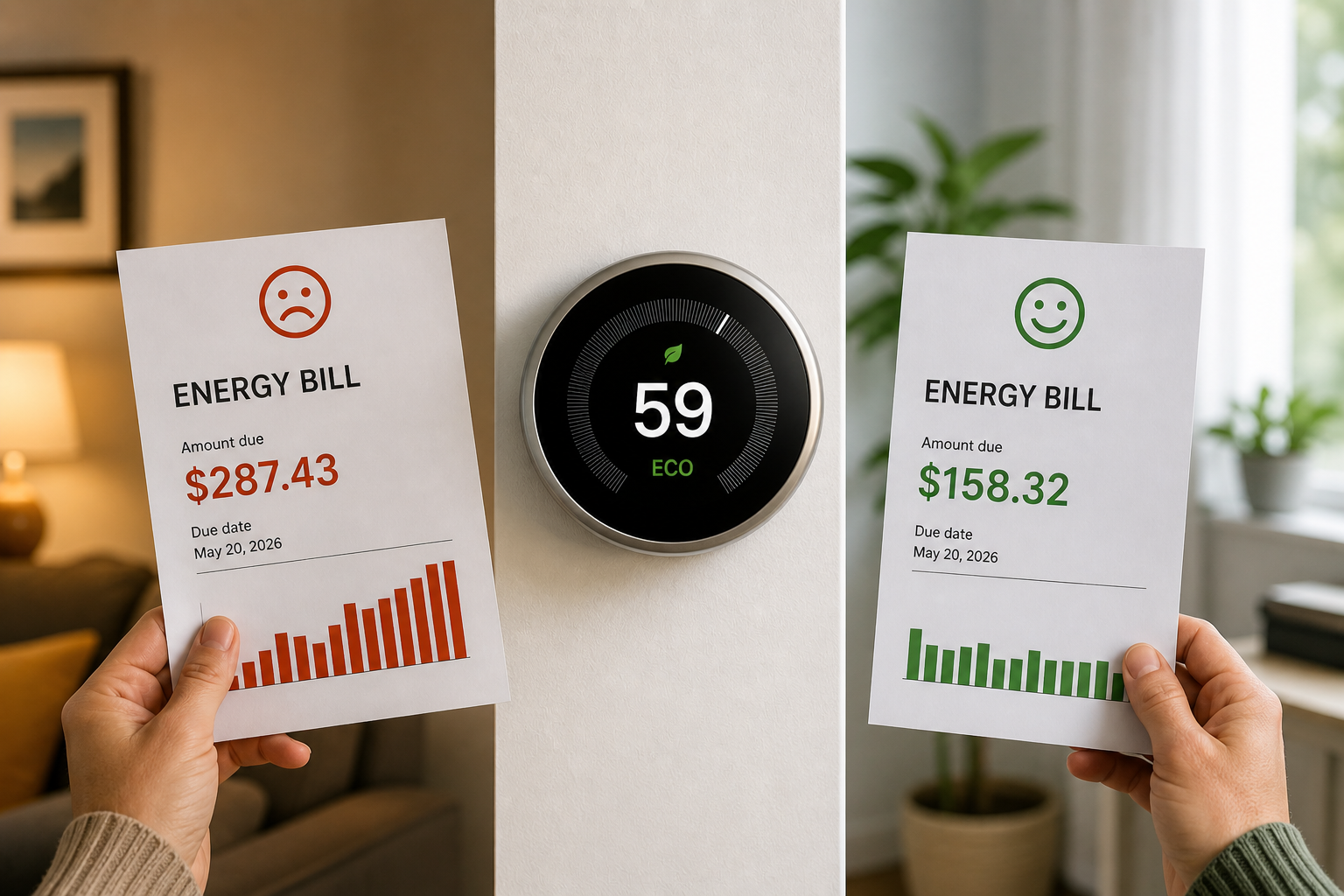
Real costs. Real savings. Honest advice on who benefits and who does not.
That is what this guide covers.
Researched using data from ENERGY STAR, the US Department of Energy, BBC Radio 4 Sliced Bread, The Heating Hub, Which?, Money Saving Expert, Eco Temp HVAC, and leading HVAC professionals.
What Does a Smart Thermostat Actually Do?
A smart thermostat replaces your existing thermostat and connects to your WiFi. You control it from your phone, anywhere in the world.
The useful part is what happens automatically.
Geofencing Detects when you leave home and turns the heating down. Warms the house back up before you return. No action needed.
Learning Available on models like the Google Nest. Watches how you use your heating for about a week and builds a schedule around your actual life.
Scheduling Set different temperatures for different times of day. Traditional thermostats can do this too but most people never bother to set it up properly.
Energy reports Shows how much energy you used and when. Seeing the data tends to change behaviour and reduce bills further.
The short version: It does the things you know you should do but keep forgetting to do. Automatically.
Is a Smart Thermostat Worth It for Most Homes?
Here is the quick answer based on your situation.
| Your situation | Worth it? |
|---|---|
| You leave home regularly and forget to adjust the heating | Yes, strong return |
| Your schedule changes often or is unpredictable | Yes, strong return |
| Your energy bills are high | Yes, faster payback |
| You want remote control and convenience | Yes, immediate benefit |
| You work from home all day with a consistent routine | Probably not |
| You already use manual schedules effectively | Probably not |
| Small flat or apartment with low energy use | Borderline |
| Very old HVAC system or boiler | Check compatibility first |
How Much Does a Smart Thermostat Actually Cost?
The device $80 to $300 in the US. £50 to £150 in the UK for most popular models.
Installation $80 to $150 for a professional swap. Add $50 to $150 if your home needs a C wire. DIY is free if you are comfortable with basic wiring.
Optional extras Room sensors, C wire adapters, and smart radiator valves all add to the total. Consumer affairs journalist Harry Kind told BBC Radio 4’s Sliced Bread:
“If you have a large house with multiple heating zones you can be spending £200 to £300. And then if you start adding smart thermostatic radiator valves into the mix, you can be adding more money. There is a rabbit hole you can go down.”
For most homes the basic setup is more than enough.
Typical total cost
| Setup | Estimated cost |
|---|---|
| Budget device, DIY | $80 to $150 |
| Mid range device, DIY | $150 to $250 |
| Mid range device, professional install | $250 to $400 |
| Premium device, professional install | $300 to $500 |
| Complex system with sensors | $400 to $700 plus |
Rebates that can cut the cost significantly
Many utility companies offer cash back that reduces what you pay.
- AEP Ohio: $100 rebate
- PECO: $50 back
- Mass Save: up to $100 per thermostat (up to three per home)
- CenterPoint Energy (Indiana): eligible customers can get a no-cost thermostat at checkout
Pro tip: Check your local utility provider before buying. In some cases, the thermostat costs you nothing at all.
Search: “smart thermostat rebate + your state” to find yours.
UK readers: government support worth knowing about
- Smart thermostats on their own are not typically funded directly by UK government grants. However, they may be included as part of a broader funded package under schemes such as the Warm Homes Plan or Warm Homes Local Grant.
- According to UK government and energy policy sources, the Warm Homes Plan is a £13.2 billion programme to upgrade 5 million UK homes by 2030. It provides grants for lower income homes, low interest loans for other households, and expanded heat pump support.
- The ECO4 scheme has been extended to 31 December 2026. Smart energy controls including smart thermostats are increasingly included within funded upgrade packages under ECO4 and local Warm Homes projects.
- If you are on qualifying benefits or live in a property with a low energy performance rating, it is worth checking your eligibility. Under ECO4, eligible households can receive free smart thermostat installations as part of a broader package that includes boiler replacements, insulation, and renewable heating solutions.
Check your eligibility at gov.uk or contact your energy supplier directly.
What Can You Actually Expect to Save?
The verified figure
According to ENERGY STAR, average savings are approximately 8% of heating and cooling bills, or $50 per year.
This is based on real world data from thousands of actual homes, verified by a third party. Not a lab test. Not a manufacturer’s claim.
What manufacturers report
- Nest: customers save 10 to 12% on heating and 15% on cooling, roughly $140 per year
- ecobee: customers report saving up to $284 per year using eco+ features
The honest savings range
| Scenario | Annual saving (US) | Annual saving (UK) |
|---|---|---|
| Conservative (ENERGY STAR verified) | Around $50 | Around £50 |
| Typical real world | $100 to $180 | £100 to £158 |
| High energy use households | $180 to $284 | £150 to £300 |
Why the gap exists
Jo Alsop from The Heating Hub explained it clearly on BBC Radio 4’s Sliced Bread.
Savings are mostly driven by geofencing. If you already turn the heating off when you leave and on when you return, the thermostat is just automating something you were already doing. The saving is real but smaller.
If you currently heat an empty home without thinking about it, the saving is much larger.
Worth knowing: The savings come from three things most people are genuinely bad at. Remembering to turn the thermostat down when leaving. Sticking to a schedule. And not cranking the heating the second they walk in from the cold. A smart thermostat handles all three automatically.
Estimate your own payback in 30 seconds
Take your annual heating and cooling spend. Apply 8 to 12%. Divide your device cost by that figure.
- Spend $1,500 a year, save 10% = $150 saved. A $200 thermostat pays back in 16 months.
- Spend $600 a year, save 8% = $48 saved. The same thermostat takes over 4 years.
The higher your current bill, the faster it pays for itself.
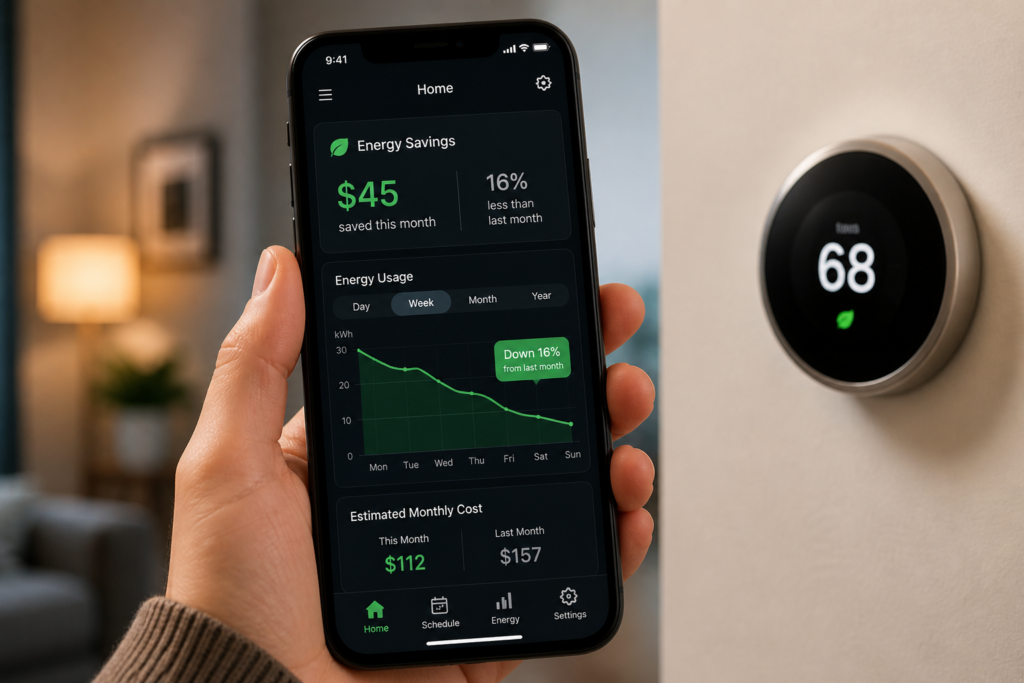
How Long Before It Pays for Itself?
Most homeowners: 2 to 3 years in moderate climates. 4 to 5 years in milder regions.
UK homeowners: 12 to 18 months based on 2026 Ofgem tariff rates, according to UK energy analysis.
Jo Alsop from The Heating Hub gave an honest counterexample on BBC Radio 4. For a well insulated home where the owner already manages heating carefully, a £200 thermostat could take six years to pay back if savings are only £50 a year.
The rule: The messier your current habits, the faster it pays for itself.
Payback at a glance
| Annual saving | Total cost | Approximate payback |
|---|---|---|
| $50 | $200 | 4 years |
| $100 | $200 | 2 years |
| $150 | $300 | 2 years |
| $180 | $350 | Around 2 years |
| $284 | $400 | Around 17 months |
When a Smart Thermostat IS Worth It
✔ You leave home regularly and sometimes forget to turn the heating down
✔ Your schedule changes from week to week
✔ Your energy bills are high so a percentage saving means real money
✔ You want remote control from your phone
✔ You travel frequently or spend extended time away
✔ You have a larger home where different rooms need different temperatures
✔ You find programming traditional thermostats confusing or never get around to it
✔ Your utility offers a rebate that reduces or eliminates the upfront cost
When It Is NOT Worth It
This is the section most buying guides skip. It matters.
- You work from home all day with a predictable routine Money Saving Expert is clear on this. A traditional programmable thermostat does the same job at a fraction of the price.
- You already manage your heating efficiently Jo Alsop from The Heating Hub said it directly on BBC Radio 4. A smart thermostat automates what you already do manually. If you are already doing it well, it adds very little.
- You live in a small flat with low energy use The percentage saving is real but the absolute amount may be too small to justify the cost in any reasonable timeframe.
- Your heating system is old or incompatible Some older boilers cannot communicate with smart thermostats at all. Jo Alsop noted on BBC Radio 4 that anyone with a boiler older than eight years may not be able to get advanced controls to work with it. Always check compatibility before buying.
- You are renting and cannot make permanent changes Check with your landlord before purchasing.
If you fall into one of these: a basic programmable thermostat costing $20 to $100 can still deliver the Department of Energy’s recommended 10% saving through proper scheduling. The key is actually programming it, which most people never do.
Real Benefits Beyond Saving Money
For many households the non financial benefits are what actually justify the purchase.
- Control from anywhere in the world You are halfway to the airport and you suddenly cannot remember if you turned the heating off. You check your phone. You did not. You fix it in ten seconds and carry on. That scenario alone is worth the price of admission for frequent travellers.
- More consistent comfort Smart thermostats, especially those with room sensors, keep temperatures more consistent throughout the day and across different rooms. Less of that experience where the living room is too hot and the bedroom is freezing.
- Automation that fits your actual life If you get home late it adjusts. If you leave early it responds. It works around your real life, not a fixed schedule you set once and forget.
- Seeing your energy use clearly Most people are genuinely surprised by what the monthly reports show them. That surprise almost always leads to small changes that reduce bills further, independently of what the thermostat does automatically.
- Smart home integration Works with Alexa, Google Assistant, and Apple HomeKit. The Matter standard means compatibility across platforms keeps improving every year.
The Downsides Worth Knowing
Upfront cost Several hundred pounds or dollars before you have saved a penny. A real barrier on a tight budget. Check rebates first.
C wire requirement Many older homes do not have one. Adapters exist and some models include workarounds. See our C wire guide before buying.
Compatibility is not guaranteed Not all smart thermostats work with all heating systems. Always check the manufacturer’s compatibility tool first.
Setup takes time App configuration, WiFi connection, setting preferences. Most people find it straightforward. Some find it frustrating.
Security matters Harry Kind flagged this on BBC Radio 4’s Sliced Bread. Cheaper brands may not receive regular updates, leaving software vulnerable over time. Choose a well supported brand.
Smart Thermostat vs Traditional Thermostat
| Feature | Smart | Traditional |
|---|---|---|
| Remote control via app | Yes | No |
| Automatic scheduling | Yes | Manual only |
| Geofencing | Yes | No |
| Energy tracking | Yes | No |
| Learns your routine | Some models | No |
| Room sensors | Some models | No |
| Upfront cost | Higher | Lower |
| Ongoing subscription | Usually none | None |
| Lifespan | 10 to 20 years | 10 to 20 years |
| Warranty | Typically 2 years | Typically 1 year |
Which Homes Benefit Most?
Large homes More rooms, more zones, more opportunity to save. Room sensors and zoned control make a proportionally bigger difference when heating needs vary significantly from room to room.
Busy families Children’s activities, varying work patterns, and unpredictable schedules mean heating needs change constantly. Geofencing handles this far better than any fixed programme ever could.
High energy bill households A 10% saving on a $2,000 annual bill is $200. On a $500 bill it is $50. The higher your bill, the faster the payback and the stronger the case for buying one.
Frequent travellers and commuters Away mode means you never pay to heat or cool an empty home. For people who travel regularly for work or spend extended periods away, this is the most immediate return you will see.
Homes with no existing programmable thermostat If you currently have only a basic on and off thermostat with no programming at all, the improvement will be immediate and significant.
Final Verdict: Is It Worth It in 2026?
For most people, yes.
A smart thermostat typically pays for itself within two years and lasts 10 to 20 years. The maths works.
But the real value is not just the saving on your bill.
It is coming home to a warm house without thinking about it. It is turning the heating off from your phone when you forget. It is never paying to heat an empty home again.
Most people who buy one say they would not go back even if it saved them nothing.
Who should skip it?
If you work from home all day, already manage your heating well, or live somewhere small with low energy bills, a basic programmable thermostat does the same job for much less.
The bottom line
If you leave the house regularly and want your home to look after itself, a smart thermostat is worth it in 2026. No hype. Just real savings and smarter control.
Ready to Take the Next Step?
Not sure which model to buy? See our best smart thermostats for home (2026) guide for honest recommendations at every budget.
Worried about monthly fees? See our best smart thermostats without subscription fees guide. None of them require a monthly payment for core functions.
Not sure if your wiring is compatible? Read our C wire guide before buying anything.
Frequently Asked Questions
How much does a smart thermostat save per year?
On average $50, according to ENERGY STAR. Real world savings from Nest and ecobee users typically run $100 to $200 depending on your home and habits.
How long before it pays for itself?
Around two years for most homes. Longer in milder climates or if your heating is already well managed.
Worth it if I work from home?
Probably not for the savings. A basic programmable thermostat does the same job for less if your routine is consistent.
Does it work with all heating systems?
No. Always check the manufacturer’s compatibility tool before buying. See our C wire guide for wiring questions.
Are the savings real?
Yes. ENERGY STAR figures are verified using real data from thousands of homes, not lab tests.
What is the biggest factor in how much I save?
Your current habits. If you heat an empty home regularly you will save more. If you already manage heating well you will save less.
Can I get a rebate?
In the US yes. AEP Ohio, PECO, Mass Save, and CenterPoint Energy all offer rebates. In the UK, smart thermostats may be included as part of a funded package under the Warm Homes Plan or ECO4 scheme if you meet eligibility criteria. Check gov.uk or contact your energy supplier.
What happens if my WiFi goes down?
Your heating keeps running on its last schedule. You just lose remote access until the connection comes back.
Is there a smart meter link in the UK?
Yes. Many UK smart thermostats work alongside smart meters, giving you a clearer picture of your energy use in real time. Some energy suppliers also offer tariff linked features that shift heating to cheaper off peak periods when the two systems are connected.
Sources
- ENERGY STAR (US EPA)
- US Department of Energy
- BBC Radio 4 Sliced Bread
- Money Saving Expert
- UK Government Warm Homes Plan
- House of Commons Library (ECO4 and Warm Homes Plan)
- CenterPoint Energy
Reviewed by The Thermo Expert Team
The Thermo Expert Team researches and compares smart thermostats, heating systems, and common HVAC issues to provide clear, practical advice for homeowners. Our content is based on manufacturer documentation, real user experiences, and industry research to help you understand problems quickly and choose the right solution with confidence.