
Thermostat not reaching set temperature? If your home is not hitting the temperature you want, you are not alone. This is one of the most common heating and cooling issues homeowners face and in most cases it is fixable without calling a technician.
The problem can be caused by anything from incorrect settings to airflow issues, poor thermostat placement, or a faulty thermostat. The good news? Many of these fixes are quick, simple and completely free.
Some links in this guide may earn us a small commission at no extra cost to you. This helps support the site so we can keep creating helpful content.
In this guide we break down the seven most common reasons your thermostat is not getting to the desired temperature and exactly what you can do to fix each one.
If your thermostat is not turning on at all, that is a different problem. See our guide on why your thermostat is not turning on for step by step fixes.
How This Guide Was Researched
While we have not physically diagnosed every HVAC system, this guide is built on verified information from:
- US Department of Energy guidance on heating and cooling efficiency
- HVAC professional forums and technician discussions
- Manufacturer documentation from Google Nest, Ecobee and Honeywell
- Analysis of thousands of verified homeowner reviews describing temperature problems
- Energy Saving Trust UK government-backed recommendations
Quick Answer: Thermostat Not Reaching Set Temperature
If your thermostat is not reaching the set temperature, the most common causes are a dirty air filter, incorrect settings, poor airflow, or a faulty thermostat. Most issues can be fixed in under 10 minutes without professional help.
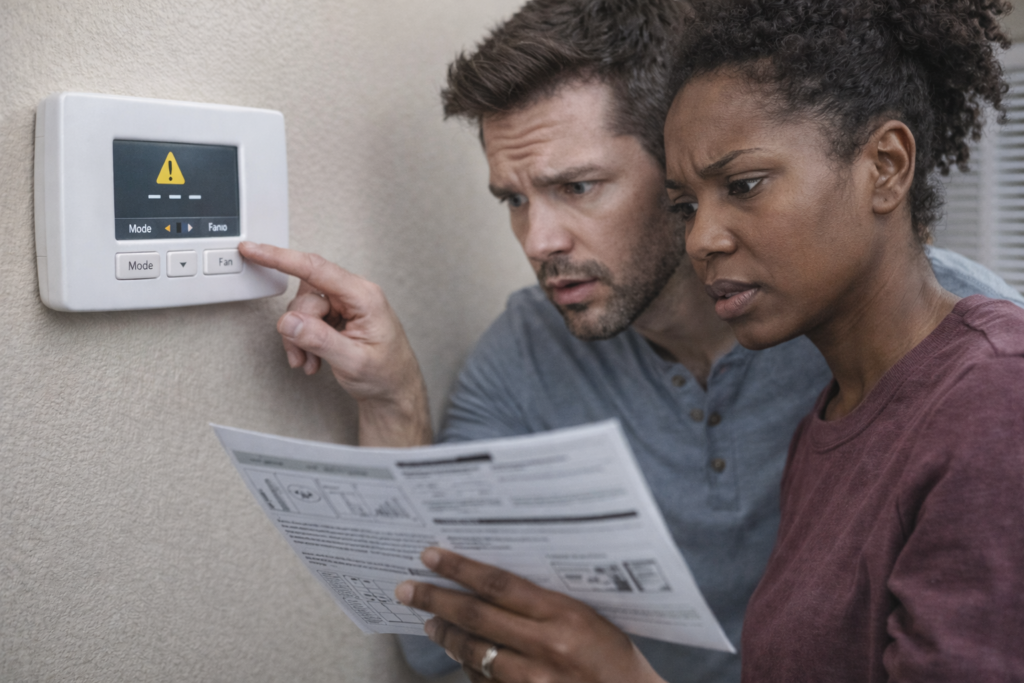
Start with Fix 1 and Fix 2. They solve the problem for most homeowners.
Try this first:
- Check thermostat mode
- Replace air filter
- Turn off eco mode
If your thermostat still isn’t reaching the set temperature after trying the basic fixes, the issue is often the thermostat itself — especially in older homes.
Check modern smart thermostat options on Amazon
Quick Diagnosis Guide
| Your Symptom | Most Likely Cause | Start With |
|---|---|---|
| House never reaches temperature | Dirty filter or HVAC too small | Fix 2 or Fix 4 |
| Temperature drops after reaching target | Poor insulation or air leaks | Fix 6 |
| One room colder than others | Airflow issue or thermostat placement | Fix 3 |
| System runs constantly but fails | Low refrigerant or HVAC fault | Fix 5 |
| Temperature reading seems wrong | Faulty or misplaced thermostat | Fix 3 or Fix 7 |
| Problem only in extreme weather | HVAC system undersized | Fix 4 |
| Problem started recently | Check settings first | Fix 1 |
Fix 1: Incorrect Thermostat Settings (Wrong Mode, Schedule, or Eco)
This is always where to start and it catches more problems than you might expect. Before assuming something is wrong with your system, spend two minutes checking the basics.
What to check:
Wrong mode. Is your thermostat set to Heat when you need cooling, or Cool when you need heat? It sounds obvious but it happens more often than anyone admits, especially after seasons change when someone may have adjusted the settings without you realising.
Schedule overriding your temperature. Many smart thermostats follow a programmed schedule that will override any manual temperature adjustment after a set period. If you turn the temperature up and it keeps dropping back down, your schedule is likely overriding your manual change. Check your schedule in the app and adjust or temporarily disable it.
Eco mode or Away mode. Smart thermostats like the Google Nest and Ecobee automatically activate energy-saving modes when they detect nobody is home. If your thermostat thinks you are away when you are actually sitting in the living room, it will deliberately avoid reaching your set temperature to save energy.
Fan setting. If your fan is set to On rather than Auto it will circulate air continuously even when the system is not actively heating or cooling. This can make it feel like the temperature is not being reached when the system is actually working normally.
How to fix it:
Check your thermostat’s mode, schedule and eco settings. Disable Away or Eco mode if it has activated incorrectly. Set the fan to Auto. For smart thermostats check the app as well as the device itself as the two can sometimes show different states.
This fix costs nothing and takes under five minutes. Try it first every time.
Fix 2: Dirty Air Filter Blocking Airflow
A dirty air filter is one of the most common and most overlooked causes of a thermostat not reaching its set temperature. It is also one of the easiest and cheapest fixes.
Think of your HVAC system like a person trying to breathe through a thick scarf. The harder it is to draw air in, the less effectively it can heat or cool your home. A clogged filter restricts airflow so severely that even a perfectly functioning HVAC system cannot do its job properly.
According to the US Department of Energy, a dirty filter is one of the leading causes of reduced HVAC efficiency and can increase energy consumption by 5 to 15 percent while simultaneously reducing the system’s ability to reach target temperatures.
Signs your filter needs replacing:
- You cannot remember the last time you replaced it — if it has been more than three months it is overdue
- The filter looks grey, brown or visibly clogged when you remove it
- Your system is running longer than usual to reach temperature
- There is more dust than normal around your vents
How to fix it:
Locate your air filter, typically found in the return air vent or in the air handler unit itself. Remove it and hold it up to the light. If you cannot see light through it replace it immediately.
Most standard filters should be replaced every one to three months depending on usage and whether you have pets. Replacing a filter costs between $5 and $20 and takes about two minutes. It is the single most impactful maintenance task you can do for your HVAC system.
One verified homeowner described their experience perfectly: they were about to call an HVAC technician when they remembered they had not changed their filter in over a year. Five minutes and $12 later the system was working perfectly again. They felt a little embarrassed but saved $150.
After replacing the filter give your system 30 to 60 minutes to see whether temperature performance improves.
Fix 3: Thermostat Placement Issues (Sunlight, Drafts, Vents)
Your thermostat can only measure the temperature where it is physically installed. If it is installed somewhere unrepresentative of your home’s actual temperature it will make decisions based on inaccurate information and your home will never feel quite right.
Think of it like a weather station placed in a greenhouse trying to report on outdoor conditions. The reading is not wrong exactly. It is just measuring the wrong thing.
Common thermostat placement problems that cause temperature issues:
Direct sunlight. A thermostat hit by afternoon sunlight will read significantly higher than the actual room temperature. Your cooling system will then over-cool the house trying to bring the thermostat reading down and other rooms will become uncomfortably cold before the thermostat is satisfied.
Near a drafty window or door. Cold air coming through gaps will make the thermostat read lower than the actual room temperature, causing your heating system to run longer and harder than necessary.
Near a supply vent. A thermostat positioned directly in the path of conditioned air from a vent will be satisfied almost immediately after the system starts, cutting the cycle short before the rest of the house reaches the target temperature.
In a room that is rarely used. If the thermostat is in a hallway or room that heats or cools quickly but you spend most of your time in a bedroom or living room with different temperature characteristics, the thermostat will never accurately represent your comfort.
How to fix it:
If possible move the thermostat to a more central and representative location. If moving it is not practical consider a smart thermostat with remote room sensors. See thermostats with room sensors on Amazon. The Ecobee SmartSensor and Google Nest Temperature Sensor allow you to place sensors in the rooms where you actually spend time, so the thermostat makes decisions based on the temperature where it matters rather than where the thermostat happens to be mounted.
For more detail on this problem see our guide on why one room is colder or hotter than the rest.
Fix 4: HVAC System Too Small or Too Large for Your Home
This is a problem that no amount of thermostat adjustment will fix. If your HVAC system is undersized for your home it will simply never be able to reach your set temperature during extreme weather no matter how long it runs.
Think of it like trying to fill a swimming pool with a garden hose. The water is flowing perfectly well but the container is too large for the tool being used.
An oversized system creates a different but equally frustrating problem. It reaches temperature so quickly that it shuts off before the air has circulated properly, leaving parts of your home uncomfortable even though the thermostat is technically satisfied.
Signs your system may be the wrong size:
- The system runs almost constantly during hot summers or cold winters without reaching the target temperature — too small
- The system cycles on and off very frequently, sometimes within just a few minutes — too large, known as short cycling
- The problem only occurs during extreme weather and the system performs normally during mild conditions
An important note:
If your system only struggles during genuinely extreme weather that is not necessarily a sign it is undersized. HVAC systems are designed to maintain indoor temperature within a certain range of outdoor conditions. During a heat wave or unusually severe winter the system may simply be at the limits of its design capacity, which is normal.
How to fix it:
This is not a DIY fix. If you genuinely suspect your HVAC system is incorrectly sized have a qualified HVAC technician perform a Manual J load calculation. This is the industry standard method for determining the correct system capacity for any home and will confirm whether your system is appropriately sized.
Fix 5: Low Refrigerant or Heating System Fault
If your air conditioning system is running but the air from the vents does not feel cold, or your heating system is running but the air does not feel warm, there may be a mechanical issue with the system itself rather than the thermostat.
For cooling systems:
Low refrigerant is one of the most common causes of an air conditioning system that runs continuously but fails to cool the home to the set temperature. Refrigerant does not deplete in a healthy system, so if levels are low it means there is a leak somewhere that needs professional diagnosis and repair.
Signs of low refrigerant include ice forming on the outdoor unit, warm air from the vents despite the system running, and unusually high electricity bills.
For heating systems:
Gas furnaces can develop issues with the heat exchanger, ignition system or gas valve that prevent them from producing adequate heat. Electric heating systems can have failed heating elements. Heat pumps can have issues with the reversing valve that prevents them from switching correctly between heating and cooling modes.
How to fix it:
This is not a DIY repair. Low refrigerant and mechanical heating issues require a qualified HVAC technician with the proper tools and certifications. Do not attempt to add refrigerant yourself as this requires specialist equipment and handling of regulated substances.
If you suspect a mechanical issue contact an HVAC professional for diagnosis. Typical diagnostic and repair costs range from $150 to $500 depending on the issue.
Fix 6: Poor Insulation or Air Leaks (Heat Escaping)
Sometimes the thermostat reaches the set temperature perfectly well but the home simply cannot hold that temperature. The heating or cooling escapes faster than the system can maintain it and the result feels like the thermostat is never quite reaching its target.
Think of it like trying to keep a bath warm with the plug partially out. The hot water tap is working perfectly. The problem is that warmth is draining away as fast as it is being added.
Common sources of heat loss and air infiltration:
- Gaps around window and door frames
- Letterboxes and keyholes
- Loft hatches with inadequate insulation
- Poorly insulated walls or floors
- Gaps where pipes or cables enter through walls
- Old or damaged weatherstripping around exterior doors
How to check:
On a cold windy day hold a lit candle or a thin strip of tissue near the edges of windows and doors. If it flickers there is an air leak. Pay particular attention to corners and where different materials meet.
How to fix it:
Draught-proofing is one of the cheapest and most immediately effective home improvements available. Self-adhesive foam strips for windows and doors cost just a few pounds or dollars and can make a noticeable difference almost immediately.
According to the Energy Saving Trust, draught-proofing a home can save a typical UK household around £45 per year on energy bills with US homes seeing comparable proportional savings.
For more substantial insulation improvements, loft insulation is consistently ranked as one of the most cost-effective home upgrades. According to the Energy Saving Trust, properly insulating a loft can save a typical household between £150 and £225 per year.
Fix 7: Faulty Thermostat (Old or Inaccurate Sensor)
If you have worked through fixes 1 to 6 and your system still is not reaching the set temperature, the thermostat itself may be faulty. Thermostats do have a lifespan and accuracy issues, response delays and outright failures become more common as they age.
Signs your thermostat may be faulty:
- The temperature displayed on the thermostat does not match readings from a separate thermometer placed nearby
- The system does not respond when you adjust the temperature
- The thermostat display behaves erratically or shows error codes
- The thermostat is more than 10 years old
- The problem started suddenly with no other changes to the system
How to check accuracy:
Place a reliable standalone thermometer next to your thermostat and leave it for 15 minutes. If the two readings differ by more than 2 to 3 degrees Fahrenheit or 1 to 1.5 degrees Celsius your thermostat’s sensor may be inaccurate.
How to fix it:
Some smart thermostats including the Ecobee allow you to apply a manual temperature offset in the settings to compensate for sensor inaccuracy. This can be a short-term solution but if the thermostat is old or the inaccuracy is significant replacement is usually the better long-term choice.
When You Should Replace Your Thermostat
If your thermostat is old, consistently inaccurate, or unresponsive to adjustments, replacing it is often the simplest and most cost-effective solution. A thermostat more than 10 years old may simply lack the precision and reliability of modern devices.
If you want a simple, affordable upgrade that fixes most accuracy issues, the Amazon Smart Thermostat is one of the easiest options to install and use.
Modern smart thermostats offer:
- Significantly better temperature accuracy than older models
- AI-powered learning that adapts to your routine
- Remote control from anywhere via smartphone
- Energy reports that help you identify and reduce waste
- Room sensors that measure temperature where you actually spend time rather than just in the hallway
If your goal is to spend the absolute minimum and still get real smart thermostat benefits, the Amazon Smart Thermostat at $61.99 is the one to beat. For those wanting the full premium experience with room sensors and AI learning, the Ecobee and Nest are the clear leaders.
For a full comparison of the best options available in 2026 at every price point, see our complete guide.
And if you are wondering whether a new smart thermostat will actually save you money, we have done the full analysis.
When to Call a Professional
Some causes of a thermostat not reaching temperature require professional diagnosis and repair. Call a qualified HVAC technician if:
- You suspect low refrigerant — this requires specialist equipment and certification
- Your heating system is producing no heat or warm air despite running
- Your system is making unusual noises suggesting mechanical failure
- You have worked through all seven fixes and the problem persists
- Your energy bills have increased significantly alongside the temperature problem
According to RepairPal, a professional HVAC diagnostic visit typically costs between $75 and $150. That cost is almost always worth paying rather than running an inefficient system for months.
How to Prevent This Problem From Coming Back
Once you have fixed the issue a few simple habits will keep your thermostat reaching its set temperature reliably.
| Prevention Tip | How Often |
|---|---|
| Change your air filter | Every 1 to 3 months, set a calendar reminder |
| Check your thermostat settings seasonally | When clocks change, review your schedule |
| Test your thermostat accuracy | Once a year with a standalone thermometer |
| Have your HVAC system serviced | Annually, catches issues before they cause problems |
| Keep vents clear | Always ensure furniture and rugs are not blocking airflow |
Your filter is not a set it and forget it component, unless you enjoy paying higher energy bills.
Quick Summary: 7 Fixes at a Glance
| Fix | Cause | Difficulty | Typical Cost |
|---|---|---|---|
| 1 | Incorrect thermostat settings | Very easy | Free |
| 2 | Dirty air filter | Very easy | $5 to $20 |
| 3 | Poor thermostat placement | Easy | Free to moderate |
| 4 | HVAC system wrong size | Professional needed | $150 to $300+ |
| 5 | Low refrigerant or heating fault | Professional needed | $150 to $500 |
| 6 | Poor insulation or air leaks | Easy to moderate | $5 to $500 |
| 7 | Faulty thermostat | Easy | $60 to $260 |
Start with fixes 1 and 2 before anything else. They are free, take five minutes each, and between them they resolve the problem for a significant proportion of homeowners who search this question.
Frequently Asked Questions
Why is my thermostat set to 72 but my house is only 68?
The most common causes are a dirty air filter restricting airflow, poor insulation allowing heat to escape, incorrect thermostat placement giving inaccurate readings, or an HVAC system struggling to keep up with conditions. Start with checking your air filter and thermostat settings before calling a professional.
How long should it take to reach the set temperature?
Most homes with a correctly sized and properly functioning HVAC system should reach the set temperature within 10 to 30 minutes under normal conditions. In extreme weather this can extend to 45 minutes or more. If your system consistently takes longer than this investigate the causes above.
Can a bad thermostat cause temperature problems?
Yes. Faulty thermostats often give incorrect temperature readings, respond slowly to adjustments, or fail to communicate correctly with the HVAC system. If your thermostat is more than 10 years old and you are experiencing consistent temperature problems the thermostat itself may be the cause.
Why does my house reach temperature and then drop again quickly?
If your home reaches the set temperature but cannot hold it the most likely cause is poor insulation or air leaks allowing conditioned air to escape. Check for draughts around windows, doors and any gaps where pipes or cables enter through walls.
Why does my thermostat not reach temperature only in winter or summer?
If the problem only occurs during extreme weather your HVAC system may be at the limits of its designed capacity, which is normal for unusually severe conditions. If it happens every winter or every summer your system may be undersized for your home. A Manual J load calculation by an HVAC professional can confirm this.
Is it worth replacing a thermostat to fix this problem?
If your thermostat is old, inaccurate or unresponsive and you have ruled out other causes, yes. Modern smart thermostats are significantly more accurate than older models and the replacement cost is often recovered in energy savings within one to two years. See our guide on the best smart thermostats for 2026 for recommendations at every price point.
Why does my smart thermostat not reach temperature even though it worked before?
If a previously working smart thermostat is suddenly not reaching temperature check whether it has switched into Away or Eco mode, whether a software update has changed its behaviour, and whether the schedule has changed, perhaps someone adjusted it without mentioning it. Also check your air filter as this is the most common maintenance-related cause of sudden performance changes.
Final Verdict
A thermostat not reaching its set temperature is frustrating but it is almost always fixable. Work through the seven causes in order, starting with the simplest and cheapest, and most homeowners will find their answer before reaching fix four.
Here is a quick summary of where to start:
- Check your thermostat settings — free, two minutes, fixes the problem surprisingly often
- Replace your air filter — under $20, two minutes, one of the most impactful things you can do
- Check thermostat placement — free, may require a sensor or repositioning
- Assess HVAC system size — professional help needed if suspected
- Check for refrigerant or heating faults — professional repair required
- Improve insulation and seal air leaks — affordable DIY fixes available
- Replace a faulty thermostat — often the simplest long-term solution for older units
If none of these fixes work your thermostat may need replacing, especially if it is over five to ten years old. A modern smart thermostat will not only be more accurate but will actively help you maintain the temperatures you want while saving money on energy bills in the process.
Based on guidance from the US Department of Energy, Energy Saving Trust, manufacturer documentation from Google Nest, Ecobee and Honeywell, HVAC professional forum discussions, and verified homeowner reviews.
Best Thermostats to Fix This Issue
Best Overall – Google Nest Learning Thermostat
Reliable, smart, and learns your schedule automatically. Ideal if your current thermostat is inaccurate or inconsistent.
Check latest price on Amazon
Best Budget – Amazon Smart Thermostat
Simple, affordable, and fixes most temperature control issues without overcomplicating things.
Check lates price on Amazon
Best Premium – Ecobee Smart Thermostat Premium
Includes room sensors and advanced control, perfect if temperature varies between rooms.
Check price on Amazon
Related Guides:
- Best Smart Thermostat for Home (2026).
- Why Is My Thermostat Not Turning On? 7 Real Fixes (2026).
- Why Is One Room Colder or Hotter Than the Rest? (2026).
- Do Smart Thermostats Save Money? Full Cost Breakdown (2026).
- Do You Need a C-Wire for a Smart Thermostat? (2026).
- Do Smart Thermostats Work Without WiFi? (2026).
Reviewed by The Thermo Expert Team
The Thermo Expert Team researches and compares smart thermostats, heating systems, and common HVAC issues to provide clear, practical advice for homeowners. Our goal is to help you understand problems quickly and choose the right solution with confidence.