
This guide applies to Nest, Ecobee, Honeywell and most modern smart thermostats.
Thermostat not cooling? You’re not alone. This is one of the most common AC problems homeowners face and in most cases, it’s fixable without calling a technician. Few home problems feel quite as urgent as an air conditioner that simply refuses to cool. The thermostat display looks perfectly normal. The system appears to be running. And yet the house gets warmer by the hour.
Here is the reassuring truth: in most cases the cause is something straightforward, and professional help is not always necessary. Working through a logical sequence of checks will resolve the problem for the majority of homeowners before they ever need to pick up the phone.
Some links in this guide may earn us a small commission at no extra cost to you. This helps support the site so we can keep creating helpful content.
We dug through thousands of verified homeowner reviews, manufacturer documentation from Google Nest, Ecobee, Amazon Smart thermostat and Honeywell, and HVAC professional discussions to bring you a complete honest answer.
Thermostat not turning on at all? That is a separate issue with its own fixes. See our step by step guide here.
Running but not quite hitting the target temperature? We have that covered too.
How This Guide Was Researched
Rather than speculation, everything here draws from verified sources:
- US Department of Energy guidance on cooling system efficiency
- HVAC professional forums and technician discussions
- Manufacturer documentation from Google Nest, Ecobee and Honeywell
- Thousands of verified homeowner reviews describing real cooling problems
- Energy Saving Trust UK government-backed recommendations
Quick Answer
If your thermostat is not cooling, the most common causes are:
- Incorrect thermostat settings
- Dirty air filter restricting airflow
- Low refrigerant (requires professional repair)
- Outdoor AC unit not running
- Faulty thermostat
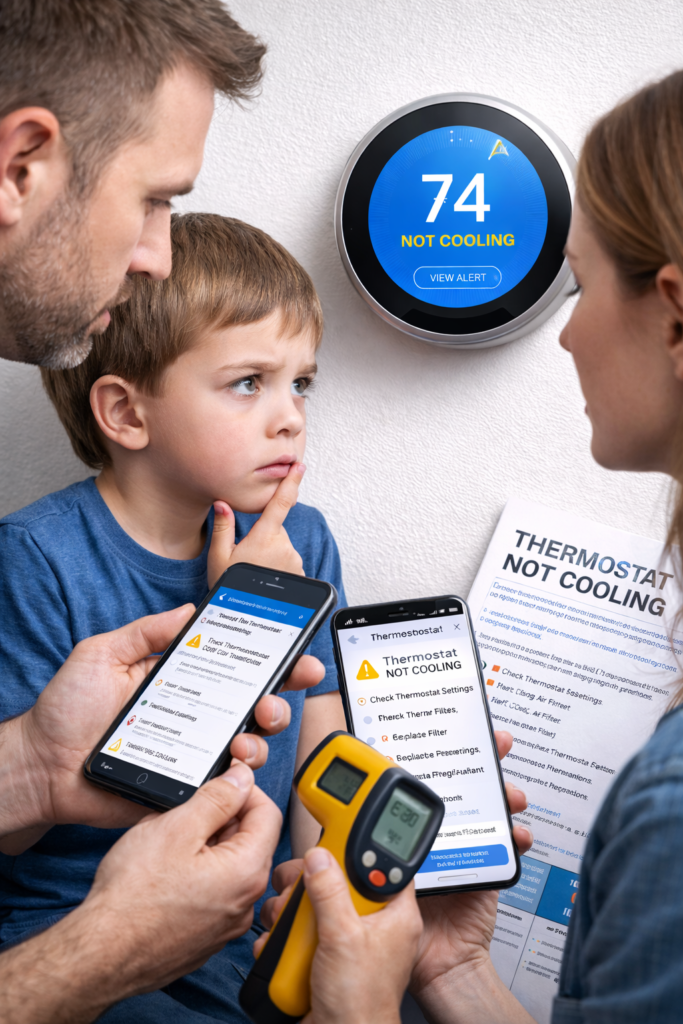
Start by checking settings and replacing the air filter. These two fixes resolve most cases in under 10 minutes and cost almost nothing.
Quick Diagnosis Guide
| Your Symptom | Most Likely Cause | Start With |
|---|---|---|
| System running but blowing warm air | Low refrigerant or AC fault | Fix 3 or Fix 5 |
| System not running at all | Settings, power or electrical issue | Fix 1 or Fix 7 |
| System runs briefly then stops | Short cycling or thermostat issue | Fix 4 or Fix 5 |
| One room not cooling | Airflow issue or duct problem | Fix 6 |
| System runs constantly but house stays warm | Dirty filter or undersized system | Fix 2 |
| Problem started after changing settings | Incorrect mode or schedule | Fix 1 |
| Display normal but no cooling | AC unit not responding | Fix 5 |
Fix 1: Thermostat Not Cooling Due to Incorrect Settings
Always start here. A surprising number of cooling calls turn out to be nothing more than a settings issue and this one costs absolutely nothing to check.
Wrong mode. Cool mode must be active for the air conditioning to engage. Set to Heat, Fan Only, or Off and your AC will simply never run regardless of how high the temperature climbs. Embarrassing to admit when it happens but HVAC technicians check this first on every single call out.
Temperature set too high. Cooling only activates when the room exceeds the target temperature. Set 74°F as your target in a 72°F room and nothing happens because the system does not think it needs to. Drop the target at least 3 to 5 degrees below current room temperature and wait a few minutes to see whether the system responds.
Away or Eco mode active. Smart thermostats like Nest and Ecobee are designed to let temperatures drift when they think nobody is home. Being in Away or Eco mode means the system is deliberately holding back. Check your app rather than just the device itself and switch to Home mode if needed.
Fan set to On rather than Auto. Running the fan continuously circulates air whether or not the system is actually cooling. The result feels like the AC is doing something when the compressor has not activated at all. Switch to Auto and the fan will only run during active cooling cycles.
How to fix it: Confirm Cool mode, drop the target temperature, set the fan to Auto, and disable any Away or Eco mode. Give it five minutes. Many homeowners find this is all it takes.
Fix 2: Replace Your Air Filter
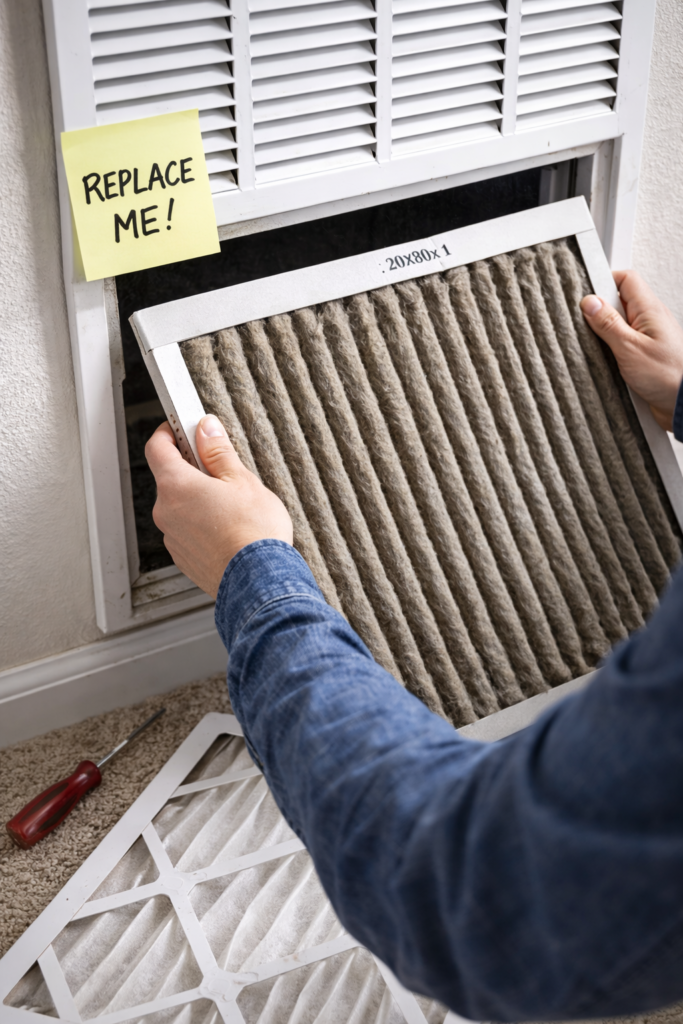
Clogged filters cause more cooling failures than most homeowners realise. Consistently overlooked, easy to fix, and genuinely important.
Picture trying to cool yourself with a fan wrapped in a thick towel. The motor works fine but almost no air gets through. A blocked filter does exactly this, restricting airflow so severely that even a fully functioning HVAC system cannot do its job properly.
According to the US Department of Energy, a dirty filter can push energy consumption up by 5 to 15 percent while simultaneously reducing the system’s ability to maintain target temperatures.
Worth knowing too: severely restricted airflow causes the evaporator coil to freeze over. A frozen coil blocks airflow entirely, leading to warm air from the vents or no cooling whatsoever. Ice on your indoor unit means turn the system off and replace the filter immediately.
Signs it needs replacing:
- Cannot remember the last time it was changed. If it has been more than three months it is overdue
- Looks grey, brown or visibly clogged when removed
- System running longer than usual without cooling the space
- Reduced airflow from the vents
How to fix it: Find the filter in the return air vent or air handler, hold it up to the light, and if no light passes through replace it immediately. Between $5 and $20, two minutes, done. Set a calendar reminder for every one to three months and this problem largely disappears from your life.
Want a Long-Term Fix?
Many homeowners solve cooling problems permanently by upgrading to a smart thermostat that automatically manages cooling schedules, airflow and energy usage. Rather than reacting to problems, a good smart thermostat prevents them.
See our full breakdown of the best options available right now.
Fix 3: Low Refrigerant
Fan running, system apparently working but only warm or barely cool air coming from the vents. Low refrigerant is near the top of the list of likely culprits.
Refrigerant is what makes air conditioning physically possible. It pulls heat from inside the house and releases it outside. Without enough of it the system runs all day and barely makes a dent on the temperature. Think of it as the essential ingredient in the recipe. Remove it and the whole thing stops working regardless of how hard the appliance tries.
One thing worth understanding clearly: refrigerant does not just deplete over time in a healthy system. Low levels mean a leak exists somewhere. Adding more without finding and fixing the leak is a short-term patch that will fail again.
Signs of low refrigerant:
- Warm or barely cool air despite the system running
- Ice on the outdoor unit or the copper pipes leading to it
- A hissing or bubbling sound near the indoor or outdoor unit
- Noticeably higher electricity bills compared to previous summers
- Constant running but the house stays warm
How to fix it: Do not attempt this yourself. Refrigerant handling requires specialist equipment and is legally regulated in most countries. Call a qualified HVAC technician who will find the leak, repair it, and recharge the system correctly. Costs typically range from $200 to $600 depending on the leak severity and refrigerant type.
Fix 4: The Thermostat Itself May Be Faulty
Not every cooling problem lives in the AC unit. Sometimes the thermostat is the culprit, appearing completely normal while quietly failing to send the right signals to activate cooling.
A useful way to think about it: a manager who agrees with everything in meetings but never passes instructions to the team. On the surface all looks well. In practice nothing gets done.
Signs pointing to a faulty thermostat:
- Cool mode showing correctly, target temperature set appropriately, but the system never activates
- Cooling works sometimes and fails other times with no obvious pattern
- Temperature on the thermostat differs noticeably from a separate thermometer placed beside it
- More than 10 years old
- Problem appeared suddenly with no other changes to the system
How to check: Place a standalone thermometer next to the thermostat and leave it for 15 minutes. A difference of more than 2 to 3 degrees Fahrenheit suggests the thermostat sensor is inaccurate, reading the room as cooler than it actually is and therefore never triggering cooling. Alternatively set the target significantly below current room temperature and listen for the outdoor unit to activate. Silence after several minutes points to a communication failure between the thermostat and the system.
How to fix it: Some smart thermostats offer a manual offset in settings to compensate for sensor inaccuracy. Older or intermittently failing units are usually better replaced than patched. More detail on faulty thermostat diagnosis here.
Fix 5: Check the Outdoor AC Unit
An air conditioning system has two main components working together: the indoor air handler and the outdoor condenser. No matter how perfectly the thermostat is set, if the outdoor unit is not running the house will not cool.
The outdoor unit is the engine. The thermostat gives the instructions perfectly but if the engine itself is off the car simply is not going anywhere.
How to check: Step outside when the thermostat is set to Cool and the room is above target temperature. The outdoor unit should be audibly running with the fan visibly spinning. Complete silence and a stationary fan signal a problem with the unit itself.
Common outdoor unit problems:
Tripped circuit breaker. The outdoor AC unit runs on its own dedicated breaker, separate from the indoor air handler. Check the electrical panel for a tripped breaker labelled AC, air conditioner, or condenser. Reset once if tripped. If it trips again immediately, stop. That means a deeper electrical problem requiring an electrician.
Dirty condenser coils. Heat has to go somewhere when your AC removes it from your home. The outdoor coils are where it exits. Clogged with dirt, leaves or debris those coils cannot release heat efficiently and the unit may shut itself down as protection. A gentle rinse with a garden hose from inside outward can help but high pressure is not advisable.
Blocked airflow around the unit. Overgrown plants, accumulated debris or fencing placed too close can choke the airflow the outdoor unit needs to function. Clear at least two feet of space around it on all sides.
Thermal shutdown on very hot days. During extreme heat outdoor units can temporarily shut themselves down to avoid damage. Clear any debris, ensure adequate airflow and allow time for the unit to cool before expecting it to restart.
How to fix it: Check the breaker first, then clear debris, and ensure unobstructed airflow around the unit. Persistent problems or a unit that runs but still fails to cool effectively warrants a professional cleaning or inspection.
Fix 6: Airflow and Duct Problems
Thermostat working, outdoor unit running, and still one or more rooms refuse to cool properly. Attention shifts to how conditioned air actually moves through the home.
Ductwork is the road network for cool air. Even perfect air conditioning cannot reach its destination if the roads are blocked or full of holes.
Closed or blocked supply vents. Walk through every room and check. All supply vents should be fully open and unobstructed by furniture, curtains or rugs. Accidentally closed vents cause more single-room cooling problems than most people expect.
Closing vents in unused rooms to save energy is a common instinct but a counterproductive one. According to the US Department of Energy it increases pressure in the duct system, forces air out through leaks, and actually reduces overall efficiency. Keep every vent open.
Leaky ductwork. Conditioned air escaping through gaps before it reaches living spaces means rooms struggle to cool even when everything else functions correctly. The US Department of Energy estimates the average home loses 20 to 30 percent of conditioned air through duct leaks, a staggering amount.
Blocked return vents. Warm room air needs to travel back through return vents to be cooled and recirculated. Furniture blocking those vents prevents effective air circulation throughout the home.
How to fix it: Open all supply vents and clear any obstructions. Confirm return vents have clear space around them. Accessible duct joints showing signs of leakage can be sealed with metal foil tape. More serious leakage is best diagnosed with a professional duct blower test.
Dealing with uneven room temperatures more broadly? Our dedicated guide covers every fix in detail.
Helpful tools for fixing cooling and airflow issues:
- Replacement air filters — the single most impactful maintenance purchase you can make
- Fin comb — restores bent condenser fins and improves outdoor unit efficiency
- Smart thermostat — the permanent long-term solution for most cooling management problems
Fix 7: An Electrical Issue
Working through fixes 1 to 6 and still no cooling? An electrical fault somewhere in the system becomes the likely explanation. Electrical problems can affect any component from the thermostat right through to the outdoor unit.
Blown control board fuse. Many HVAC systems have a small fuse on the furnace or air handler control board. Blow this fuse and the system cannot activate cooling even if everything else appears completely normal. Inexpensive to replace but requires locating and accessing the control board.
Faulty capacitor in the outdoor unit. Capacitors start and run the compressor and fan motor in the outdoor unit. A failed capacitor is among the most common outdoor unit electrical faults and will prevent the unit from running even with power connected.
Wiring issue at the thermostat. Loose or damaged wiring prevents cooling signals from reaching the system. Particularly common following a recent thermostat installation or any work done near the thermostat wiring.
How to fix it: Check circuit breakers for both the indoor air handler and outdoor condenser. Look for a blown fuse on the control board if accessible. Everything beyond that belongs with a qualified HVAC technician. Capacitors and control board components store electrical charge and carry real injury risk even after power is disconnected.
When to Consider Replacing Your Thermostat
Old, inaccurate, or unresponsive thermostats often cause more trouble than the HVAC system itself. Replacing one is frequently the simplest and most cost-effective resolution once other causes have been ruled out.
Modern smart thermostats bring significantly better temperature accuracy, AI-powered cooling schedules that learn your routine, remote control from anywhere, and detailed energy reports that help identify inefficiency before it becomes a problem.
Quick Comparison: Top Smart Thermostat Options
| Thermostat | Best For | Price Range |
|---|---|---|
| Google Nest 4th Gen | Automation and AI learning | $$$ |
| Ecobee Premium | Room sensor control and air quality | $$$ |
| Amazon Smart Thermostat | Budget Alexa households | $ |
At the budget end the Amazon Smart Thermostat at $61.99 delivers genuine smart thermostat functionality for very little outlay. For those wanting AI learning, room sensors and the most sophisticated cooling management available, the Ecobee Premium and Nest 4th Gen lead the market.
Full comparison of every option at every price point.
Wondering whether the investment is actually worth it? Our full analysis answers that here.
Ready to take a look at current prices? Here are our top picks:
The Nest Learning Thermostat is consistently one of the most popular upgrades on Amazon US.
Based in the UK? Find it here.
The Ecobee Premium comes packed with features and is well worth a look.
Working with a tighter budget? The Amazon Smart Thermostat punches well above its price.
When to Call a Professional
Some situations genuinely need expert hands. Call a qualified HVAC technician if:
- Warm air is coming from the vents despite the system running. Low refrigerant is the most likely explanation
- The outdoor unit stays silent after a breaker reset
- Hissing, bubbling or unusual sounds come from either the indoor or outdoor unit
- Ice appears on the outdoor unit or copper pipes
- All seven fixes have been attempted without success
- Electricity bills have climbed noticeably alongside the cooling problem
According to RepairPal, a professional HVAC diagnostic visit runs between $75 and $150. Almost always worth it rather than running a faulty system through an entire summer.
How to Prevent This From Coming Back
| Prevention Tip | How Often |
|---|---|
| Replace your air filter | Every 1 to 3 months |
| Clear debris from outdoor unit | Before each cooling season |
| Check vents are open and unblocked | At the start of cooling season |
| Have HVAC system professionally serviced | Once per year |
| Review thermostat settings when seasons change | Every spring and autumn |
| Test cooling before the first hot day | Before it is urgently needed |
Of everything on that list, filter replacement matters most. More cooling failures trace back to a neglected filter than any other single cause.
Quick Summary: 7 Fixes at a Glance
| Fix | Cause | Difficulty | Typical Cost |
|---|---|---|---|
| 1 | Incorrect thermostat settings | Very easy | Free |
| 2 | Dirty air filter | Very easy | $5 to $20 |
| 3 | Low refrigerant | Professional needed | $200 to $600 |
| 4 | Faulty thermostat | Easy to moderate | $60 to $260 |
| 5 | Outdoor AC unit problem | Easy to professional | Free to $300+ |
| 6 | Airflow and duct issues | Easy to moderate | Free to $500 |
| 7 | Electrical issue | Professional needed | $75 to $400 |
Frequently Asked Questions
Why is my thermostat set to Cool but the AC is not turning on?
Most likely the system is in the wrong mode, the target temperature is set too high relative to current room temperature, or the outdoor unit has lost power. Start with Fix 1 and then step outside to check whether the outdoor unit is actually running.
Why is my AC running but not cooling the house?
Running without producing cold air almost always points to low refrigerant, severely restricted airflow from a dirty filter, or a problem with the outdoor condenser. Low refrigerant needs a professional. A dirty filter needs two minutes and $12.
Can a faulty thermostat cause cooling failure?
Absolutely. A thermostat that looks fine can quietly fail to send the activation signal to the AC. An inaccurate sensor can also convince the thermostat the room is cooler than it actually is, preventing the cooling cycle from ever starting. Thermostats over 10 years old are worth testing carefully.
Why is my AC not cooling below 75 degrees?
Usually low refrigerant, a clogged filter, or a system that is simply undersized for the conditions. Gradual deterioration in cooling performance over time rather than a sudden failure is a particularly strong indicator of refrigerant loss.
How do I know if my AC is low on refrigerant?
Warm air from the vents despite the system running, ice on the outdoor unit or copper pipes, a hissing or bubbling sound near either unit, and higher than expected electricity bills are the key signs. Always indicates a leak rather than normal depletion and professional repair is required.
Should I turn my AC off if it is not cooling?
Suspected low refrigerant or visible ice forming on the unit both call for turning the system off. Running a refrigerant-depleted AC risks compressor damage, which is a far more expensive fix. Switch to Fan Only mode to melt any ice safely before the technician arrives.
Why does my AC cool in the morning but struggle in the afternoon?
Three common explanations: an undersized system struggling at peak heat load, a thermostat positioned in direct afternoon sunlight reading hotter than the actual room, or a system gradually losing refrigerant and unable to keep up as outdoor temperatures rise through the day. Checking thermostat placement costs nothing and is the best place to start.
Final Verdict
Stressful? Absolutely. Unfixable? Rarely. Work through these seven causes methodically and most homeowners find their answer well before reaching the professional repair section.
Here is the order to follow:
- Check your settings — free, two minutes, resolves more problems than you might expect
- Replace your air filter — under $20, two minutes, the highest-impact maintenance task available
- Look for low refrigerant signs — warm air from vents despite the system running is the tell
- Test the thermostat itself — a standalone thermometer beside it will reveal any sensor inaccuracy
- Check the outdoor AC unit — confirm it is actually running and clear of debris
- Inspect airflow and ducts — open vents, clear return air paths, look for obvious duct issues
- Consider an electrical fault — fuses, breakers and wiring are the final check
Persistent problems after working through all seven call for a professional. Running a faulty cooling system through a hot summer costs money, wastes energy, and risks damaging expensive equipment.
Worth mentioning too: if the thermostat itself is old and unreliable, upgrading to a modern smart thermostat is one of the most practical home improvements available. More accurate, more responsive, and genuinely cheaper to run over time.
Based on guidance from the US Department of Energy, Energy Saving Trust, manufacturer documentation from Google Nest, Ecobee and Honeywell, HVAC professional forum discussions, and verified homeowner reviews.
Related Guides:
- Best Smart Thermostat for Home (2026).
- Thermostat Not Reaching Set Temperature? 7 Fixes (2026).
- Why Is My Thermostat Not Turning On? 7 Real Fixes (2026).
- Why Is One Room Colder or Hotter Than the Rest? (2026).
- Do Smart Thermostats Save Money? Full Cost Breakdown (2026).
- Do Smart Thermostats Work Without WiFi? (2026).
Reviewed by The Thermo Expert Team
The Thermo Expert Team researches and compares smart thermostats, heating systems, and common HVAC issues to provide clear, practical advice for homeowners. Our goal is to help you understand problems quickly and choose the right solution with confidence.