
AC running but not cooling? Your system is on, you can hear it, and air is blowing — but the room is still warm.
If your air conditioner is blowing air but not actually cooling your home, you are not alone. This is one of the most common and frustrating AC problems, especially on the hottest day of the year.
The good news? In many cases the fix is simple and does not require a technician. You might sort it in the next ten minutes.
If you only check one thing, start here: your air filter, thermostat settings, and outdoor unit.
Prefer to see it in action? Scroll down for a quick video walkthrough showing exactly what to check.
Some links in this guide may earn us a small commission at no extra cost to you. This helps support the site so we can keep creating helpful content.
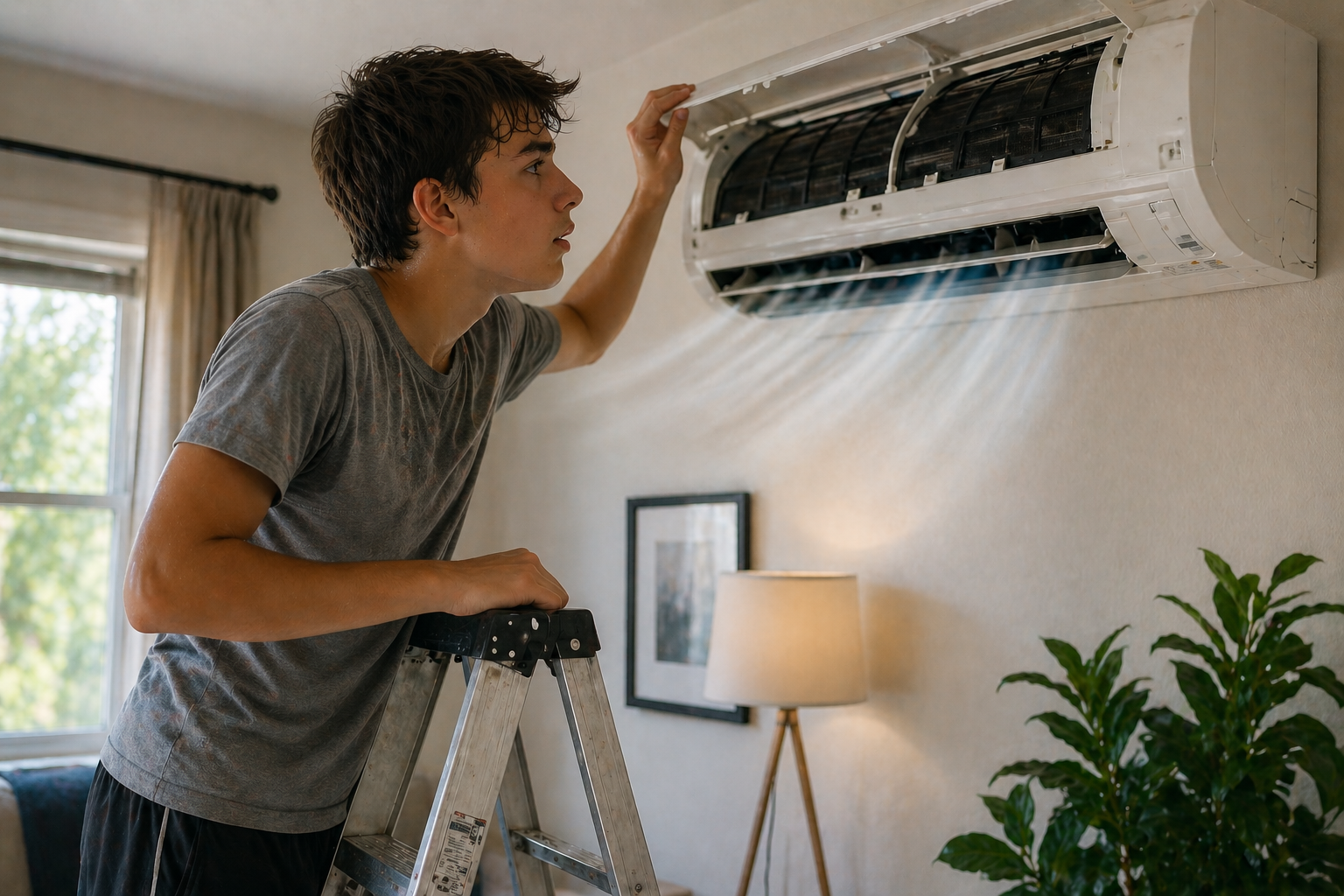
Why Is My AC Running But Not Cooling?
Answer:
If your AC is running but not cooling, the most common causes are a dirty air filter, incorrect thermostat settings, or restricted airflow. In some cases, low refrigerant or system faults may be to blame. According to the US Department of Energy, many of these issues can be fixed without a technician, saving you time and money.
The most likely culprits are:
- A dirty or clogged air filter
- Incorrect thermostat settings
- A blocked or dirty outdoor unit
- Low refrigerant levels
- A system that simply needs a service
Start with the simple checks first before you call anyone out.
Here Are the 9 Most Common Reasons Your AC Is Running But Not Cooling and Exactly How To Fix Each One

1. Dirty or Clogged Air Filter
This is the first thing to check. Seriously. Before anything else.
A dirty air filter is the single most common reason an AC runs without cooling properly. Dust, pet hair, and debris build up and block airflow. When that happens, your system cannot circulate cool air no matter how hard it works.
The result? An AC that sounds like it is doing its job but is not actually cooling anything.
Most manufacturers recommend changing your filter every one to three months. Most people do it far less often, or forget entirely.
Fun fact: According to the US Department of Energy, a clogged air filter can reduce your AC’s efficiency by up to 15%. That means you could be paying for cooling you are not actually getting, every single month.
Quick check: Pull out your filter and hold it up to a window. If you cannot see light through it, replace it today. This single step fixes the problem for more people than anything else.
The fix:
- Locate your air filter (usually in the return air vent or inside the unit)
- Pull it out and check it
- If it looks grey and clogged, replace it
- Check it again every month during summer
If you have never changed yours, it is almost certainly overdue.
Check latest prices for AC air filters on Amazon
2. Thermostat Set Incorrectly
It sounds too simple but this is one of the most common causes.
Your thermostat might be set to the wrong mode or a setting that runs the fan without actually activating the cooling. Either will leave you with air moving but no actual cooling happening.
If you are not sure what to check, see our thermostat troubleshooting guides for a full walkthrough.
Common mistakes:
- Mode set to “heat” instead of “cool”
- Fan set to “on” instead of “auto” (fan runs constantly even when cooling is off)
- Target temperature higher than the current room temperature
- A schedule that has accidentally turned cooling off
Quick check: If air is blowing but it feels warm, your thermostat may be set incorrectly. Switch to “cool” and lower the temperature 3 to 5 degrees.
The fix:
- Set mode to “cool”
- Set fan to “auto”
- Lower the target temperature below the current room temperature
- Check that no schedule is overriding your settings
3. Blocked or Dirty Outdoor Unit
Your outdoor condenser unit releases heat from inside your home to the outside. For it to work properly, it needs clear airflow all the way around it.
If leaves, grass, dirt, or garden furniture block the unit, it cannot release heat efficiently. Warm air gets pushed back into your home instead of being expelled outside.
This is easy to overlook because the outdoor unit is often out of sight.
Hidden money saver: A blocked outdoor unit can make your AC run 20 to 30% longer than necessary. Clearing debris takes five minutes and costs nothing.
The fix:
- Switch off the system before doing anything
- Clear any debris within two feet of the unit
- Gently rinse the outside with a garden hose
- Make sure nothing is stored directly against it
- Switch back on and see if cooling improves
Keep an eye on this through summer, especially after windy or stormy weather.
4. Low Refrigerant Levels
Refrigerant is the substance that actually makes your AC cool the air. Without enough of it, your system can run all day and never properly cool your home.
The American Society of Heating, Refrigerating and Air Conditioning Engineers (ASHRAE) notes that effective refrigerant management is critical for system efficiency. Even small leaks reduce efficiency and increase energy use significantly.
Signs of low refrigerant:
- AC runs continuously but barely cools
- Air from vents feels slightly cool but never properly cold
- A hissing or bubbling sound near the unit
- Ice on the refrigerant lines or the indoor unit
Fun fact: Refrigerant does not get “used up” like fuel. If your system is low, it means there is a leak somewhere. A well maintained AC can keep the same refrigerant for its entire lifespan, which can be 15 to 20 years.
Important: In the US, EPA Section 608 certification is legally required to handle refrigerant. This is not a DIY job.
The fix:
- Call a certified technician to locate the leak, repair it, and recharge the system
- Do not keep running the AC with low refrigerant as it can damage the compressor, which is one of the most expensive components to replace
5. Dirty Evaporator Coils
Inside your AC unit are evaporator coils that absorb heat from your home’s air. When they are covered in dirt, they cannot absorb heat properly and cooling performance drops significantly.
According to ENERGY STAR, simply cleaning dirty evaporator and condenser coils can improve efficiency by over 21%.
Signs of dirty coils:
- System runs but cooling is noticeably weaker than before
- Higher energy bills without any change in usage
- Ice forming on coils or refrigerant lines
The fix:
- Light dust can be carefully removed with a soft brush
- Heavy buildup needs a professional clean during an annual service
- Annual servicing (see section 9) usually includes a coil inspection and clean
6. Leaky Ductwork
Your AC might be producing perfectly cold air but losing it before it ever reaches you.
If your ductwork has gaps or holes, cool air can escape into walls, attics, or crawl spaces. You end up paying to cool spaces you never use while the rooms you actually live in stay warm.
The US Department of Energy’s Building Science Education states that a properly sealed duct system can reduce utility bills by up to 20%.
Signs of leaky ducts:
- Some rooms cool well while others stay warm
- Energy bills are higher than expected
- Dust around vents or registers
Did you know? Sealing leaky ducts is one of the highest return on investment home improvements you can make, according to the US Department of Energy.
The fix:
- Check visible ductwork for obvious gaps or disconnected sections
- Seal small gaps with specialist duct sealing tape (not regular tape, which degrades over time)
- For a full inspection, a professional duct test can identify hidden leaks
7. AC Unit Too Small for Your Home
If your AC is simply not powerful enough for the space it is trying to cool, it will run constantly, struggle on hot days, and never quite get your home to the temperature you want.
This is more common than people realise, particularly in homes that have had extensions added or where the original system was cheaply installed without proper sizing.
Signs your unit may be too small:
- System runs almost continuously without reaching the target temperature
- Cooling works reasonably on mild days but completely fails on very hot days
- Some rooms are noticeably warmer than others
The fix:
- Short term: use fans to help circulate cooled air, close doors to unused rooms, and use blinds or curtains to block direct sunlight
- Long term: consult an HVAC professional about whether your system is correctly sized and whether an upgrade makes sense
8. Electrical or Capacitor Issues
Your AC might be running in the sense that you can hear something happening, but if a key electrical component has failed, the system will not cool effectively.
According to Sig Cox Heating and Air Conditioning, the capacitor is like a car battery for your AC. The run capacitor smooths current to keep motors running efficiently, while the start capacitor gives a quick energy boost to start the compressor or outdoor fan motor. When either fails, the system can appear to be running but nothing is actually cooling.
Signs of a failing capacitor:
- Weak or warm airflow despite the system appearing to run
- A clicking or humming noise when the system tries to start
- The system starts briefly then shuts off
- Intermittent cooling that comes and goes
- Visible bulging or leaking from the capacitor case
Safety warning: Capacitors store electrical charge even when the system is switched off and can deliver a serious shock. Do not attempt to repair electrical components yourself.
The fix:
- Switch off at the breaker and call a qualified HVAC technician
- Capacitor replacement is usually a quick and affordable repair
- For those comfortable with electrical safety, a multimeter can help test whether components are receiving power
See current prices and availability of multimeters on Amazon
9. System Needs Servicing
Sometimes nothing is dramatically wrong. The system just needs attention.
We Energies, a major US utility company, recommends an annual AC tune up for peak performance, noting that a preseason service extends the unit’s life, reduces the risk of expensive repairs, and helps the unit maintain a more consistent temperature.
According to ENERGY STAR, regular maintenance can reduce energy consumption by 5% to 15%.
A professional service typically includes:
- Checking and topping up refrigerant levels
- Cleaning evaporator and condenser coils
- Inspecting electrical connections and the capacitor
- Checking thermostat calibration
- Clearing the condensate drain
The fix:
- Book an annual AC service before summer begins, when engineers are less busy and rates are often lower
- Keep a record of when the system was last serviced
- If your system has not been serviced in over two years, book one now
See current prices and availability of AC coil cleaning kits on Amazon
Which AC Fix Should You Try First If It’s Not Cooling ?
Watch: Step-by-Step Checks for AC Running But Not Cooling
If your AC is running but not cooling, this quick walkthrough shows you exactly what to check first — including filters, thermostat settings, and airflow.
Tip: Start with the air filter and thermostat settings. These fix the problem for most people in under 10 minutes.
Not sure where to start? Work through this order:
- Check and replace the air filter — five minutes, fixes the problem more often than anything else
- Check thermostat settings — mode, temperature, and fan setting
- Inspect the outdoor unit — clear debris and gently rinse
- Look for ice on the indoor unit — if you see ice, turn the system off and let it thaw completely before restarting
- If none of the above work — call a professional
Most people find the problem in step one or two. Do not skip them.
Key Takeaways: Why Your AC Is Not Cooling
Dirty air filter → Replace it. Check monthly in summer.
Thermostat set incorrectly → Set to “cool”, fan to “auto”.
Blocked outdoor unit → Clear debris and rinse with a hose.
Low refrigerant → Call a technician. Not a DIY fix.
Dirty evaporator coils → Light clean yourself or professional service.
Leaky ductwork → Seal gaps or book a duct test.
AC unit too small → Use fans short term. Upgrade long term.
Capacitor or electrical issue → Switch off and call a technician.
System needs servicing → Book an annual AC tune up.
Want to Prevent This Happening Again?
If you want to avoid this problem in the future, upgrading to a smart thermostat can make a real difference. Smart thermostats manage your cooling automatically, adjust when you leave the house, and help prevent the kind of unnecessary strain that leads to breakdowns.
See our guide to the best smart thermostats for home to compare your options and find the right fit for your budget.
Frequently Asked Questions
Why is my AC running but not cooling the house?
Usually a dirty filter, incorrect thermostat settings, or a blocked outdoor unit. According to the US Department of Energy, starting with these simple checks can save you a service call.
Should I turn my AC off if it is not cooling?
Yes. Running a faulty AC can damage the compressor, one of the most expensive components to replace.
How do I know if my AC is low on refrigerant?
The system runs constantly without reaching temperature, air from vents feels only slightly cool, and you may hear a hissing sound or see ice on the lines. ASHRAE notes that even small refrigerant leaks reduce system efficiency significantly.
Can a dirty filter stop AC from cooling? Yes.
It is the most common cause. A blocked filter restricts airflow so much that the system cannot circulate cool air properly.
When should I call a technician?
If the filter, thermostat, and outdoor unit checks do not fix the problem, call a professional. Refrigerant, electrical, and capacitor issues all need qualified help.
How often should I service my AC?
Once a year, ideally before summer. We Energies notes that a preseason tune up extends the unit’s life and reduces the risk of expensive repairs.
What does a failing capacitor sound like?
A humming or buzzing from the outdoor unit, a system that will not start or frequently shuts off shortly after starting, or warm air from the vents despite the system appearing to run. Switch off and call a technician.
Can I clean evaporator coils myself?
Light surface dust can be carefully removed with a soft brush. Heavy buildup needs a professional clean to avoid damaging the coils.
Still Not Cooling? Here Is What to Do Next
If your AC is still not cooling after working through these fixes, it is time to call a professional.
Most AC problems are not as expensive to fix as people fear. A clogged filter, a dirty coil, or a failed capacitor are all relatively quick and affordable repairs when caught early. Leaving them unfixed is what turns a small problem into a big one.
Start with the simple checks in this guide. In most cases the solution is faster and cheaper than you expect.
If you are also having issues with your thermostat, see our thermostat troubleshooting guide to rule out any control problems. And if you are thinking about upgrading your system, our best smart thermostats for home guide covers options that help you manage cooling more efficiently all year round.
Sources
- US Department of Energy Building Science Education
- ASHRAE
- We Energies
- ENERGY STAR
- Sig Cox Heating and Air Conditioning
Reviewed by The Thermo Expert Team
The Thermo Expert Team researches and compares smart thermostats, heating systems, and common HVAC issues to provide clear, practical advice for homeowners. Our content is based on manufacturer documentation, real user experiences, and industry research to help you understand problems quickly and choose the right solution with confidence.