This article may contain affiliate links. If you purchase through these links, we may earn a commission at no extra cost to you.
Uneven room temperature is one of the most common problems in modern homes.
You crank up the heating, the living room feels perfect, but another room feels completely different. Whether you are dealing with hot and cold spots in the house, one room colder than the rest, or one room hotter than all the others, the frustrating part is that most people assume it is just how their home is built and there is nothing they can do about it. That is almost never true.
In most cases uneven room temperatures have a specific, fixable cause. Many homeowners eventually solve this permanently using a smart thermostat system — see our full guide on the best smart thermostats for home.
This guide explains exactly why it happens and gives you seven practical fixes ordered from the simplest to the most technical — no engineering degree required.
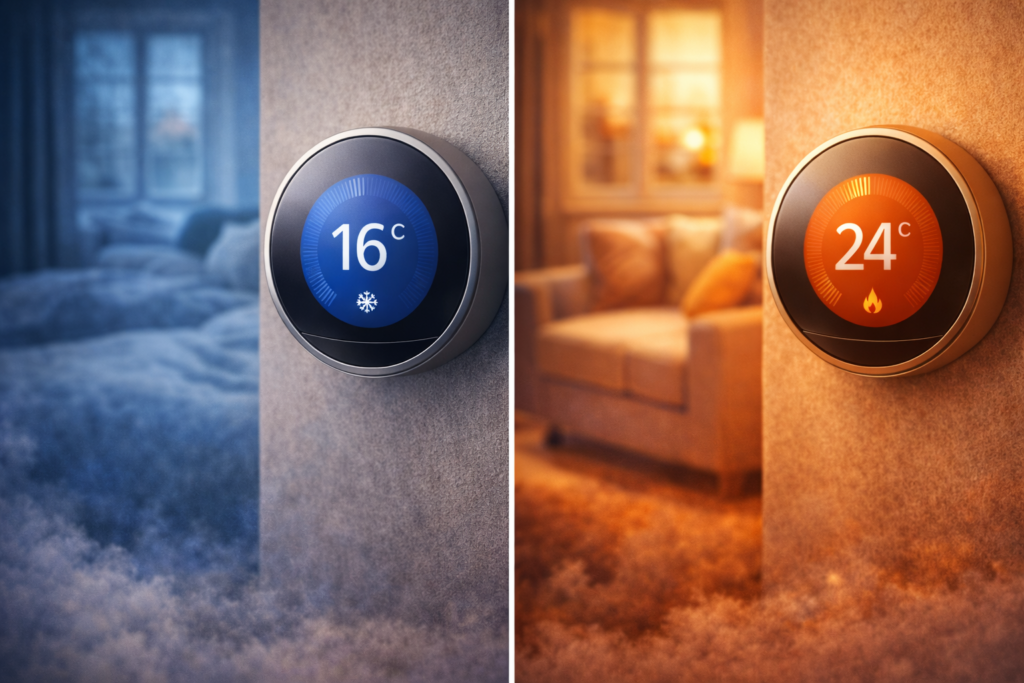
What Causes One Room to Be Hotter or Colder Than the Rest?
The most common causes of uneven room temperatures are:
- Blocked or closed air vents
- Leaky ductwork losing conditioned air before it reaches the room
- Poor insulation in walls, floors or ceilings
- Incorrect thermostat placement
- Air leaks around windows, doors and walls
- Incorrect HVAC system size
- Lack of room-by-room temperature control
How This Guide Was Researched
While we have not physically inspected every home, this guide is built on verified information from:
- US Department of Energy guidance on home heating and cooling efficiency
- Energy Saving Trust (UK government-backed) recommendations
- HVAC professional forums and technician discussions
- Ecobee and Google Nest manufacturer documentation on room sensors
- Analysis of thousands of verified homeowner reviews describing uneven temperature problems
Quick Answer
One room being colder or hotter than the rest is almost always caused by one of these seven things:
| Fix | Likely Cause |
|---|---|
| 1 | Blocked or closed air vents |
| 2 | Leaky or poorly insulated ductwork |
| 3 | Poor insulation in walls, floors or ceilings |
| 4 | Incorrect thermostat placement |
| 5 | The wrong size HVAC system for your home |
| 6 | Air leaks around windows, doors and walls |
| 7 | No room-by-room temperature control |
Start with the simplest fixes first. Many people solve their problem with fix 1 or 2 before ever needing to call anyone.
Why Uneven Room Temperatures Happen in Homes
Before diving into fixes it helps to understand why this problem exists in the first place.
Think of your heating and cooling system like a garden hose. The water pressure at the tap is consistent, but if something partially blocks the hose the flow gets disrupted and some areas get more water than others. Your HVAC system works the same way. It pushes heated or cooled air through a network of ducts and vents. When something disrupts that flow — a blockage, a leak, a gap in insulation — some rooms get too much conditioned air and others get too little.
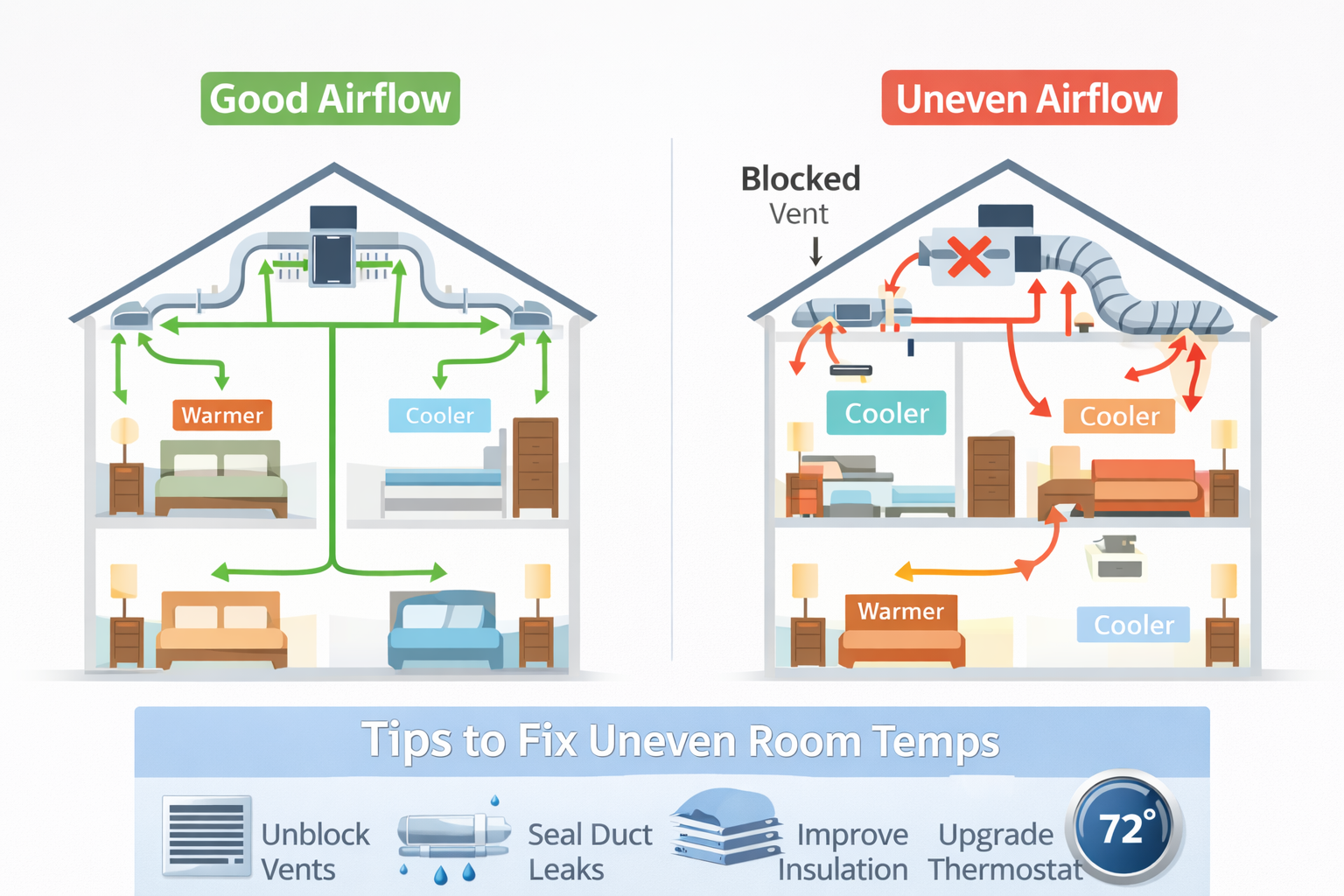
Watch how uneven airflow causes temperature differences in real homes
Video source: Vimeo (embedded for educational purposes)
This video shows how airflow problems like blocked vents and duct leaks lead to uneven room temperatures and how to fix them.
The result is exactly what you experience. One room feels perfect while another feels like a completely different climate. This is what HVAC professionals call poor air distribution and it is one of the most solvable home comfort problems there is.
According to the US Department of Energy, poor air distribution is one of the leading causes of home energy waste and comfort problems. Fixing it not only improves comfort but can reduce your energy bills significantly.
How to Find Your Problem Rooms
Before you start fixing anything take 10 minutes to confirm which rooms are actually problematic.
- Wait for a day when your heating or cooling has been running for at least an hour
- Walk through your home with a simple thermometer
- Write down the temperature in each room at the same time
- Compare the readings
If one room is 3°F (1.5°C) or more different from others you have a genuine problem worth investigating. If the difference is smaller your system is performing normally.
Fix 1: Check Your Air Vents (Most Common Cause of Uneven Room Temperature)
This is the first thing to check because it is free, takes two minutes, and solves the problem more often than you would expect.
Walk through every room in your home and check every air vent. Look for:
- Vents that are fully or partially closed
- Furniture or rugs sitting directly over vents
- Vents that are visibly clogged with dust
Picture trying to heat a room while a sofa is pushed right against the radiator. The heat is there but it simply cannot get into the room properly. A blocked or closed vent does exactly the same thing — it stops conditioned air from reaching the space that needs it.
How to fix it: Open every vent fully and move any furniture or objects covering them. Give dirty vents a quick vacuum to clear any dust buildup.
Pro Tip: If one room is consistently colder, try closing the door slightly while the heating is running to help build up heat faster in that specific space.
The One Fix Everyone Gets Wrong
Many homeowners close vents in unused rooms thinking it saves energy. According to the US Department of Energy this actually makes things worse. Closed vents increase pressure in your duct system, force air to escape through leaks, and can damage your HVAC equipment. Keep all vents open throughout your home — always.
Fix 2: Check for Leaky Ductwork (A Hidden Cause of Hot and Cold Spots in the House)
If your vents are all open and clear but one room colder than the rest of the house is still a problem, leaky ductwork is the next most likely cause.
Your ductwork is the network of tubes that carries heated or cooled air from your HVAC system to every room. Think of sending a parcel across the country in a van with holes in the floor. Half the parcels fall out before they reach their destination. Leaky ducts do the same thing — the air you are paying to heat or cool escapes before it ever reaches the room that needs it.
According to the US Department of Energy, the average home loses 20 to 30 percent of its conditioned air through duct leaks. Signs to watch for include:
- Rooms that are consistently hard to heat or cool regardless of the thermostat setting
- Higher than expected energy bills
- Rooms that seem dustier than the rest of the house
- You can sometimes feel air escaping from joints in exposed ductwork in your attic or basement
How to fix it: Minor duct leaks can be sealed with metal foil tape at accessible joints. Standard duct tape is not suitable as it degrades over time. For more serious leaks a professional HVAC technician can perform a duct blower test to locate all leak points and seal them properly.
According to the Energy Saving Trust, properly sealed and insulated ductwork can reduce heating and cooling costs by up to 20 percent while dramatically improving how evenly temperatures spread across your home.
Fix 3: Check Your Insulation (Why One Room Is Always Colder or Hotter)
Poor insulation is one of the most common reasons a specific room has an uneven room temperature compared to the rest of the house, regardless of what your thermostat is set to.
Think of insulation like a coat for your house. A well-insulated room keeps warm air in during winter and hot air out during summer, just like a good winter coat keeps you comfortable outside. A room with thin or missing insulation loses heat rapidly — like stepping outside in January wearing only a t-shirt. The heating works perfectly but the warmth simply cannot stay in the room long enough to make a difference.
The rooms most commonly affected are:
- Top floor bedrooms — lose heat through the roof
- Ground floor rooms — lose heat through the floor in older homes
- Corner rooms — have more external walls exposed to outside temperatures
- Rooms above garages — typically have very little insulation beneath them
How to check: Touch the internal walls of the problem room on a cold day. If they feel noticeably colder than walls in other rooms the insulation may be inadequate. Check your loft or attic to see whether insulation is present and in good condition.
According to the Energy Saving Trust, properly insulating a loft can save a typical UK household between £150 and £225 per year on energy bills. The US Department of Energy reports similar proportional savings for American homes.
Fix 4: Check Where Your Thermostat Is Located
This one surprises a lot of people but it is a genuine and frequently overlooked cause of uneven room temperatures. Your thermostat can only measure the temperature where it is physically installed. Every other room in your home is invisible to it.
Picture a restaurant manager trying to make sure every guest is comfortable, but they can only feel the temperature in the kitchen. They might keep the kitchen perfectly warm while the dining room is freezing and they would never know because they are only getting information from one place. Your thermostat works exactly like this.
Common placement problems:
- Thermostat in a hallway that warms up quickly while bedrooms stay cold
- Thermostat near a south-facing window that gets direct afternoon sun making it think the whole house is warmer than it is
- Thermostat in a room that is rarely occupied while the rooms you actually live in are uncomfortable
How to fix it: If your thermostat is in a poorly representative location moving it to a more central position can make a meaningful difference. This is also where smart room sensors become genuinely transformative — which we cover in detail in Fix 7.
Pro Tip: If you cannot move your thermostat, placing a smart room sensor in your most-used room is the next best thing. It gives your thermostat real information from the room that actually matters.
Fix 5: Check if Your HVAC System Is the Right Size
An HVAC system that is too small for your home will struggle to heat or cool the rooms furthest from the unit. A system that is too large will heat or cool too quickly, shut off before air has properly circulated, and leave certain rooms uncomfortably warm or cold regardless of the thermostat setting.
Think of it like a kettle. A small travel kettle is fine for one cup of tea but hopeless if you need to boil water for a large pot for a family dinner. An industrial catering urn would be completely impractical in a small flat — it would constantly switch on and off without doing the job properly. The size needs to match the situation.
Signs your system may be incorrectly sized:
- It runs almost constantly without reaching the target temperature — too small
- It turns on and off very frequently within just a few minutes of each cycle — too large, known as short cycling
How to fix it: This is not a DIY fix. If you suspect your HVAC system is incorrectly sized have a qualified HVAC technician perform a Manual J load calculation. This is the industry standard method for determining the correct system capacity for any home.
Fix 6: Check for Air Leaks Around Windows and Doors
Air leaks are invisible but surprisingly powerful causes of uneven room temperatures. Cold outside air seeping in through gaps around windows, doors and walls can make specific rooms dramatically colder than the rest of the house even when the heating is working perfectly everywhere else. This is one of the most common reasons why one room is hotter or colder than others in older homes.
Think of it like trying to stay warm while someone keeps a window cracked open just slightly. It does not matter how hard the heating works — the cold keeps creeping in. Air leaks do exactly this, silently and invisibly, through gaps you might never think to look for.
How to check: On a windy day hold a lit candle or a thin piece of tissue near the edges of windows and doors. If it flickers or moves there is an air leak. Pay particular attention to:
- The edges and corners of window frames
- Around door frames and letterboxes
- Where walls meet floors and ceilings
- Around any pipe or cable entry points
How to fix it: Draught-proofing is one of the cheapest and most immediately effective home improvements you can make. Self-adhesive foam strips for windows and doors cost just a few pounds or dollars and can make a noticeable difference within hours of fitting them.
According to the Energy Saving Trust, draught-proofing a home can save a typical UK household around £45 per year on energy bills, with US homes seeing comparable proportional savings.
Pro Tip: Pay special attention to the bottom of external doors. A simple draught excluder costs under $10 and can eliminate a significant source of heat loss in minutes.
Fix 7: Add Smart Room Sensors for a Permanent Solution to Uneven Room Temperatures
If you have worked through fixes 1 to 6 and the problem persists, or if you simply want the most effective long-term solution available, smart room sensors are the best technology on the market for uneven room temperatures in 2026.
Smart room sensors are small wireless devices that you place in different rooms around your home. They measure the actual temperature and occupancy of each specific room and send that information back to your smart thermostat, which then adjusts your heating and cooling to keep every occupied room comfortable rather than just the room where the thermostat happens to be installed.
Going back to our restaurant analogy — it is like hiring a member of staff to stand in every room and report back constantly. Instead of guessing what the dining room needs based on kitchen temperature alone, you now have real-time information from every room and can respond to what is actually happening.
These are two of the most recommended smart thermostat systems by HVAC professionals in 2026.
Ecobee SmartSensor
The Ecobee Smart Thermostat Premium includes a SmartSensor in the box at no extra cost. Additional sensors can be placed in bedrooms, home offices or any room that consistently runs too hot or cold. The Ecobee thermostat uses the average temperature reading across all sensors to make heating and cooling decisions, ensuring every room gets attention rather than just the hallway where the thermostat is mounted.
According to Ecobee, using SmartSensors can reduce temperature variation between rooms by up to 50 percentcompared to relying on a single thermostat location.
“The room sensors are a game changer. My bedroom used to be freezing while the living room was roasting. Now every room is comfortable.” — Verified US Ecobee buyer ⭐⭐⭐⭐⭐
Google Nest Temperature Sensor
Google also offers a separate temperature sensor that works with Nest thermostats. You can place it in any room and schedule which sensor the Nest prioritises at different times of day. For example, the living room sensor during daytime hours and the bedroom sensor at night — so the thermostat is always responding to the room you are actually using.
“I put the sensor in my home office and the difference was immediate. The office used to be the coldest room in the house and now it is the most comfortable.” — Verified US Nest buyer ⭐⭐⭐⭐⭐
Check latest prices and availability (recommended models):
Ecobee Smart Thermostat Premium with SmartSensor on Amazon US.
Google Nest Learning Thermostat on Amazon US.
Google Nest Learning Thermostat on Amazon UK.
Quick Diagnosis Guide
| Your Situation | Start With |
|---|---|
| One room always cold in winter | Fix 3 (insulation) and Fix 6 (air leaks) |
| One room always hot in summer | Fix 1 (vents) and Fix 6 (air leaks) |
| Multiple rooms with uneven temperatures | Fix 2 (ductwork) and Fix 4 (thermostat location) |
| System runs constantly without results | Fix 5 (system size) |
| Hot and cold spots throughout the house | Fix 2 (ductwork) and Fix 7 (smart sensors) |
| Want a permanent intelligent solution | Fix 7 (smart sensors) |
How to Prevent Uneven Room Temperatures
Once you have fixed the problem a few simple habits can keep it from coming back:
- Change your air filter every 3 months — a dirty filter restricts airflow and is one of the most common causes of uneven temperatures returning
- Have your ducts cleaned every 5 to 7 years — reduces blockages and keeps air flowing evenly throughout your home
- Check your insulation annually before the winter heating season begins
- Test your room sensors and replace batteries when low
- Keep all vents open always — never close vents in unused rooms
When to Call a Professional
Some causes of uneven room temperatures require professional diagnosis. Call a qualified HVAC technician if:
- You suspect leaky ductwork that you cannot access yourself
- Your system appears to be the wrong size for your home
- The problem persists after working through all seven fixes
- Your energy bills are significantly higher than expected
- You hear unusual noises from your HVAC system
Frequently Asked Questions
Why is one room always colder than the rest of the house? The most common causes of one room being colder than the rest are blocked vents, poor insulation, air leaks around windows and doors, or the thermostat being located in a part of the house that does not represent the cold room’s temperature. Work through the seven fixes above starting with the simplest.
Why do I have hot and cold spots in my house? Hot and cold spots in the house are almost always caused by poor air distribution. The most likely culprits are leaky ductwork losing air before it reaches certain rooms, blocked vents, or an HVAC system that is incorrectly sized for the home. Start with Fix 1 and work through the list in order.
Should I close vents in rooms I don’t use? No. According to the US Department of Energy closing vents increases pressure in your duct system, causes air to leak from joints, and can damage your HVAC equipment. Keep all vents open even in unused rooms.
Can a smart thermostat fix uneven room temperatures? A smart thermostat alone cannot fix structural problems like poor insulation or leaky ducts. However smart thermostats with room sensors like the Ecobee SmartSensor can significantly reduce uneven room temperature issues by measuring and responding to the actual temperature in each space rather than just the thermostat location.
Why is the top floor of my house always hotter than the rest? Heat rises naturally and upper floors are also closer to the roof which absorbs heat from the sun. Poor loft insulation makes this significantly worse. Improving loft insulation and ensuring upper floor vents are fully open are the most effective fixes for this specific problem.
Why is my room cold even though the heating is on? If your heating is on but one room colder than the rest of the house is still a problem the most likely causes are a blocked or closed vent, a leaky duct losing air before it reaches that room, poor wall or floor insulation, or air leaks letting cold outside air in. Start with Fix 1 and work through the list in order.
How much does it cost to fix uneven room temperatures?
| Fix | Typical Cost |
|---|---|
| Opening blocked vents | Free |
| Draught-proofing strips | $5 to $20 |
| DIY duct sealing with foil tape | $10 to $30 |
| Loft insulation DIY | $200 to $500 |
| Professional duct sealing | $300 to $1,000 |
| Smart room sensors | $50 to $100 |
| HVAC system replacement if wrong size | $2,000 to $7,000 |
Most homeowners solve the problem with fixes costing under $50.
Final Verdict
Uneven room temperatures are frustrating but they are almost always fixable. The key is identifying the specific cause rather than assuming it is just how your home is built.
Quick Summary of the Seven Fixes:
| Fix | Action |
|---|---|
| 1 | Check your air vents — open and unblock all vents throughout your home |
| 2 | Check for leaky ductwork — seal leaks in your air distribution system |
| 3 | Check your insulation — improve loft, floor and wall insulation where needed |
| 4 | Check thermostat placement — move it or add room sensors for better coverage |
| 5 | Check your HVAC system size — have a professional assess if needed |
| 6 | Check for air leaks — draught-proof windows, doors and any gaps you find |
| 7 | Add smart room sensors — the most effective permanent solution available |
For most homeowners the first three fixes solve the problem entirely and cost very little. For those who want a permanent intelligent solution smart thermostat sensors from Ecobee and Nest represent the best technology available in 2026.
Based on guidance from the US Department of Energy, Energy Saving Trust, Ecobee and Google Nest manufacturer documentation, HVAC professional forum discussions, and verified homeowner reviews.
Related Guides:
- Best Smart Thermostat for Home (2026).
- Nest vs Ecobee — Which Is Better in 2026?.
- Do Smart Thermostats Save Money? Full Cost Breakdown (2026).
- Why Is My Thermostat Not Turning On? 7 Real Fixes (2026).
- Do Smart Thermostats Work Without WiFi? (2026).
Reviewed by The Thermo Expert Team
The Thermo Expert Team researches and compares smart thermostats, heating systems, and common HVAC issues to provide clear, practical advice for homeowners. Our goal is to help you understand problems quickly and choose the right solution with confidence. Learn more about us →