This article may contain affiliate links. If you purchase through these links, we may earn a commission at no extra cost to you.
A stuck open vs stuck closed thermostat can cause very different engine problems — and understanding the difference is critical. A thermostat can fail in two ways: stuck open or stuck closed — and each causes very different symptoms.
In this guide we explain exactly what each failure looks like, what causes it, how to diagnose it, and what to do about it before it becomes an expensive repair.
Quick Answer
- Stuck open thermostat: Engine takes forever to warm up, heater blows cold air, poor fuel economy
- Stuck closed thermostat: Engine overheats rapidly, temperature gauge spikes, risk of serious engine damage
A stuck closed thermostat is the more dangerous of the two — it can cause engine overheating within minutes of driving.
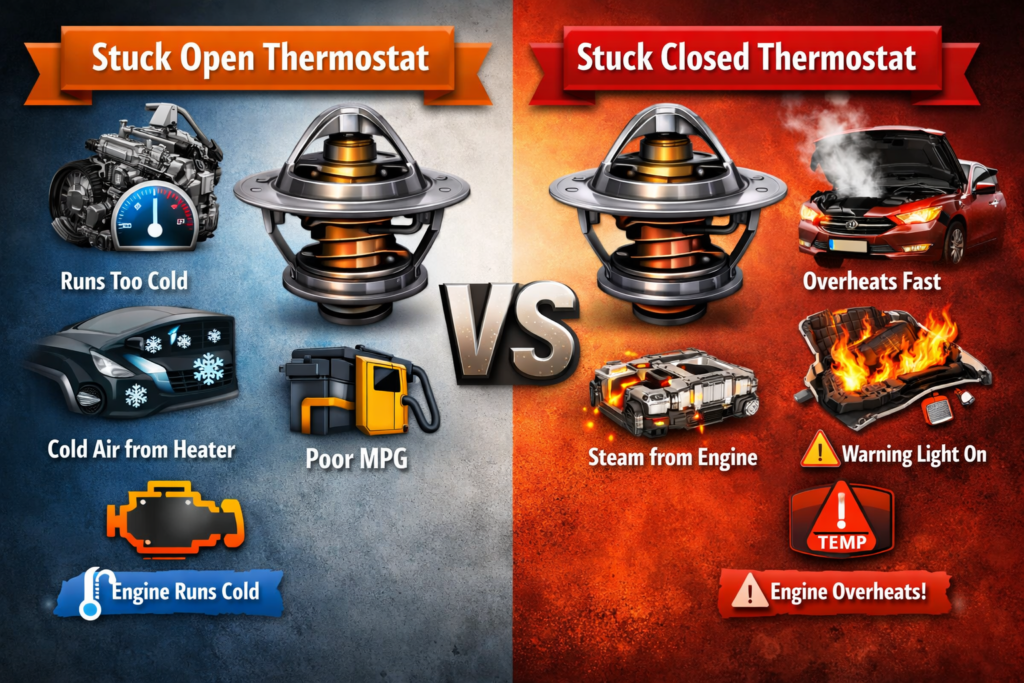
Stuck Open vs Stuck Closed Thermostat
Check replacement thermostats on Amazon
⚠️ Warning: Driving with a stuck closed thermostat can destroy your engine in minutes. If your temperature gauge spikes, stop immediately and turn off the engine.
What Does a Car Thermostat Actually Do?
The thermostat is a temperature-controlled valve that sits between your engine and radiator. When your engine is cold it stays closed, allowing the engine to warm up quickly. Once the engine reaches its optimal operating temperature — typically between 180°F and 210°F — the thermostat opens and allows coolant to flow through the radiator to prevent overheating.
When the thermostat fails it usually gets stuck in one position — either open or closed — and that’s when problems start.
What Causes a Thermostat to Get Stuck?
Thermostats usually fail due to:
- Wear and tear over time — most common after 80,000–100,000 miles
- Low quality aftermarket parts — cheap thermostats are significantly more likely to fail early
- Coolant contamination or sludge buildup — dirty coolant can clog the valve mechanism
- Corrosion inside the cooling system — particularly in older vehicles
- Manufacturing defects — even new thermostats can occasionally be faulty
Cheap thermostats are more likely to fail early — which is why choosing a reliable brand and testing before installation is so important.
Stuck Open Thermostat — Symptoms
A stuck open thermostat means the valve is permanently open, constantly allowing coolant to flow through the radiator even when the engine is cold. In a stuck open vs stuck closed thermostat situation, this type of failure is less dangerous but still affects performance and efficiency. A stuck open vs stuck closed thermostat comparison clearly shows why this type of failure is far more dangerous and requires immediate action.
Symptoms of a stuck open thermostat:
- Engine takes a very long time to warm up — the most common sign. Your engine may never reach normal operating temperature
- Heater blows cold or lukewarm air — because the coolant never gets hot enough
- Temperature gauge stays low — the needle barely moves from the cold position
- Poor fuel economy — engines burn more fuel when running below optimal temperature
- Check engine light — the ECU may detect the temperature sensor reading as abnormal
Is a stuck open thermostat dangerous?
Less immediately dangerous than a stuck closed thermostat — your engine won’t overheat — but it will run inefficiently, cause increased fuel consumption, and over time can damage your engine’s internal components due to running too cold.
Stuck Closed Thermostat — Symptoms
A stuck closed thermostat is the more serious failure. The valve is permanently closed, preventing coolant from flowing to the radiator. Heat builds up rapidly inside the engine with nowhere to go.
Symptoms of a stuck closed thermostat:
- Engine overheats quickly — temperature gauge spikes rapidly after starting
- Temperature warning light comes on — often within minutes of driving
- Steam from under the bonnet/hood — coolant boiling over
- Heater suddenly blows very hot air — then nothing as coolant stops circulating
- Sweet smell inside the car — sign of coolant leaking or burning
- Engine making unusual sounds — knocking or gurgling
Is a stuck closed thermostat dangerous?
Yes — extremely. Left unaddressed it can cause catastrophic engine damage including warped cylinder heads, blown head gaskets, and cracked engine blocks — repairs that can cost thousands of dollars.
⚠️ If your temperature gauge is spiking — pull over immediately and turn off the engine. Do not continue driving.
What Real Car Owners Say
Understanding how a stuck open vs stuck closed thermostat works helps you diagnose problems much faster before they become serious. The consequences of thermostat failure are well documented by real vehicle owners:
“Stuck closed after 2 months. Overheated. Not recommended.” — Tony Armstrong, verified US buyer ⭐
“It doesn’t open at 195 degrees. I tested this on the kitchen stove with 2 temperature probes. It consistently started to open at 212 and was fully open at 217.” — CatSr, verified US buyer ⭐
“Left me stranded on the freeway a week after installation. The thermostat didn’t open.” — Steven Backlund, verified US buyer ⭐
These reviews highlight why choosing a quality replacement thermostat matters — and why testing before installation is always a smart move.
How to Test Your Thermostat
When diagnosing a stuck open vs stuck closed thermostat, testing is one of the most reliable ways to confirm the issue before replacing parts. Before replacing your thermostat, you can test it at home to confirm it’s the problem.
The boiling water test:
- Remove the thermostat from your vehicle
- Place it in a pot of cold water
- Heat the water gradually on the stove
- Watch the thermostat — it should begin opening around its rated temperature (usually marked on the unit)
- Remove from heat — it should close again as it cools
If it doesn’t open at the correct temperature or doesn’t close — it needs replacing.
Always test a new thermostat before installation too — experienced car owners confirm it takes five minutes and can save hours of frustrating work.
How to Replace a Stuck Thermostat
Replacing a stuck open vs stuck closed thermostat is usually straightforward and can prevent much more expensive engine damage. Most thermostat replacements are straightforward DIY jobs that take 30-60 minutes.
Basic steps:
- Let the engine cool completely — never work on a hot cooling system
- Drain some coolant from the radiator
- Locate the thermostat housing — usually where the upper radiator hose meets the engine. If your housing is damaged or leaking, read our full guide on plastic vs aluminum thermostat housing to choose the right replacement.
- Remove the housing bolts — typically 2-3 bolts
- Remove the old thermostat and gasket
- Clean the mating surfaces thoroughly
- Install the new thermostat and gasket
- Reassemble and refill coolant
- Run the engine and check for leaks
If you are also replacing the housing, read our full guide on plastic vs aluminum thermostat housing for help choosing the right material for your vehicle.
As one verified buyer who replaced his Chevy Silverado thermostat described: once all hoses are clamped, start the vehicle, run the heater at max until operating temperature, top off coolant — and you’re done.
Best Replacement Thermostats
MotoRad 2000-195 High Performance Thermostat — #1 Best Seller
The MotoRad 2000-195 is the #1 Best Seller in Automotive Replacement Engine Thermostats on Amazon with 4.6 stars from 687 reviews and over 800 sold per month.
Its improved design features a larger movable inner ring that allows greater coolant flow and faster temperature response — resulting in temperature swings of only 1-2 degrees compared to 5 degrees on older designs.
Compatible with a huge range of vehicles including Jeep Wrangler, Grand Cherokee, Ford F-150, Ranger, Mustang, Taurus, Dodge Ram, Chevy C1500, Camaro, and hundreds more.
“Works very well for my ’98 4.0 Jeep system. It only opens when it should at 195, which is the optimum temp for fuel delivery.” — Todd, verified US buyer ⭐⭐⭐⭐⭐
“Water temp is holding steady at 195°F.” — Tsmokey, verified US buyer ⭐⭐⭐⭐⭐
“Works great. I like the included burp/flow hole so I didn’t have to drill a hole. It fit perfectly in my 2004 Jeep Wrangler. Installation went smoothly.” — 101sm, verified US buyer ⭐⭐⭐⭐⭐
Pros:
- #1 Best Seller in category
- High performance improved design
- Compatible with hundreds of vehicle models
- Excellent value at $8.52
- Includes burp/flow hole for easy installation
Cons:
- Some users report temperature inconsistencies
- Always test before installation to confirm it opens at correct temperature
Dorman 902-2090 Thermostat Housing Assembly — Amazon’s Choice
If your thermostat housing is damaged or leaking alongside a failed thermostat, the Dorman 902-2090 Housing Assembly is Amazon’s Choice with 4.6 stars from 548 reviews.
Compatible with select Cadillac, Chevrolet, and GMC models, it’s engineered to withstand extreme temperature changes and resist cracking and leaking. Dorman has over 100 years of automotive engineering experience behind every product.
“Fit my 2015 GMC Sierra 1500 perfectly. Well made. Good value for the money.” — Beth Littleton, verified US buyer ⭐⭐⭐⭐⭐
“Works just as well as the OEM part and cheaper. Easy to install, just pull up a YouTube video.” — BUCC, verified US buyer ⭐⭐⭐⭐⭐
“Amazing fit. Works excellent. Very simple. No leaks and my heat finally works!” — Brian, verified US buyer ⭐⭐⭐⭐⭐
Pros:
- Amazon’s Choice
- Direct OEM replacement fit and finish
- Durable construction — resists cracking and leaking
- Over 100 years of Dorman engineering experience
- Good value compared to dealer prices
Cons:
- Some fitment issues reported for certain model years
- Always verify your vehicle fitment before purchasing
Stuck Open vs Stuck Closed Thermostat — Key Differences
| Symptom | Stuck Open | Stuck Closed |
|---|---|---|
| Engine temperature | Runs too cold | Overheats rapidly |
| Heater performance | Cold or lukewarm air | Very hot then nothing |
| Fuel economy | Poor | Normal until failure |
| Warning lights | Possibly | Yes — temperature warning |
| Danger level | Low to moderate | High — immediate danger |
| Time to act | Soon | Immediately |
Frequently Asked Questions
What happens if I drive with a stuck closed thermostat? Your engine will overheat very quickly — potentially within minutes. Pull over immediately if your temperature gauge is spiking and let the engine cool completely before attempting to drive further. Continued driving risks catastrophic and expensive engine damage including blown head gaskets and cracked engine blocks.
Can a stuck thermostat fix itself? No — a failed thermostat will not recover on its own. Once stuck it needs replacing. Fortunately thermostat replacement is one of the most affordable car repairs, with quality thermostats available for under $10.
How long does a car thermostat last? Most thermostats last between 10 years or 100,000 miles, though cheaper aftermarket units can fail much sooner. Always choose a quality brand and test before installation.
How do I know if my thermostat or water pump is the problem? If your engine overheats but the thermostat tests correctly, the water pump may be the issue. If the engine runs cold and the thermostat tests correctly, check your coolant level and temperature sensor first.
Is it easy to replace a car thermostat yourself? Yes — for most vehicles it’s a straightforward 30-60 minute DIY job. You’ll need basic tools, a new thermostat, a gasket, and some fresh coolant. Always consult a vehicle-specific guide or YouTube tutorial for your exact make and model.
What is the best replacement thermostat? The MotoRad 2000-195 is the #1 Best Seller in its category on Amazon with 4.6 stars and hundreds of verified reviews. At $8.52 it offers excellent value and is compatible with hundreds of vehicle models.
Final Verdict
Understanding the difference between a stuck open and stuck closed thermostat can save you from serious — and expensive — engine damage.
- Stuck open = engine runs too cold, poor efficiency, fix soon
- Stuck closed = engine overheats rapidly, fix immediately
If you suspect your thermostat has failed, test it using the boiling water method, then replace it with a quality unit. At under $10 for a quality replacement thermostat, it’s one of the most cost-effective car repairs you can make — and one of the most important for protecting your engine. Knowing the difference between a stuck open vs stuck closed thermostat can help you prevent serious engine damage and avoid costly repairs.
Based on real customer reviews, automotive engineering data, and vehicle maintenance research.
Check latest price on Amazon — Top Rated Thermostat
Check thermostat housing on Amazon
Reviewed by The Thermo Expert Team
The Thermo Expert Team researches and compares smart thermostats, heating systems, and common HVAC issues to provide clear, practical advice for homeowners. Our goal is to help you understand problems quickly and choose the right solution with confidence.
Pingback: Signs of a Bad Car Thermostat: Symptoms, Diagnosis and How to Fix It (2026 Guide) - The Thermo Expert