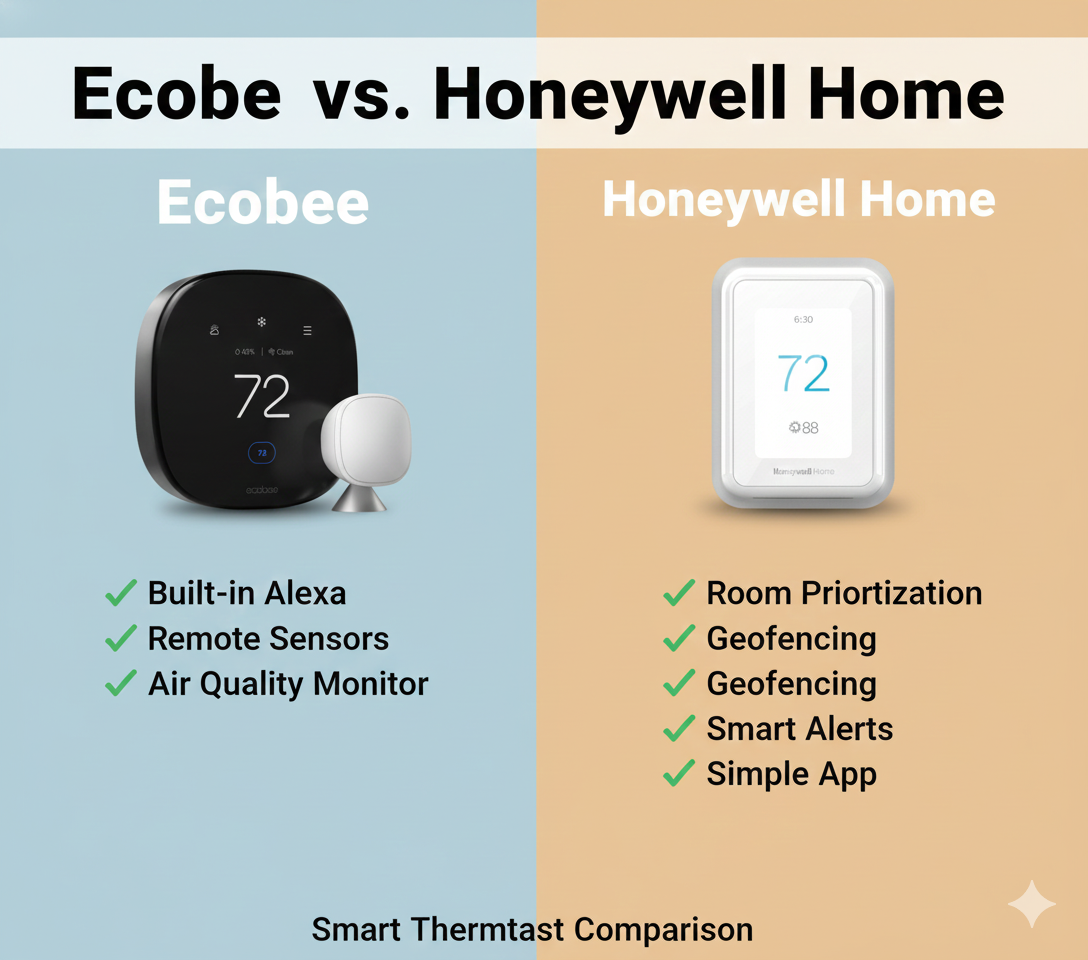
Ecobee vs. Honeywell Home: Which Smart Thermostat Reigns Supreme?
The battle for the modern wall is fierce. On one side, you have Honeywell Home (now under Resideo), a brand with over a century of HVAC heritage. If you grew up in a house with a thermostat, it was likely a round, beige Honeywell dial. On the other side is Ecobee, the Canadian tech disruptor that invented the smart thermostat category before Nest even existed.
Choosing between them isn’t just about picking a device; it’s about choosing a philosophy. Do you want the tried-and-true reliability of an HVAC giant, or the slick, app-driven innovation of a tech startup? In this comprehensive “Ecobee vs. Honeywell Home” comparison, we break down installation, features, app experience, and real-world energy savings to help you decide.
At a Glance: The Tale of the Tape
Before we dive deep, here is how the flagship models—the Ecobee Smart Thermostat Premium and the Honeywell Home T9—stack up against each other.
| Feature | Ecobee Smart Thermostat Premium | Honeywell Home T9 |
|---|---|---|
| Build Material | Zinc & Glass (Premium Feel) | Plastic (Utilitarian) |
| Remote Sensors | 1 SmartSensor Included | 1 Smart Room Sensor Included |
| Air Quality Monitoring | Yes (VOCs & CO2 estimate) | No |
| Voice Control | Built-in (Alexa & Siri) | Compatible (Needs external speaker) |
| C-Wire Adapter | Included (PEK) | Included (C-Wire Adapter) |
| App Rating | 4.7/5 (Consistently High) | 4.2/5 (Improved, but laggy) |
Round 1: Design & Aesthetics
When you mount something on your wall for the next decade, looks matter.
Ecobee: The Modernist
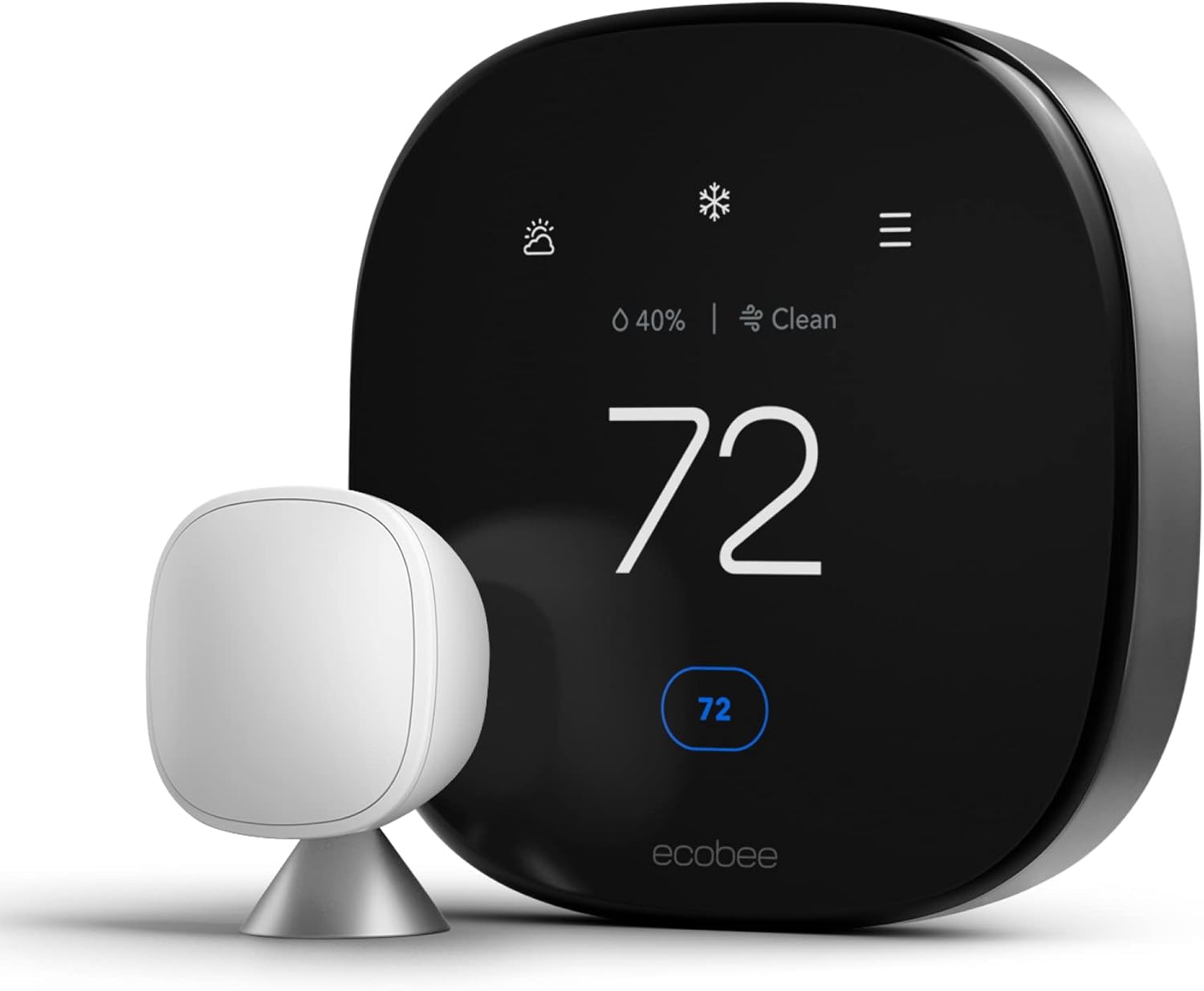
Ecobee has refined its “squircle” design over the years. The Ecobee Smart Thermostat Premium review units reveal a stunning glass face housed in a zinc body. It feels heavy, expensive, and futuristic. The interface is high-resolution, resembling a smartphone screen. It uses a radar sensor to wake up as you approach, which feels magical.
Honeywell: The Utilitarian
Honeywell Home focuses on function over form. The T9 and T10 Pro models are white, rectangular, and made of plastic. They look like thermostats. For many homeowners, this is a plus—they don’t want a “gadget” on the wall; they want a control panel. However, compared to the Ecobee, the Honeywell T9 feels a bit dated.
Winner: Ecobee. It simply looks better in a modern home.

Round 2: Installation & Compatibility
Both brands excel here, but they take different approaches to the dreaded “C-wire” issue. If your old thermostat didn’t have a common wire, you might see thermostat low battery symptoms with cheaper models.
The Wiring Solution
Ecobee includes a Power Extender Kit (PEK). It’s a small module you install at your furnace control board. The instructions are phenomenal. We have a guide on how to switch out an hz311 thermostat for an ecobee thermostat that highlights just how adaptable the Ecobee backplate is.
Honeywell also includes a C-wire adapter with the T9 and T5 models. However, Honeywell’s legacy means it supports a wider range of obscure HVAC systems, including dual-fuel and complex zoning systems, right out of the box. If you are debating Honeywell vs Emerson thermostat for an older boiler system, Honeywell is often the safer bet.
Note on High Voltage: Neither the Ecobee Premium nor the Honeywell T9 works with high voltage systems. If you need a thermostat for baseboard heaters, look for the Mysa Smart Thermostat review instead.
Winner: Tie. Ecobee has better instructions; Honeywell has broader legacy system support.Round 3: Remote Sensors & Temperature Control
This is where the magic happens. Both brands use remote sensors to solve the problem of a thermostat not reaching set temperature in upstairs bedrooms.
Honeywell Smart Room Sensors
Honeywell’s sensors are powerful. They can detect temperature, humidity, and motion. Their range is impressive—up to 200 feet. The Honeywell Home T9 review highlights that these sensors are excellent at prioritizing occupied rooms. If you choose to prioritize a specific room, the T9 will aggressively work to get that room to the set point, sometimes sacrificing the rest of the house.
Ecobee SmartSensors
Ecobee invented this category. Their sensors are smaller and magnetically mount to stands. The “Follow Me” feature is smoother than Honeywell’s implementation, gradually averaging the temperature of occupied rooms rather than abrupt switching.
However, Ecobee takes the lead with the Premium model because it also monitors indoor air quality. If you are comparing Ecobee vs Wyze thermostat, the sensor ecosystem of Ecobee is vastly superior.
Winner: Ecobee, primarily for the aesthetic of the sensors and the “Follow Me” algorithm smoothness.Round 4: The App Experience & Smart Features
A smart thermostat is only as good as its app.
Ecobee App
The Ecobee app is user-friendly and mirrors the thermostat interface perfectly. It provides “Eco+” reports, showing exactly how does a smart thermostat save money by leveraging time-of-use rates.
Resideo (Honeywell Home) App
The Resideo app is functional but lacks the polish of Ecobee or Nest. It has improved, but users often report geofencing lag. If you are asking what is geofencing thermostat capability, Honeywell was one of the first to do it, but Ecobee does it more reliably today.
Voice Control
Ecobee wins hands down. The Ecobee Premium has a speaker and microphone built-in. You can talk directly to Alexa or Siri through the thermostat. Honeywell requires you to buy a separate Echo Dot or Google Home device.

Head-to-Head: Specific Model Comparisons
It’s not fair to compare the most expensive Ecobee to the cheapest Honeywell. Let’s break it down by tier.
Flagship: Ecobee Premium vs. Honeywell T9
The Ecobee Premium costs more but gives you a speaker, air quality monitoring, and a metal body. The T9 is a workhorse that focuses purely on temperature. If you check our Honeywell thermostat vs Nest articles, you’ll see Honeywell often loses on “tech” but wins on “HVAC control.” Against Ecobee, the T9 feels like a generation behind.
Budget: Ecobee3 Lite vs. Honeywell T5
The ecobee3 Lite Smart Thermostat review shows it is a stripped-down version of the premium (no voice, no accessory support). The Honeywell T5 review reveals a solid budget option, but it lacks support for remote sensors (unless you get the T5+).
If you want remote sensors on a budget, Ecobee3 Lite is the winner because it remains compatible with the full Ecobee sensor suite.
Reliability & Troubleshooting
Honeywell is a legend for a reason. Their systems are incredibly durable. We rarely see issues where a Honeywell thermostat keeps rebooting unless there is a severe wiring fault.
Ecobee is also reliable, but being more cloud-dependent, it can suffer from occasional server outages that prevent app control (though manual control always works).
If you ever find your thermostat says heat on but no heat, Honeywell’s display often gives error codes that technicians understand immediately. Ecobee gives more user-friendly alerts, like emails warning you that your furnace is “acting up.”
If you think your unit is failing, consult our guide: how to tell if your thermostat is bad.
Pros & Cons: The Verdict
Ecobee (The Smart Choice)
Pros
- Superior design and build quality.
- Built-in Alexa and Siri support.
- Air Quality Monitoring (Premium).
- Excellent HomeKit integration.
- Smooth “Follow Me” sensor averaging.
Cons
- More expensive than equivalent Honeywell models.
- Server reliance for data features.
Honeywell Home (The Safe Bet)
Pros
- Extremely reliable hardware.
- Sensors have excellent range (200ft).
- Often cheaper than Ecobee.
- Trusted by every HVAC technician on earth.
Cons
- App interface feels dated.
- Plastic design looks cheap.
- No built-in voice assistants.
- Geofencing can be glitchy.
Frequently Asked Questions
Does Honeywell T9 work with Ecobee sensors?
No. Honeywell uses its own proprietary Smart Room Sensors, and Ecobee uses its own SmartSensors. They are not interchangeable.
Which is better for Apple HomeKit: Ecobee or Honeywell?
Ecobee is widely considered the best thermostat for Apple HomeKit. It integrates natively and deeply, while Honeywell’s HomeKit support is present but more basic.
Do these thermostats save money?
Yes. If you ask “do smart thermostats really save money?“, studies show Ecobee can save up to 23% on heating/cooling costs annually through its Eco+ algorithms.
Can I install Ecobee if I have a humidifier?
Yes, the Ecobee Premium and SmartThermostat models have accessory terminals (ACC) to control humidifiers, dehumidifiers, or ventilators. The Honeywell T9 does NOT support humidifiers, but the T10 Pro does.
What if my thermostat keeps clicking but not turning on?
This is often a system issue, not the thermostat. Check our guide on why is my thermostat clicking but not turning on to diagnose capacitor or relay failures.
Final Verdict: Which Should You Buy?
The decision between Ecobee vs. Honeywell Home comes down to what you value most: Tech or Tradition.
Choose Ecobee if: You want the absolute best smart features, you use Apple HomeKit, you want a premium design, or you want to monitor your indoor air quality. It is the best smart thermostat for energy savings due to its advanced Eco+ software.
Choose Honeywell Home if: You want a “set it and forget it” device that is rock-solid reliable, you have a very large home where sensor range is critical (over 60ft from the thermostat), or you want to save $50-$80 upfront.
For most modern smart homes, Ecobee is the winner.
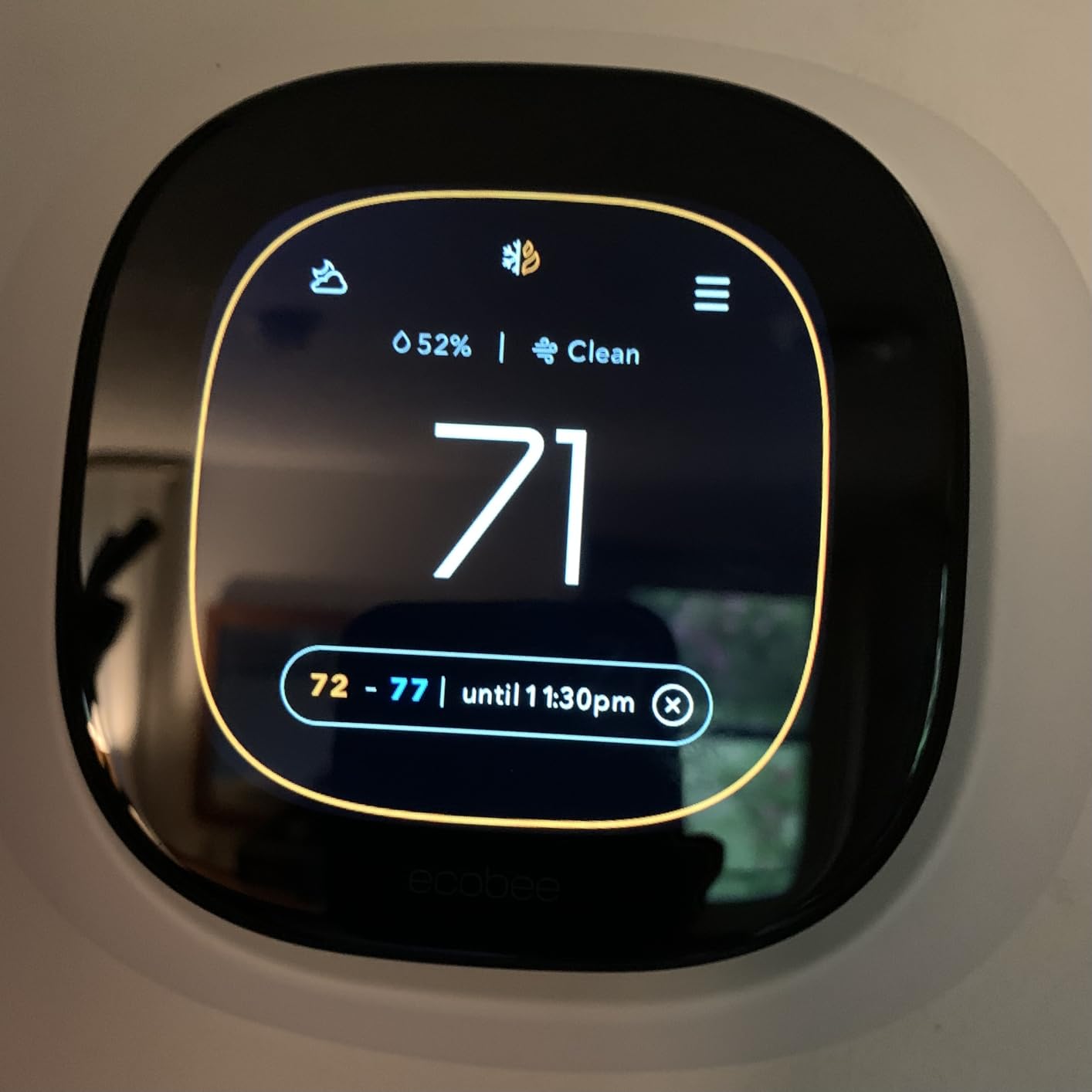
Our Top Pick: Ecobee Smart Thermostat Premium
Upgrade your home with the smartest thermostat on the market.
Check Ecobee Price on AmazonNeed to keep things warm on the go? Don’t forget to check our complete thermos guide and find the most durable thermos options for your winter commute.



 Home
Home
 Info
Info
 Compare
 Reviews
 Shop
Shop