This article may contain affiliate links. If you purchase through these links, we may earn a commission at no extra cost to you.
Do smart thermostats save money? The short answer is yes — but only if you use them correctly. Many homeowners install a smart thermostat expecting instant savings, only to see little difference in their energy bills. In this guide, we break down real-world data, actual cost savings, and how long it really takes for a smart thermostat to pay for itself in 2026.
Based on our analysis of multiple independent studies and real world user data, smart thermostats consistently deliver measurable energy savings when used correctly.
We have analysed data from:
- ENERGY STAR (US government)
- US Department of Energy
- PG&E field trials (California utility — 1,000+ homes)
- National Grid evaluations (Northeast US utility — 2,000+ homes)
- Consumer Reports survey of 15,000+ owners
- Energy Saving Trust (UK government-backed)
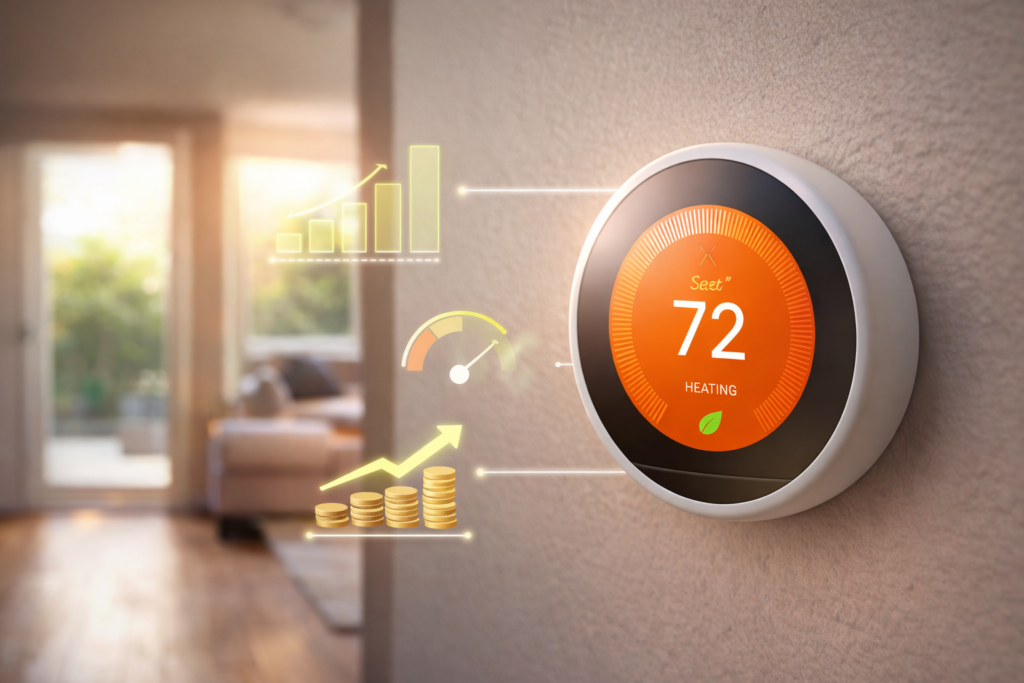
Do Smart Thermostats Save Money? Quick Answer
Yes — smart thermostats genuinely save money for most households. Independent studies show average savings of 10-15% on heating and cooling bills, which typically means the thermostat pays for itself within 2 years.
| Source | Estimated Savings |
|---|---|
| ENERGY STAR | ~$50 per year |
| Google independent studies | $131-$145 per year |
| PG&E field trial | 8.5-11.3% |
| National Grid evaluation | 9-13.8% |
| Consumer Reports (15,000+ owners) | 12% average reduction |
| Energy Saving Trust (UK) | £75-£150 per year |
| Ecobee (manufacturer data) | Up to 26% |
If you’re considering upgrading, check our full guide on the best smart thermostat for home to see the top models available right now.
How Much Money Do Smart Thermostats Save?
Let’s start with independent data rather than manufacturer claims. So, do smart thermostats save money in real life? Let’s look at what the data actually shows.
ENERGY STAR (US Government)
Many homeowners ask: do smart thermostats save money long term? The answer becomes clearer when we look at independent studies rather than marketing claims. According to ENERGY STAR, the US government’s energy efficiency programme, a smart thermostat can save the average household around $50 per year on energy bills. However this is a conservative baseline figure — real world savings are often significantly higher.
Google Independent Studies
According to Google, independent studies show the Nest Learning Thermostat saves an average of 10-12% on heating bills and 15% on cooling bills. Google estimates this equals average savings of $131 to $145 per year for US households.
Pacific Gas and Electric Field Trial — Independent Utility Data
A Pacific Gas and Electric field trial with over 1,000 Nest users found average annual savings of 10.7% for natural gas heating, 11.3% for electric resistance heating, and 8.5% for heat pumps.
Savings were highest in homes that previously left systems running all day. This is independent third-party data — not manufacturer marketing.
National Grid Evaluation — Utility Data
National Grid’s evaluation of over 2,000 Nest installations found average heating savings of 9.2%, average cooling savings of 13.8%, and median savings of $72 per year.
However 20% of participants saw little to no savings — often because they already used programmable thermostats effectively. This honest finding helps you understand whether a smart thermostat is right for your situation.
Ecobee
Ecobee reports savings of up to 26% per year on heating and cooling costs (manufacturer data) — one of the highest figures in the industry.
UK Energy Saving Trust
According to the UK’s Energy Saving Trust, a smart thermostat combined with smart heating controls can save the average UK household between £75 and £150 per year. According to EDF Energy citing the Energy Saving Trust, simply turning your thermostat down from 22°C to 21°C can save £90 per year — smart thermostats achieve these savings automatically without sacrificing comfort.
Consumer Reports Survey
A Consumer Reports survey of 15,000 smart thermostat owners found Nest users reported a 12% average reduction in HVAC costs, an 86% satisfaction rate, and a payback period of 1.5 to 3 years.
Full Cost Breakdown: Is a Smart Thermostat Worth It?
If you’re comparing models, see our detailed Nest vs Ecobee comparison to understand which one offers the best value for your home.
US Household Example
The average US household spends approximately $1,500 per year on heating and cooling according to the US Energy Information Administration.
With a smart thermostat saving 10-15%:
- Heating savings: $90-$108 per year
- Cooling savings: $67-$75 per year
- Total estimated annual saving: $130-$145 per year
UK Household Example
The average UK household spends approximately £1,200-£1,500 per year on gas and electricity for heating.
With a smart thermostat saving 10-15%:
- Total estimated annual saving: £120-£225 per year
How Long Until a Smart Thermostat Pays for Itself?
The payback period depends on your starting point:
- Manual thermostat with no schedule — annual saving $131-$145, payback approximately 1.7-2 years
- Poorly used programmable thermostat — annual saving $100-$120, payback approximately 2-2.5 years
- Well used programmable thermostat — annual saving $50-$80, payback approximately 3-5 years
- With $100 utility rebate — annual saving $131-$145, payback approximately 1 year or less
By Thermostat Model:
- Google Nest Learning Thermostat — approximately $250 / £280 — saves $131-$145 / £120-£150 per year — payback 1.7-2 years
- Ecobee Smart Thermostat Premium — approximately $260 — saves up to 26% on heating and cooling — payback 1.5-2 years
- Google Nest Thermostat budget model — approximately $130 / £100 — saves $50-$100 per year — payback 1-2 years
After the payback period every pound or dollar saved goes straight back into your pocket — year after year.
What Actually Makes Smart Thermostats Save Money?
1. Auto-Schedule
Traditional thermostats heat or cool your home even when nobody is there. Smart thermostats learn your routine and automatically reduce heating and cooling when you’re away or asleep.
According to the US Department of Energy, you can save as much as 10% per year on heating and cooling by simply turning your thermostat back 7-10 degrees Fahrenheit for 8 hours a day. Smart thermostats do this automatically without you having to think about it.
2. Home and Away Detection
Most smart thermostats use geofencing or motion detection to sense when you’ve left the house and automatically adjust the temperature. This eliminates the common problem of heating or cooling an empty home — one of the biggest sources of wasted energy.
3. Learning Your Habits
The Google Nest Learning Thermostat monitors your adjustments over the first week and builds a personalised schedule automatically. Over time it learns exactly when you like your home warm and when you’re happy with lower temperatures — optimising energy use without sacrificing comfort.
4. Energy Reports
Smart thermostats provide detailed energy reports showing exactly how much energy you’re using and why. This awareness alone encourages more energy-conscious behaviour — and according to multiple studies awareness of energy usage consistently leads to reduced consumption.
5. Remote Control
Being able to adjust your thermostat from your phone means you can turn heating or cooling off when plans change unexpectedly — eliminating the energy waste of coming home to a house that’s been heated or cooled all day unnecessarily.
Smart Thermostat vs Traditional Thermostat
| Feature | Smart Thermostat | Traditional Thermostat |
|---|---|---|
| Auto-schedule | ✅ Learns automatically | ❌ Manual programming required |
| Home/Away detection | ✅ Automatic | ❌ Manual override needed |
| Remote control | ✅ From anywhere | ❌ Must be at the thermostat |
| Energy reports | ✅ Detailed usage data | ❌ Not available |
| Savings potential | High | Low |
Smart Thermostat Savings by Brand
Google Nest Learning Thermostat
The Nest Learning Thermostat is one of the most studied smart thermostats in the world. Its energy saving claims are backed by multiple independent sources:
- Google independent studies — 10-12% heating, 15% cooling, $131-$145 per year
- PG&E field trial over 1,000 homes — 10.7% gas heating, 11.3% electric heat, 8.5% heat pumps
- National Grid evaluation over 2,000 homes — 9.2% heating, 13.8% cooling, $72 median savings
- Consumer Reports survey of 15,000+ owners — 12% average HVAC cost reduction, 86% satisfaction
The Nest has also saved over 4 billion kWh of energy in millions of homes worldwide since 2011 — a figure that represents genuine measurable impact.
“I can easily see how the money will be clawed back in a year. The thermostat is easy to use and the Nest timing is far easier to use than our old 7 day programmer.” — Momo, verified UK buyer ⭐⭐⭐⭐⭐
“I especially love that it learns our habits and helps create an energy-efficient schedule — I’ve definitely noticed our HVAC isn’t running as much during times we don’t need it.” — Victoria, verified US buyer ⭐⭐⭐⭐⭐
Ecobee Smart Thermostat Premium
Ecobee reports savings of up to 26% per year on heating and cooling costs (manufacturer data) — one of the highest figures in the industry. The key to Ecobee’s superior savings is its included SmartSensor, which monitors temperature in the rooms you actually use rather than just the hallway where the thermostat is installed.
This means your HVAC system only works as hard as it needs to — not harder — resulting in genuine energy savings beyond what a standard smart thermostat achieves.
“Well worth the expenditure which I should recoup over time. Wish I had done this sooner!” — Rick M, verified US buyer ⭐⭐⭐⭐⭐
“This thermostat does everything I wish my Nest had done. The vacation scheduling feature was a big surprise — I can schedule vacation holds as soon as I book my flights.” — Erik B, verified US buyer ⭐⭐⭐⭐⭐
Energy Company Rebates — Get Paid to Install a Smart Thermostat
One of the most overlooked ways to reduce the cost of a smart thermostat is through energy company rebates.
According to Google, rebates starting at $100 are available from many US energy providers for purchasing a Nest thermostat. This effectively means you can get a $250 thermostat for $150 — cutting the payback period almost in half.
Real Rebate Examples (2026):
The City of Red Deer in Alberta Canada offers a $50 rebate for purchasing and installing a qualifying ENERGY STAR certified smart thermostat, with participants seeing energy use reductions of up to 12% compared with standard programmable models.
The Peabody Municipal Light Plant in Massachusetts offers a 50% rebate up to $125 for qualifying WiFi-enabled smart thermostats for homes with central air conditioning, air source heat pumps, ground source heat pumps, electric heat, or ductless mini-split heat pumps.
How to find rebates:
- Check your energy company’s website and search for “smart thermostat rebate”
- Use DSIRE — the Database of State Incentives for Renewables and Efficiency at dsireusa.org
- Ask your energy provider directly — many offer rebates that are not widely advertised
- Check manufacturer websites — Google Nest and Ecobee both list participating energy companies
In the UK, some energy suppliers offer smart thermostat grants or subsidies as part of government energy efficiency schemes. Check with your energy supplier and the UK government’s energy efficiency advice pages for current offers.
The answer to whether smart thermostats save money depends heavily on how your heating system is currently used and how much energy is being wasted.
Do Smart Thermostats Save Money for Everyone? (Honest Answer)
According to independent utility studies not everyone sees dramatic savings.
You will save MORE if:
- You currently use a manual thermostat with no schedule — biggest opportunity for improvement
- You often forget to adjust temperatures — automation adds the most value here
- You have electric resistance heating — most expensive fuel type
- You live in an extreme climate with very hot summers or very cold winters
- You have irregular schedules — Home/Away detection saves significantly
- You have a larger home with higher baseline energy costs
You will save LESS if:
- You already use a programmable thermostat correctly — smaller improvement margin
- You work from home with a very regular schedule — less opportunity for setback savings
- You live in a mild climate with low baseline heating and cooling costs
- Your home is very well insulated and already energy efficient
According to National Grid’s evaluation, in their study of over 2,000 Nest installations 20% of participants saw little to no savings — often because they already used programmable thermostats effectively. The biggest savings went to homes that previously left their systems running all day.
Bottom line: Smart thermostats save money for most households but the amount varies significantly based on your starting point.
Are There Any Hidden Costs?
If you’re planning installation yourself, read our step-by-step guide on how to install a smart thermostat safely and correctly.
In the interest of giving you a complete picture here are the costs beyond the purchase price:
- DIY installation — possible for most homes in 15-30 minutes, free
- Professional installation — typically $100-$200 if required
- Energy company installation — some offer free installation as part of rebate programmes
- C-wire — some smart thermostats require one in older homes
- Ecobee — includes Power Extender Kit for homes without a C-wire at no extra cost
- C-wire adapter — $15-$25 if needed separately for other models
- Google Nest subscription — no monthly fees for core features
- Ecobee subscription — core features free, some advanced eco+ features may require subscription
- WiFi dependency — smart features require working WiFi, though basic schedule still works without
Smart Thermostat vs Programmable Thermostat: Which Saves More?
Many homes already have a programmable thermostat. Is it worth upgrading?
According to the US Department of Energy, programmable thermostats can save money but only if used correctly — and studies show that most people either don’t programme them properly or override them regularly because they are too complicated.
Smart thermostats solve this problem entirely by programming themselves. The result is that most households save significantly more with a smart thermostat than with a programmable thermostat — even if the programmable thermostat is technically capable of similar savings.
Frequently Asked Questions
How much does a smart thermostat save per month? Based on average annual savings of $131-$145 a smart thermostat saves approximately $11-$12 per month for a typical US household. UK households can expect savings of around £10-£18 per month depending on home size and energy usage.
Do smart thermostats save money in summer? Yes — independent studies show the Nest Learning Thermostat saves an average of 15% on cooling bills which can be significant in warmer climates.
Do smart thermostats work with all heating systems? Most smart thermostats are compatible with 95% of standard 24V HVAC systems including gas, electric, forced air, heat pumps, and radiant systems. Always check compatibility before purchasing.
Is a smart thermostat worth it for renters? It can be — particularly battery-powered models that don’t require hardwiring and can be taken when you move. Check with your landlord before installing and factor in that you may not benefit from long-term savings if your tenancy is short.
Do smart thermostats save money in the UK? Yes — UK households can save between £75 and £150 per year according to the Energy Saving Trust. With rising energy costs in the UK the return on investment is increasingly attractive.
Which smart thermostat saves the most money? Ecobee reports the highest savings at up to 26% per year (manufacturer data), supported by its included SmartSensor technology. Google Nest claims 10-15% savings backed by multiple independent studies including PG&E and National Grid utility trials.
What if I already have a programmable thermostat? According to National Grid’s evaluation 20% of homes with existing programmable thermostats saw little to no savings after switching to a smart thermostat. If you already use your programmable thermostat effectively the upgrade may not pay off quickly. If you find it confusing or often override it a smart thermostat will likely save you money.
Do Smart Thermostats Save Money? Final Verdict
Based on multiple independent studies, smart thermostats do save money for most households — typically reducing heating and cooling costs by 10–15% per year.
Here is what the data shows:
- ENERGY STAR — approximately $50 per year baseline
- PG&E field trial over 1,000 homes — 8.5-11.3% savings
- National Grid evaluation over 2,000 homes — 9.2-13.8% savings, $72 median
- Consumer Reports over 15,000 owners — 12% average reduction, 86% satisfaction
- Google independent studies — 10-15% savings, $131-$145 per year
- Ecobee — up to 26% savings (manufacturer data)
- Energy Saving Trust UK — £75-£150 per year
The biggest savings go to homes that currently leave systems running all day, have irregular schedules, live in extreme climates, or have electric resistance heating.
The Google Nest Learning Thermostat and Ecobee Smart Thermostat Premium are the two strongest options in 2026. Both are backed by independent energy saving data and thousands of verified customer reviews. If you’re on a tighter budget the standard Google Nest Thermostat offers smart features at a lower price point and will still deliver meaningful savings.
Based on data from ENERGY STAR, US Department of Energy, PG&E field trials, National Grid evaluations, Consumer Reports, Google independent studies, Ecobee product data, UK Energy Saving Trust, and verified customer reviews.
Check the Google Nest Learning Thermostat on Amazon US
Check the Google Nest Learning Thermostat on Amazon UK
Check the Ecobee Smart Thermostat Premium on Amazon US
Still deciding? Check our full smart thermostat comparison guide to see how the top models stack up side-by-side.
Related Guides:
- Best Smart Thermostat for Home (2026)
- Nest vs Ecobee — Which Is Better in 2026?
- Best Thermostat for Bosch Heat Pump
- Google Nest Review 2026
Reviewed by The Thermo Expert Team
The Thermo Expert Team researches and compares smart thermostats, heating systems, and common HVAC issues to provide clear, practical advice for homeowners. Our goal is to help you understand problems quickly and choose the right solution with confidence.
Pingback: Google Nest Learning Thermostat Review (2026): Is It Worth It?