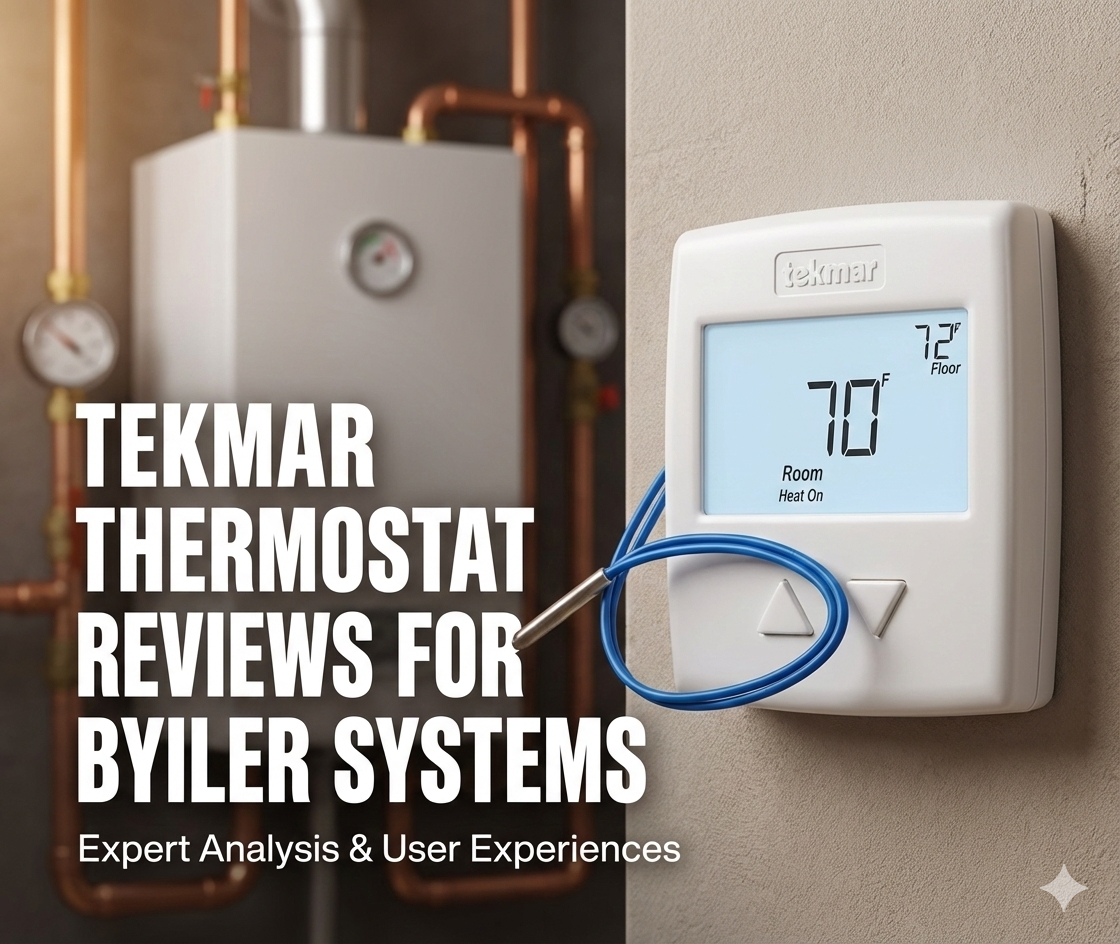
Tekmar Thermostat Reviews for Boiler Systems: Precision Hydronic Control
If you own a home with hydronic heating—whether it’s radiant floor loops, baseboards, or cast-iron radiators—you have likely realized that standard “smart” thermostats struggle to keep up. The thermal lag of water-based systems often leaves standard thermostats confused, leading to overheating, undershooting, and inefficient boiler cycling.
Enter Tekmar. Unlike consumer-grade gadgets found in big-box stores, Tekmar controls are engineered specifically for the thermodynamics of boiler systems. They don’t just turn heat on and off; they manage energy delivery.
In this extensive guide, we are reviewing the best Tekmar thermostats for boiler systems, breaking down their industrial-grade features like Pulse Width Modulation (PWM) and Outdoor Reset, and comparing them against popular alternatives. If you are tired of uncomfortable temperature swings in your radiant heated home, this review is for you.
Why Your Boiler Needs a Specialist, Not a Generalist
Most thermostats are designed for forced-air furnaces. A furnace heats air quickly, and when it turns off, the heat stops almost instantly. Boilers are different. They heat water, which retains heat for a long time. If you use a standard thermostat, the residual heat in your radiators or floor slab continues to radiate long after the thermostat clicks off. This is called “overshoot.”
Tekmar thermostats solve this using algorithms designed for high-mass systems. Before diving into the specific model reviews, it is vital to understand that upgrading to a Tekmar isn’t just about changing the interface—it is about changing the logic of how your home is heated.
However, if you are currently renting and cannot replace the entire control logic of a system, you might want to look at smart thermostats suited for rental properties that are less invasive to install.
1. Tekmar 561 WiFi Thermostat: The Best of Both Worlds

Top Pick for Modern Boiler Control
Best For: Homeowners who want professional hydronic control with mobile app convenience.
Check Price on AmazonThe Tekmar 561 is arguably the most significant release from Tekmar in the last decade. Historically, you had to choose between a “dumb” thermostat that handled boilers perfectly or a “smart” thermostat that handled boilers poorly. The 561 bridges that gap.
Performance & Features
The 561 supports a single stage of heating and one stage of cooling (or two stages of heating). However, its magic lies in its settings. It allows you to select the terminal unit type: Radiator, Baseboard, or High Mass Floor. Once selected, the thermostat automatically adjusts its cycles per hour and minimum run times to match that specific physics profile.
It also features Auto-Cycling. Unlike a Honeywell T9 which uses standard cycles, the Tekmar 561 calculates the exact amount of “on” time needed to maintain the room temperature without overshooting.
The WiFi Experience
The Watts Home app (Tekmar is owned by Watts) is utilitarian but effective. It allows for remote temperature changes, scheduling, and energy monitoring. It isn’t as polished as the interface you’d find when comparing Nest vs. Ecobee, but it offers far more technical data regarding your heating cycles.
Pros
- True boiler logic (PWM and Cycle settings).
- Supports Floor Sensor inputs (protects hardwood).
- WiFi connectivity with remote app control.
- Modern touchscreen design.
- Outdoor temperature display via internet weather.
Cons
- Requires a C-Wire (3-wire installation).
- App interface is less “glamorous” than consumer brands.
- More expensive than standard programmable thermostats.
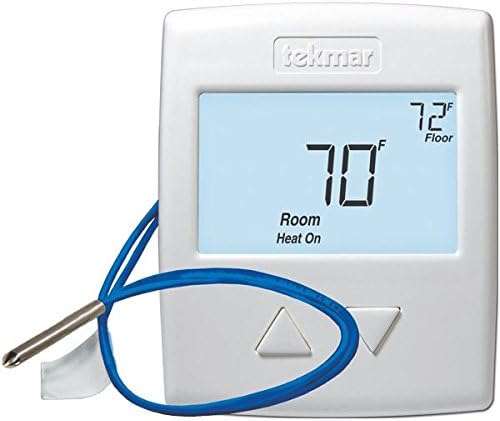
2. Tekmar 519 Radiant Thermostat: The Pure Specialist
Best Non-WiFi Option for Zoning
Best For: Multi-zone systems where you just want reliable temperature control without the hassle of WiFi setup for every room.
Check Price on AmazonIf you have a large home with 8 or 10 different heating zones, you probably don’t need a WiFi thermostat in every single guest bedroom or bathroom. The Tekmar 519 is the streamlined, heavy-hitting sibling of the 561.
Simplicity Meets Science
The 519 looks deceptively simple. It has a small footprint and a clear display. However, under the hood, it utilizes Pulse Width Modulation (PWM). This feature modulates the on/off time of your zone valves to ensure a constant floor temperature, rather than the hot/cold feeling of standard hysteresis loops.
This unit is specifically designed to work with Tekmar’s switching relays, but it works with almost any 24V switching relay. If you are looking for a cheaper alternative for secondary rooms, you might consider checking our guide on best budget thermostats, though you will sacrifice the PWM feature essential for true radiant comfort.
Pros
- Incredibly compact design (fits modern aesthetics).
- Pulse Width Modulation for constant floor heat.
- Includes slab sensor capability (protects floors).
- No batteries required.
Cons
- No WiFi (cannot control from phone).
- Small screen might be hard to read for some.
- Strictly for heating (no cooling control).
Comparison: Tekmar vs. The Competition
How does a dedicated hydronic control stack up against the popular smart home giants? If you are torn between a Tekmar and a Nest, or comparing Ecobee vs Honeywell Home for your boiler, this table clarifies the differences.
| Feature | Tekmar 561 | Google Nest Learning | Ecobee Smart Premium |
|---|---|---|---|
| Control Logic | PWM / Hydronic Specific | Time-to-Temp (AI Learning) | Threshold / Differential |
| Slab Sensor Input | Yes (Included support) | No | No |
| Boiler Protection | High (Short cycle prevention) | Low (Can short cycle boilers) | Medium |
| Power Requirement | C-Wire Required | Power Stealing (Often fails on boilers) | C-Wire (PEK included) |
| App Ecosystem | Watts Home (Basic) | Google Home (Advanced) | Ecobee / HomeKit (Advanced) |
The Verdict: If you care about smart home integrations like voice control and slick interfaces, check out our review of the Ecobee Smart Thermostat Premium. However, if your priority is the longevity of your boiler and the comfort of your heated floors, Tekmar wins on physics alone.
Deep Dive: Understanding Tekmar’s Unique Features
To truly appreciate these reviews, we must unpack the technology that justifies the price tag. Unlike standard thermostats that operate like a simple light switch, Tekmar operates like a dimmer.
1. Pulse Width Modulation (PWM)
Standard thermostats wait for the room to drop 1 degree below the setpoint, turn on the boiler, wait for it to rise 1 degree above, and turn off. With radiant floors, the floor is still hot when the thermostat turns off, so the room continues to heat up (overshoot). Then, it takes hours to cool down.
Tekmar’s PWM calculates the heating load. If the room needs 50% heat, the Tekmar might turn the zone valve on for 15 minutes and off for 15 minutes repeatedly. This keeps the floor at a perfectly constant warm temperature, rather than cycling between hot and cold.
2. Slab Sensing (Floor Protection)
Both the 561 and 519 support auxiliary sensors. You can embed a sensor in the floor. This allows you to set a Maximum Floor Temperature (crucial for protecting expensive hardwood or laminate from warping) and a Minimum Floor Temperature (crucial for bathrooms where you always want warm tiles, regardless of the air temperature).
3. Outdoor Reset (Virtual or Wired)
Traditional boiler controls run the water at 180°F regardless of whether it is 50°F or -10°F outside. This is inefficient. Tekmar pioneered “Outdoor Reset,” which lowers the boiler water temperature on milder days. The 561 uses WiFi weather data to simulate this, adjusting cycles based on outdoor conditions to save fuel.
For a comparison of how other brands handle sensors, read our analysis of Ecobee3 Lite vs Google Nest, paying attention to their remote sensor capabilities.
Installation Notes & Compatibility
Installing a Tekmar is slightly more involved than swapping out a basic Honeywell. Here are the critical factors:
The C-Wire Requirement
Many older boiler systems only run two wires to the thermostat (Red and White). This simply completes a circuit. The Tekmar 561 is a power-hungry WiFi device; it cannot run on batteries. You must have a Common (C) wire. If you lack this, you will need to either pull new wire or use an “Add-a-Wire” kit, though direct wiring is always preferred for hydronics.
Relay Compatibility
Tekmar thermostats work best with Tekmar Switching Relays or Zone Valve Controls, but they are universally compatible with Taco, Honeywell, and Argo relays. However, ensure your relay provides 24V AC power.
Need to upgrade your system wiring?
Ensure you have a reliable 24V transformer and proper zone valve controls.
Shop Tekmar Relays on AmazonAre There Alternatives?
While Tekmar is the gold standard, it isn’t the only player.
- Honeywell T10 Pro: Offers decent cycle rate control and remote sensors. See our comparison: Honeywell T9 vs T10 Pro.
- Mysa: If you have electric baseboard heating (high voltage) rather than a boiler, Tekmar is NOT for you. You need a line-voltage thermostat. Check out our Mysa review or the comparison of Mysa vs Sinope.
- Emerson Sensi: A reliable budget option that requires batteries but handles simple boiler systems well. Read about Emerson Sensi Touch here.
Frequently Asked Questions
Does Tekmar work with standard furnaces?
While some models like the 561 can handle multi-stage heating, Tekmar specializes in hydronic (water-based) heating. Using them for a basic forced-air furnace is often overkill and doesn’t utilize their core PWM and outdoor reset features.
What is Pulse Width Modulation in Tekmar thermostats?
PWM cycles the boiler zone valve on and off in short bursts rather than one long cycle. This matches the heat input to the heat loss of the room precisely, preventing the temperature swings common in radiant floor heating.
Do I need a C-wire for Tekmar thermostats?
Yes, most modern Tekmar thermostats (especially WiFi models like the 561) require a 3-wire connection (R, C, and W) to power the display and WiFi radio. Older 2-wire setups will need rewiring or an adapter.
Is Tekmar better than Nest for radiant floor heating?
Generally, yes. Tekmar uses slab sensing and specialized logic to protect floors and manage thermal mass. Nest learns schedules but lacks the specific hydronic algorithms to prevent overheating in high-mass floors.
Can I use the Tekmar 561 for air conditioning?
Yes, the Tekmar 561 supports one stage of cooling. It can manage a typical split system AC alongside your boiler heating.
Final Verdict: Is Tekmar Worth the Investment?
If you have a boiler system, specifically radiant in-floor heating, the answer is an emphatic yes. The comfort difference between a system controlled by a standard “on/off” thermostat and a Tekmar PWM thermostat is night and day. You eliminate the “cold feet” mornings and the “sweating on the couch” evenings.
For the modern homeowner who demands connectivity, the Tekmar 561 is the ultimate choice. It respects the physics of your heating system while giving you the app control you expect in 2025.
For secondary zones or users who prefer “set it and forget it” simplicity, the Tekmar 519 remains the industry workhorse.
Don’t compromise your expensive heating system with a cheap thermostat. Give your boiler the brain it deserves.