Honeywell Evohome Review: The Gold Standard for Multi-Zone Heating?
While newer, sleeker thermostats grab the headlines, the Honeywell Evohome remains the heavyweight champion of granular control. We tested it to see if it justifies the premium price tag.
In the world of smart heating, there are gadgets that look cool, and there are systems built for serious efficiency. The Honeywell Evohome falls squarely into the latter category. While Google Nest relies on learning algorithms and Tado leans on geofencing, Evohome is built on a simple, powerful premise: every room should be its own temperature zone.
For large homes, properties with underfloor heating, or just anyone obsessed with micro-managing their energy usage, Evohome has long been the recommendation of heating engineers. But in 2026, with its interface showing its age and competitors catching up, is it still the best choice? We put the full multi-zone kit to the test.
What is Honeywell Evohome?
Evohome isn’t just a thermostat; it’s a complete heating management system. At its heart is a dedicated, full-colour touchscreen controller that acts as the “brain” of your house. Unlike other systems that rely almost entirely on your smartphone, Evohome gives you a dedicated command center on your wall or table stand.
The system connects wirelessly to smart radiator valves (HR92 or the newer HR91), underfloor heating controllers, and your boiler relay. This allows you to control up to 12 independent heating zones. You can have the living room at 21°C, the baby’s room at 19°C, and the unused guest room effectively off—all scheduled independently.

Honeywell Home Evohome Wi-Fi Connected Thermostat Pack
The core of the system. Includes the central touchscreen controller, table stand, and wireless relay box. Required for controlling up to 12 heating zones.
Check Price on AmazonInstallation: Not for the Faint-Hearted
Let’s be clear: Evohome is a pro-level system. While a confident DIYer can install Tado or Hive easily, Evohome often involves more complex configurations, especially if you are integrating underfloor heating or hot water cylinders.
- Boiler Relay: Needs to be wired directly into your boiler.
- Radiator Controllers: These screw onto your existing TRV bodies. They are bulkier than Tado’s but feature a very handy flip-up screen with a backlight, so you can check the room temp without your phone.
- Configuration: You have to “bind” every single device to the central controller. It’s a process reminiscent of pairing Bluetooth devices in 2010—reliable once done, but tedious to set up.
For most users, we strongly recommend hiring a Honeywell-certified installer. It ensures the system is balanced correctly, which is crucial for getting the efficiency gains.
The Central Controller: A Blessing and a Curse
The dedicated touchscreen is Evohome’s USP. In an age where everything is an app, having a physical screen that anyone (guests, babysitters, grandparents) can walk up to and use is underrated.
The Good: It gives you an instant overview of your entire house. You see every zone, its current temp, and its target temp in one glance. No unlocking phones, no waiting for apps to load.
The Bad: The screen technology feels dated. It’s resistive (requires a firm press) rather than capacitive (like an iPhone), and the resolution isn’t exactly retina-quality. However, it is robust and does the job reliably.
Smart Zoning: Where Evohome Wins
This is why you buy Evohome. The zoning capabilities are unmatched. You can group rooms together (e.g., “Bedrooms”) or keep them separate. The “Optimum Start” and “Optimum Stop” features learn how long each specific room takes to heat up.
For example, if you want the living room to be 20°C at 7:00 AM, Evohome might start the boiler at 6:40 AM because it knows that room heats quickly. But for the conservatory, it might start at 6:00 AM. This level of intelligence ensures comfort without wasting gas.
If you have a large property, this system essentially pays for itself. Heating a 5-bedroom house when you are only using the kitchen and study is madness. Evohome stops that.
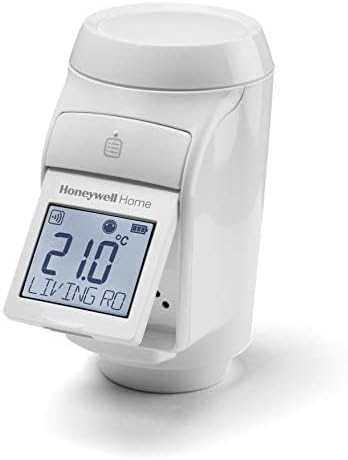
Honeywell Home HR92 Wireless Radiator Controller
The workhorse of the Evohome system. Features a local display, backlight, and localized temperature sensing. Battery powered.
View Radiator ValveThe App Experience
The “Total Connect Comfort” app is functional but basic. It allows you to change temperatures, set schedules, and activate quick actions like “Economy” or “Away” mode remotely. It integrates with IFTTT, Google Assistant, and Amazon Alexa.
However, compared to the slick, data-rich interfaces of newer competitors, it feels a bit utilitarian. It lacks the deep energy insights and graphs that Tado offers. It is a remote control, not an energy analyst.
Evohome vs. The Competition
How does it stack up against the other big players?
Evohome vs. Tado
Tado is the closest rival for multi-room control. Tado’s valves are sleeker and quieter, and its app is more modern with better geofencing. However, Tado relies heavily on the cloud and subscriptions for automation. Evohome is a local system; if your internet goes down, your heating schedule still works perfectly because it’s stored in the controller. For a deeper dive, read our Tado Smart Thermostat V3+ review.
Evohome vs. Hive
Hive is simpler and cheaper. It’s great for general “whole house” control but clunky if you try to add radiator valves to every room. Hive is better for the average user; Evohome is for the power user. Check our Hive Active Heating review for a comparison of the basic systems.
For a three-way shootout, see our Nest vs Hive vs Tado comparison to see where Evohome sits in the wider market.
Final Verdict
Pros
- Unrivaled multi-zone control (up to 12 zones).
- Dedicated controller means you don’t always need a phone.
- Works locally without internet connection.
- Compatible with underfloor heating and hot water.
- Excellent reliability and signal range.
Cons
- Expensive initial outlay.
- Controller screen tech feels dated.
- Radiator valves (HR92) are bulky.
- App lacks detailed energy usage data.
Should you buy it? If you live in a large home, have a complex heating setup (e.g., mix of radiators and underfloor), or simply want the absolute best precision control available, Honeywell Evohome is still the king. It is an investment that yields serious comfort and efficiency returns. For smaller flats or simple setups, it is likely overkill.
Frequently Asked Questions
No. Once you buy the hardware, there are no monthly fees. All features, including remote access via the app, are free to use forever.
It is possible for competent DIYers, especially just for radiator valves. However, wiring the boiler relay requires working with mains electricity. Due to the complexity of binding and configuring zones, professional installation is often recommended to ensure it runs efficiently.
Yes, it works with Combi, System, and Regular boilers. It also supports OpenTherm technology, allowing it to modulate compatible modern boilers for even greater efficiency.
Yes, it integrates with both. You can use voice commands to set temperatures for specific zones, e.g., “Alexa, set the Living Room to 21 degrees.” It also works with IFTTT.
One of Evohome’s biggest strengths is that it stores all schedules locally on the central controller. If your Wi-Fi fails, your heating continues to run perfectly. You just lose app control until the connection is restored.