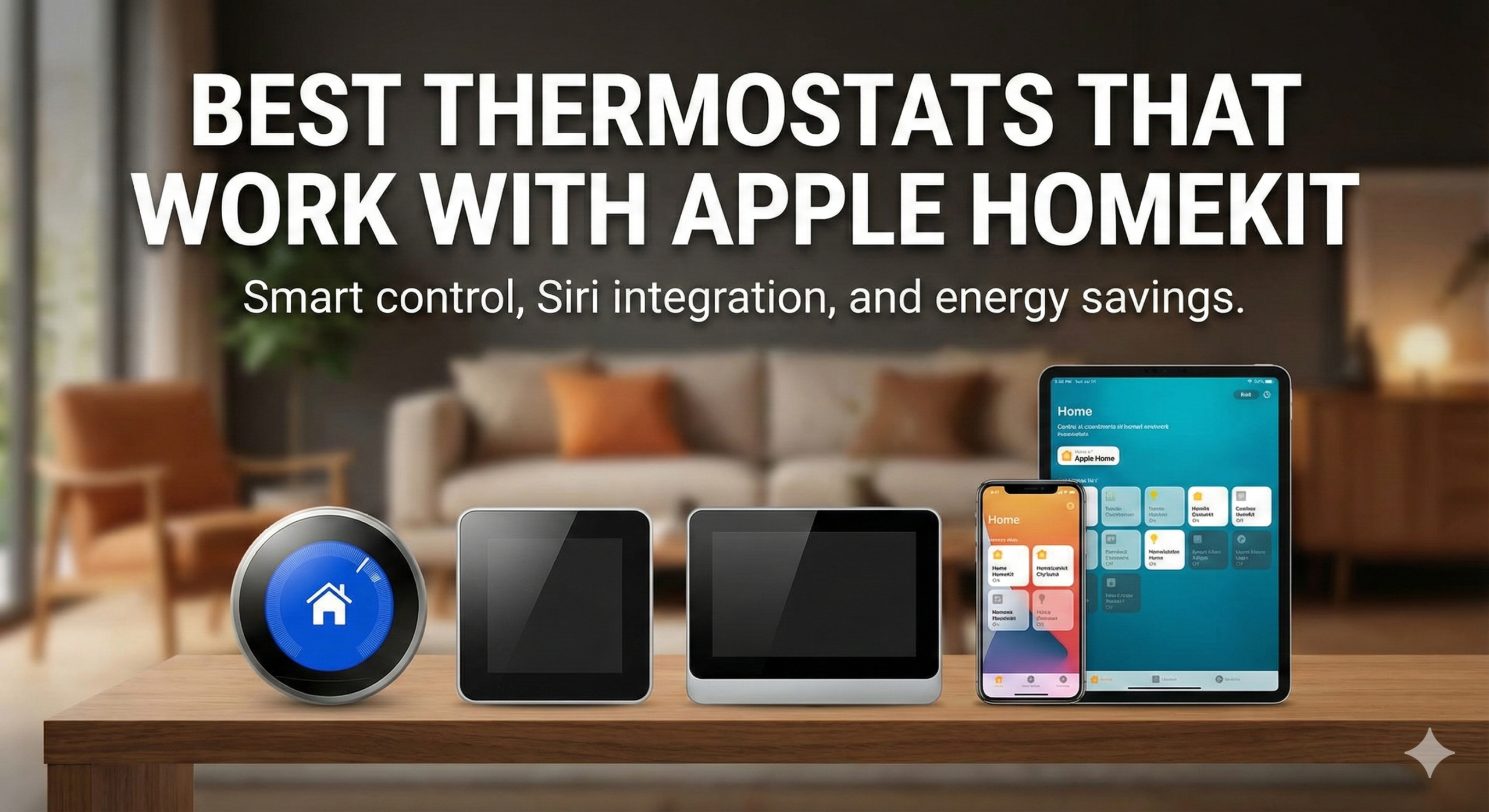
Best Thermostats That Work with Apple HomeKit: The Ultimate Guide
For years, Apple HomeKit users felt like second-class citizens in the smart home world. While Alexa and Google Assistant users had hundreds of cheap thermostat options, HomeKit’s strict security protocols and encryption requirements limited the playing field.
That era is over. Today, some of the most advanced, beautifully designed, and energy-efficient thermostats on the market are built with Apple HomeKit as a priority, not an afterthought. Whether you want to control your temperature via Siri on your Apple Watch, set up complex geofencing automations in the Home app, or simply want a device that respects your data privacy, you have excellent choices.
In this extensive review, we are breaking down the absolute best thermostats that work natively with Apple HomeKit. We will compare the heavy hitters like Ecobee and Honeywell Home, and explore specialized options for electric baseboard heating like Mysa.
Quick Comparison: Top HomeKit Thermostats
If you are in a rush, here is how the top contenders stack up against one another in the Apple ecosystem.
| Model | Best For | Siri Voice Control? | Room Sensors | C-Wire Needed? |
|---|---|---|---|---|
| Ecobee Premium | Overall Best | Yes (Built-in) | Included | Yes (PEK inc.) |
| Ecobee3 Lite | Budget Value | No | Compatible | Yes (PEK inc.) |
| Emerson Sensi Touch 2 | Reliability & Privacy | No | Compatible | Yes |
| Honeywell Home T9 | Range/Connectivity | No | Included | Yes (Adapter inc.) |
| Mysa V2 | High Voltage/Baseboards | No | No | Yes (L1/L2) |
1. Ecobee Smart Thermostat Premium: The King of HomeKit

The Ultimate Siri-Integrated Experience
Verdict: If budget isn’t your primary concern, this is the best smart thermostat for Apple users, period.
Check Price on AmazonThe Ecobee Smart Thermostat Premium is not just a thermostat; it’s a piece of high-end hardware designed to look like it came out of Cupertino itself. With a glass face, zinc body, and a radar sensor for occupancy detection, it feels premium.
Why It Wins for Apple Users
Ecobee has always been “Apple first.” This is the only thermostat on the market that can act as a Siri speaker. If you have a HomePod mini or Apple TV in the house, you can talk to Siri directly through the thermostat to set timers, ask for the weather, or control other HomeKit accessories.
Furthermore, the UI in the Apple Home app is flawless. It exposes not just temperature, but also humidity and occupancy sensors to HomeKit, allowing you to trigger other automations (like turning on lights when you walk into the hallway where the thermostat is located).
For a detailed breakdown of its features, read our full Ecobee Smart Thermostat Premium review.
Pros
- Built-in microphone/speaker for Siri.
- Includes a SmartSensor for hot/cold spots.
- Radar technology detects presence instantly.
- Air quality monitor built-in.
Cons
- Expensive premium price point.
- Requires a HomePod/Apple TV to enable Siri voice.
- Installation can be tricky for beginners.
2. Emerson Sensi Touch 2: The Reliable Workhorse

Privacy-Focused and Traditional
Verdict: The best choice for users who want a smart thermostat that acts like a traditional one.
Check Price on AmazonWhile Ecobee looks like a gadget from the future, the Emerson Sensi Touch 2 looks like a refined version of the thermostats we grew up with. It prioritizes privacy and stability over flashy features.
HomeKit Integration
Emerson (now Copland) was one of the first to embrace HomeKit. The Sensi Touch 2 pairs effortlessly via the QR code on the screen. It is incredibly responsive in the Home app. Unlike some cloud-dependent devices, Sensi works well locally. If your internet goes down, your HomeKit local control (via Home Hub) remains robust.
If you are debating between Sensi and other brands, check out our comparison: Sensi Thermostat vs Ecobee.
Pros
- Does not require a dedicated brand hub.
- Privacy-focused (doesn’t sell data).
- Standard footprint covers old paint marks.
- Very simple DIY installation.
Cons
- Requires a C-wire (unlike older Sensi models).
- No built-in voice assistant.
- Looks less “modern” than Ecobee or Nest.
3. Honeywell Home T9: The Range Master

Best Room Sensors for Large Homes
Verdict: Perfect for larger homes where signal range for sensors is a concern.
Check Price on AmazonHoneywell Home (Resideo) is a legacy name in HVAC. The T9 (and the pro-install version T10) brings that reliability to HomeKit. While early versions of the T9 lacked HomeKit support, firmware updates and newer hardware revisions have solidified its place in the Apple ecosystem.
Sensor Superiority
The T9 shines with its room sensors. Unlike Ecobee’s sensors which have a shorter range, Honeywell’s sensors use a proprietary frequency that penetrates walls better, covering up to 200 feet. You can ask Siri: “What is the temperature in the Baby’s Room?” and the T9 will pull data specifically from that sensor.
For a detailed comparison of models, read our full review of the Honeywell Home T9 or see how it stacks up in Honeywell T9 vs T10 Pro.
Pros
- Excellent sensor range (200 ft).
- Prioritizes rooms based on occupancy.
- Simple, utilitarian interface.
- Includes C-wire adapter in the box.
Cons
- Not as aesthetically pleasing as Ecobee.
- App interface can feel clunky.
- No built-in voice assistant capabilities.
4. Mysa Smart Thermostat (V2): The High-Voltage Hero

Best for Electric Baseboard Heating
Verdict: The only real choice for Apple users with high-voltage heating systems.
Check Price on AmazonMost smart thermostats (Ecobee, Nest, Honeywell) only work with low-voltage (24V) central furnace systems. If you have electric baseboard heaters, fan-forced heaters, or in-floor electric heating, those won’t work. You need a line-voltage thermostat.
Enter Mysa. Designed in Canada, Mysa is built specifically for high-voltage heating and works flawlessly with Apple HomeKit. You can group five different baseboards in your living room into one “Zone” in the Home app and control them as a single entity with Siri.
We have covered this device extensively. Read our Mysa Smart Thermostat Review or see how it compares to competitors in Mysa vs Sinope.
Pros
- Native HomeKit support for high voltage.
- Modern, minimalist LED display.
- Detailed energy charting in the app.
- Silent TRIAC switching (no clicking sounds).
Cons
- Large physical footprint on the wall.
- Requires Neutral wire (4-wire setup usually).
- More expensive per unit than low-voltage stats.
The “Elephant in the Room”: Does Google Nest Work with HomeKit?
For years, the answer was a hard “No.” Google Nest and Apple HomeKit were rivals. However, the landscape changed with the introduction of Matter.
Matter is a new smart home standard that allows devices to talk to any platform. The newest Nest Learning Thermostat (4th Gen) and the 2020 Nest Thermostat are Matter-compatible. This means you can add them to Apple HomeKit, but there are caveats:
- You need a Matter controller (like a newer Apple TV 4K or HomePod 2nd Gen).
- You will not get the native Siri integration that Ecobee offers.
- Some advanced features may still be locked to the Google Home app.
If you are determined to use a Nest device (perhaps for its learning algorithms), read our guide on Nest Learning Thermostat 4th Gen features. However, for a pure Apple experience, Ecobee remains superior.
Comparing the big two?
Check out our head-to-head analysis: Nest vs. Ecobee Thermostat.
Budget Pick: Ecobee3 Lite
Not everyone needs an air quality monitor or a zinc body. If you want the HomeKit connectivity of the Premium model but want to save $80-$100, the Ecobee3 Lite is the answer.
It strips away the built-in Siri speaker, the occupancy radar (using a standard PIR sensor instead), and the accessory terminal (for humidifiers). But the core heating and cooling logic—and the flawless HomeKit integration—remain identical. You can still use remote sensors with it, too.
For a detailed breakdown of what you lose by going “Lite,” read our Ecobee3 Lite vs Google Nest comparison.

Frequently Asked Questions
Does Google Nest work with Apple HomeKit?
Natively, no. Older Nest thermostats require a ‘Starling Home Hub’ to work with HomeKit. However, the new Nest Thermostat (2020) and the Nest Learning Thermostat (4th Gen) support ‘Matter’, which allows them to connect to Apple HomeKit directly if you have a Matter controller.
Why is Ecobee considered the best for HomeKit?
Ecobee has deeply integrated with Apple’s ecosystem for years. The Ecobee Smart Thermostat Premium even allows you to use Siri directly on the thermostat itself (via a HomePod), a feature no other competitor offers.
Do I need a C-wire for HomeKit thermostats?
Generally, yes. HomeKit requires a constant Wi-Fi connection to remain responsive in the Home app. Without a C-wire (Common wire), the Wi-Fi radio would drain batteries too quickly. Most HomeKit thermostats, like Ecobee and Honeywell T9, include a power adapter kit (PEK) if you lack a C-wire.
Can I use HomeKit automations with these thermostats?
Absolutely. You can create ‘Geofence’ automations (turning heat down when the last person leaves home) or ‘Scene’ automations (setting temperature to sleep mode when you say ‘Hey Siri, Goodnight’).
Final Verdict: Which HomeKit Thermostat Should You Buy?
Choosing the right thermostat for your Apple smart home comes down to your budget and your specific heating setup.
- The “Money is No Object” Choice: Get the Ecobee Smart Thermostat Premium. It is the only device that truly feels like an extension of the Apple ecosystem, with its glass finish and built-in Siri capabilities.
- The “Value” Choice: The Ecobee3 Lite offers 95% of the functionality for a fraction of the price.
- The “Privacy & Traditional” Choice: The Emerson Sensi Touch 2 is robust, private, and easy for anyone to use, even if they aren’t tech-savvy.
- The “High Voltage” Choice: If you have baseboard heaters, Mysa is your only reliable option for HomeKit.
Upgrading your thermostat is one of the best ROI improvements you can make for your home’s energy efficiency. With HomeKit, it becomes effortless.