This article may contain affiliate links. If you purchase through these links, we may earn a commission at no extra cost to you.
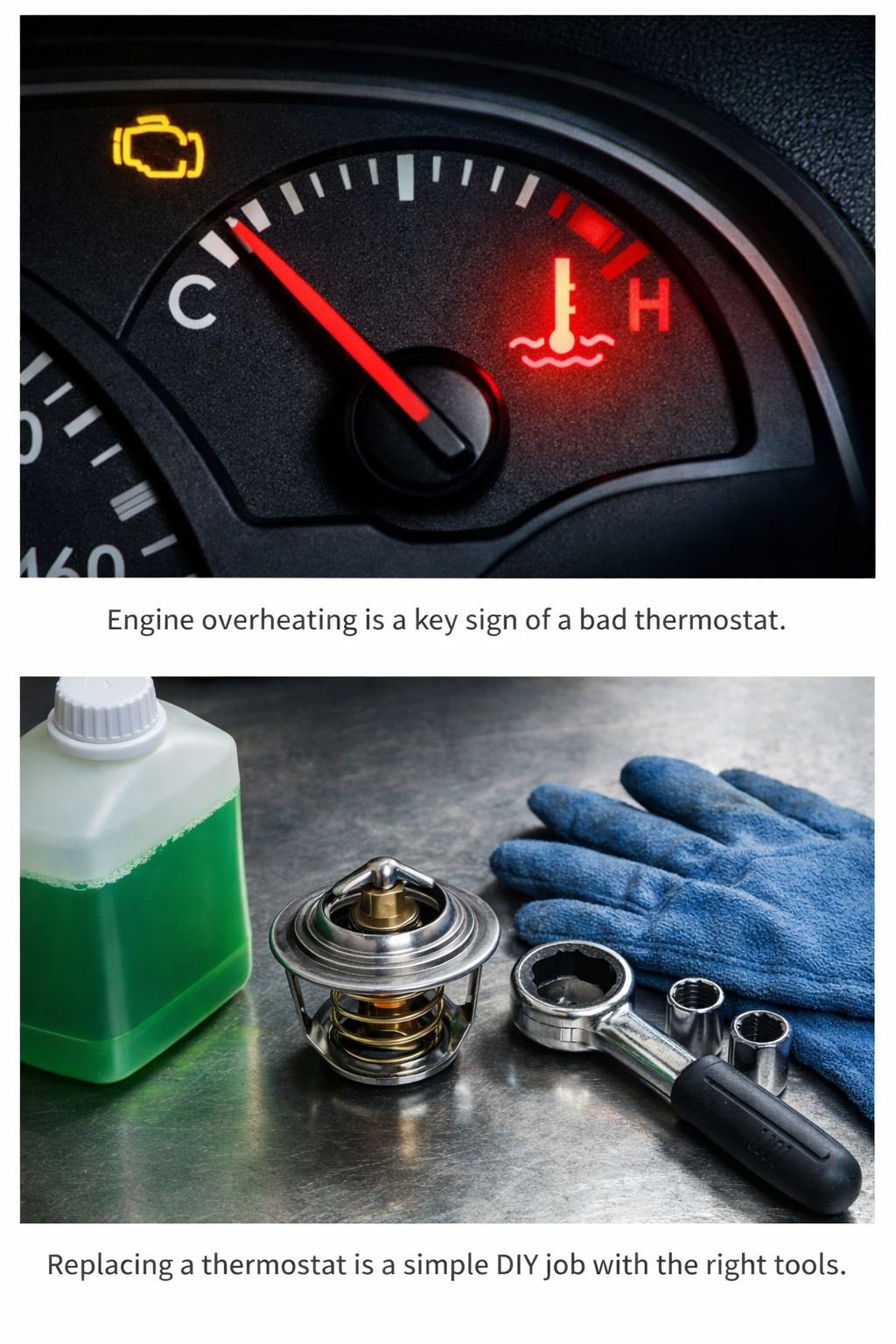
Bad car thermostat symptoms can range from engine overheating to poor fuel economy and heater issues. When it starts to fail, it can lead to anything from poor fuel economy to serious engine damage.
The good news? A bad thermostat is one of the cheapest repairs you can make — if you catch it early.
In this guide you’ll learn the key signs of a bad car thermostat, how to diagnose it at home, and exactly what to do to fix it.
Quick Answer
The most common signs of a bad car thermostat are:
- Engine overheating or running too cold
- Temperature gauge fluctuating
- Heater blowing cold air
- Poor fuel economy
- Check engine light — often code P0128
These symptoms often start gradually, but ignoring them can lead to overheating and expensive engine damage.
Check replacement thermostats on Amazon
What Does a Car Thermostat Do?
The thermostat controls how coolant flows between your engine and radiator.
When the engine is cold the thermostat stays closed, helping the engine warm up quickly to its optimal operating temperature — typically between 180°F and 210°F. Once it reaches that temperature it opens, allowing coolant to circulate through the radiator and cool the engine.
If the thermostat fails this process breaks down — which can quickly lead to performance issues or overheating.
According to NAPA Auto Parts, thermostats fail because they become weak, stuck open or stuck closed. When a thermostat is stuck open coolant constantly circulates and the engine takes longer to reach operating temperature. A closed thermostat is a more immediate problem — engine components quickly build up dangerous heat and become susceptible to major damage.
7 Bad Car Thermostat Symptoms to Watch For
1. Engine Overheating
This is the most serious symptom. If your temperature gauge is rising into the red, your thermostat may be stuck closed, preventing coolant from reaching the radiator. This causes heat to build up rapidly inside the engine with nowhere to go.
According to AAA, a car’s thermostat is a small valve that regulates coolant flow. A failing thermostat will not open or close properly and will prevent coolant from circulating — the result is overheating, and typically replacement of the thermostat is required to restore coolant flow.
⚠️ If your engine is overheating:
- Turn off the air conditioning immediately
- Pull over safely
- Switch off the engine
- Wait at least 30 minutes before opening the hood to prevent burns
Driving while overheating can cause severe and permanent engine damage.
2. Engine Running Too Cold
If your engine never reaches normal operating temperature — or takes too long to warm up — your thermostat may be stuck open. This means coolant is constantly flowing through the radiator even when the engine is cold, preventing it from warming up properly.
According to YourMechanic, when a thermostat is stuck open the temperature gauge needle will barely increase or remain at the lowest setting. Over time this can increase engine wear because oil does not reach its optimal operating condition — reducing efficiency and accelerating the deterioration of engine parts.
3. Temperature Gauge Fluctuating
A healthy engine should maintain a steady temperature. If your gauge moves up and down while driving your thermostat may be opening and closing incorrectly.
According to NAPA, unusual temperature fluctuations on the gauge are a clear sign of a failing thermostat. Inconsistent temperature control can put additional stress on engine components and reduce overall efficiency.
4. Heater Blowing Cold Air
Your car’s heater relies on hot coolant to warm the cabin. If the thermostat is stuck open the engine may never get hot enough — leaving you with cold or weak cabin heat even when set to maximum.
According to OBDeleven, in colder weather you may notice that your vehicle’s heater is not working efficiently. This happens because a cooler engine cannot generate enough heat to warm the cabin properly.
5. Poor Fuel Economy
Engines are designed to run at a specific temperature for maximum efficiency. If the engine runs too cold the fuel mixture becomes richer, efficiency drops, and fuel consumption increases.
According to OBDeleven, when the engine operates at lower than normal temperatures it uses a richer air-fuel mixture and experiences higher energy losses due to thicker oil — directly reducing fuel economy and increasing running costs.
6. Check Engine Light (Code P0128)
Modern vehicles monitor engine temperature closely. If the temperature stays below the expected range you may see code P0128 — which usually indicates the engine isn’t warming up properly.
According to OBDeleven, P0128 means coolant temperature below thermostat regulating temperature. The ECU estimates expected engine temperature by considering time since startup and intake air temperature, then compares it with actual engine temperature.
Common causes of P0128:
- Thermostat stuck open — most common cause
- Faulty engine coolant temperature sensor
- Low coolant levels
- Wiring issues
The good news: Code P0128 is almost always fixed by replacing the thermostat.
7. Coolant Leaks Near the Thermostat Housing
Over time the thermostat housing or gasket can wear out. Signs include coolant puddles under the car, a sweet smell from the engine bay, or residue around the thermostat housing.
According to YourMechanic, leaking coolant can occur when the thermostat does not allow coolant to flow when stuck in the closed position. This can be noticeable in a variety of locations, most commonly around the thermostat housing, and can eventually cause other coolant hoses to leak as well.
What Causes a Car Thermostat to Fail?
- Age and wear — most thermostats last around 10 years or 100,000 miles
- Coolant contamination — causes corrosion and buildup inside the valve
- Low quality parts — cheaper aftermarket thermostats fail much sooner
- Heat cycling — repeated expansion and contraction weakens components over time
- Manufacturing defects — even new thermostats can occasionally be faulty
According to Gates, a leading manufacturer of automotive cooling systems, thermostats fail primarily due to age and heat cycling causing wax pellet fatigue, contaminated coolant becoming acidic and corrosive, and sediment and scale buildup blocking the valve mechanism.
Stuck Open vs Stuck Closed: What’s the Difference?
Stuck Open:
- Engine runs too cold
- Poor fuel economy
- Weak heater
- P0128 check engine code
Not immediately dangerous but should be fixed soon.
Stuck Closed:
- Rapid overheating
- Temperature gauge spikes
- Steam from the engine bay
- Temperature warning lights
Serious — stop driving immediately.
According to YourMechanic, if the thermostat is stuck closed there is no way for coolant to be circulated through the radiator — this could cause the coolant temperature warning light to illuminate as well as extremely hot engine temperatures. If the thermostat is stuck open the flow of coolant is constant, resulting in the engine temperature never reaching an optimum level of heat.
How to Diagnose a Bad Thermostat at Home
Before replacing the thermostat it’s worth confirming the issue using a simple test.
The Boiling Water Test:
- Remove the thermostat — usually located near the upper radiator hose
- Place it in a pot of cold water
- Heat the water gradually on the stove
- Watch for it to open at its rated temperature — usually 180°F-195°F, printed on the thermostat
- Remove from heat — it should close again as the water cools
If it doesn’t open at the correct temperature, stays open, or doesn’t close — it needs replacing.
Other Simple Checks:
- Infrared thermometer — point at the upper radiator hose while the engine runs. If it stays cold for a long time the thermostat may be stuck closed
- OBD2 scanner — check for code P0128 or abnormal temperature readings
Check Engine Code P0128: What It Means
If your check engine light is on and a scan reveals code P0128 your thermostat is almost certainly the problem.
According to OBDeleven, this code appears when the engine control module detects that coolant temperature hasn’t reached its target range within a specified time. Typically this occurs when the thermostat is stuck open, preventing the engine from warming up properly.
Symptoms of P0128:
- Check engine light on — ECU detects temperature out of range
- Temperature gauge reads low — engine not reaching normal operating temp
- Heater blowing cool air — coolant never gets hot enough
- Decreased fuel economy — engine runs rich to compensate
According to automotive diagnostic experts, code P0128 is moderately severe. It doesn’t usually cause immediate damage but ignoring it can lead to bigger problems — running the engine at a lower temperature increases wear on mechanical components over time.
How to Fix a Bad Car Thermostat
Replacing a thermostat is one of the easiest and most beginner-friendly DIY repairs you can make. This is generally a straightforward job on most vehicles, but always follow a guide specific to your make and model.
What You’ll Need:
- New thermostat — match your vehicle’s exact specifications
- New gasket or gasket sealant — critical for preventing leaks
- Basic hand tools — typically 8mm-10mm sockets
- Coolant — to refill the system
- Drain pan — for old coolant
Basic Replacement Steps:
- Let the engine cool completely — never work on a hot cooling system
- Drain some coolant from the radiator into a drain pan
- Locate the thermostat housing — follow the upper radiator hose to the engine
- Remove the housing bolts — typically 2-3 bolts
- Remove the old thermostat and clean the mating surfaces thoroughly
- Note the thermostat orientation — an incorrectly installed thermostat may not open
- Install the new thermostat and gasket
- Reattach the housing and bolts
- Refill with coolant and bleed air from the system
- Start the engine and check for leaks
- Monitor the temperature gauge to confirm it reaches and holds normal operating temperature
According to RepairPal, when replacing the thermostat you should inspect the housing for corrosion. A corroded housing may prevent connected hoses from sealing properly. Refrain from using any leak stopper products in your cooling system — while they may seem to save money they will eventually clog the cooling system and affect the radiator, heater core and engine coolant passages.
Replacement Cost Breakdown
- DIY — $8 to $50 for the part, under $60 total
- Professional mechanic — $150 to $300 including labour
According to YourMechanic, thermostat replacement is a fairly inexpensive repair that can prevent potentially thousands of dollars in engine damage. Make sure to purchase a quality replacement thermostat to limit troubles in the future.
Best Replacement Thermostats
MotoRad 2000-195 — #1 Best Seller
The MotoRad 2000-195 is the #1 Best Seller in Automotive Replacement Engine Thermostats on Amazon with 4.6 stars from 687 reviews and over 800 sold per month at just $8.52. Compatible with hundreds of vehicles including Jeep Wrangler, Ford F-150, Mustang, Dodge Ram, Chevy Camaro and many more.
“Works very well for my ’98 4.0 Jeep system. It only opens when it should at 195, which is the optimum temp for fuel delivery.” — Todd, verified US buyer ⭐⭐⭐⭐⭐
“Perfect fit. No issues on installation.” — Karl Takai, verified US buyer ⭐⭐⭐⭐⭐
“Works great. I like the included burp/flow hole so I didn’t have to drill a hole. It fit perfectly in my 2004 Jeep Wrangler.”— 101sm, verified US buyer ⭐⭐⭐⭐⭐
Pros:
- #1 Best Seller in category
- Excellent value at $8.52
- Compatible with hundreds of vehicle models
- High flow improved design
- Includes burp hole for easy installation
Cons:
- Always test before installation
- Check vehicle compatibility before purchasing
⚠️ Honest note: While the MotoRad 2000-195 is the #1 Best Seller, always test your new thermostat in boiling water before installation to verify it opens at the correct temperature. Some buyers have reported receiving units that do not open at the rated temperature.
Dorman 902-2090 Thermostat Housing Assembly — Amazon’s Choice
If your thermostat housing is cracked or leaking alongside a failing thermostat, the Dorman 902-2090 is Amazon’s Choice with 4.6 stars from 548 reviews. Compatible with select Cadillac, Chevrolet and GMC models.
“Fit my 2015 GMC Sierra 1500 perfectly. Well made. Good value for the money.” — Beth Littleton, verified US buyer ⭐⭐⭐⭐⭐
“Works just as well as the OEM part and cheaper. Easy to install.” — BUCC, verified US buyer ⭐⭐⭐⭐⭐
“Amazing fit. Works excellent. Very simple. No leaks and my heat finally works!” — Brian, verified US buyer ⭐⭐⭐⭐⭐
Pros:
- Amazon’s Choice
- Direct OEM replacement
- Over 100 years of Dorman engineering experience
- Durable construction — resists cracking and leaking
Cons:
- Check fitment for your specific model year before purchasing
When to Call a Professional
While thermostat replacement is DIY-friendly on many cars, you should call a mechanic if:
- Your engine overheated and you continued driving — possible engine damage
- You see coolant mixing with oil — milky substance on dipstick indicates a blown head gasket
- Your car has an electronic or map-controlled thermostat — requires specialist equipment
- You are not comfortable draining coolant or working near hot engine parts
- After replacement the issue persists — other cooling system problems may be present
According to RepairPal, because there are several problems that can cause overheating a technician will do a full inspection of the entire cooling system. If the engine has overheated the shop will look for signs of engine damage — modern engines commonly have plastic parts such as intake manifolds and thermostat housings that can warp from overheating.
Signs of a Bad Thermostat: Quick Reference
- Engine overheating — likely stuck closed — stop driving immediately
- Engine runs too cold — likely stuck open — fix soon
- Temperature fluctuating — failing thermostat — fix soon
- Heater blows cold — stuck open — fix soon
- Poor fuel economy — stuck open — fix when convenient
- Check engine light P0128 — temperature out of range — fix soon
- Coolant leak — housing gasket failure — fix soon
Frequently Asked Questions
How do I know if my thermostat or water pump is bad? Both can cause overheating. If the engine overheats but the upper radiator hose stays cool the thermostat is likely stuck closed. If the hose is hot but the engine still overheats the water pump may be the issue.
Can I drive with a bad thermostat? If it is stuck open — yes, short term, but it is damaging over time. If it is stuck closed — no. Rapid overheating will cause serious and expensive engine damage.
How much does it cost to replace a car thermostat? DIY costs $8-$50 for the part. A mechanic typically charges $150-$300 including labour.
How long does a car thermostat last? Most thermostats last around 10 years or 100,000 miles. Regular coolant flushes help extend thermostat life by keeping the cooling system clean.
Will a bad thermostat cause a check engine light? Yes — if the engine temperature falls outside the expected range the ECU will trigger a check engine light. The most common code is P0128 — coolant temperature below thermostat regulating temperature.
Can a bad thermostat damage my engine? Yes — particularly if stuck closed. Rapid overheating can warp cylinder heads, blow head gaskets, and crack the engine block — repairs costing thousands of dollars. Always address thermostat issues promptly.
Final Verdict
A bad car thermostat is one of the most common — and most affordable — car repairs you’ll ever face. The key is catching the symptoms early before they lead to serious engine damage.
Watch for these warning signs:
- Engine overheating or running too cold
- Temperature gauge fluctuating
- Heater blowing cold air
- Poor fuel economy
- Check engine light — especially code P0128
If you notice any of these symptoms test your thermostat using the boiling water method and replace it if necessary. At under $10 for a quality replacement thermostat it’s one of the best value repairs you can make to protect your engine.
Based on real customer reviews, AAA automotive data, Gates manufacturing data, RepairPal cost data, YourMechanic diagnostic data, and NAPA Auto Parts technical guidance.
Still not sure if your thermostat is stuck open or closed? Check out our detailed guide to understand the differences and what action you should take next.
Reviewed by The Thermo Expert Team
The Thermo Expert Team researches and compares smart thermostats, heating systems, and common HVAC issues to provide clear, practical advice for homeowners. Our goal is to help you understand problems quickly and choose the right solution with confidence.