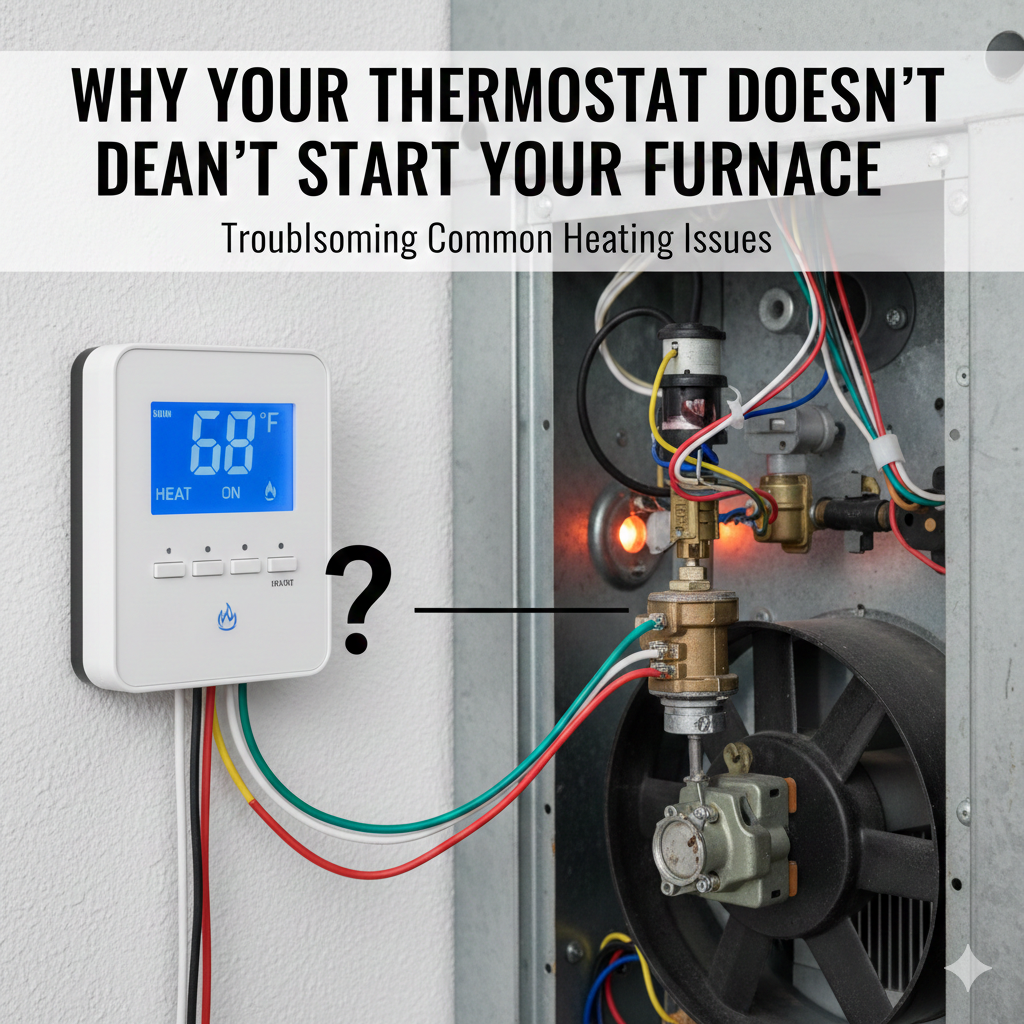
Why Your Thermostat Doesn’t Start Your Furnace (Solved)
There is nothing more frustrating than waking up to a freezing house, walking over to the thermostat, seeing it set to 72°F, but feeling absolutely no heat coming from the vents. You turn the temperature up—still nothing.
Before you panic and pay for an emergency service call, know this: Most thermostat-to-furnace communication failures are simple fixes you can handle yourself. Whether it’s a safety switch that tripped or a loose wire, we will walk you through the diagnosis process.
Common Causes at a Glance
Why is the signal getting lost? Usually, it falls into one of four buckets.
1. Power Issues
It sounds obvious, but if the furnace has no power, the thermostat can’t talk to it. This could be a tripped circuit breaker, a blown fuse on the furnace board, or a flipped “service switch” (which looks like a light switch near the unit).
2. Wrong Thermostat Mode
Modern digital thermostats can be tricky. Is it actually in “Heat” mode? Is the “Hold” setting preventing the schedule from running? Sometimes, a simple reset is all that is needed.
3. Dead Batteries
If your thermostat display is blank or fading, the batteries might be too weak to close the relay that signals the furnace. Even if the display is on, low voltage can cause the system to fail. Specifically, check if the thermostat clicks but the HVAC won’t start, which is a classic sign of relay or power failure.
4. Wiring & Signal Issues
Vibrations can loosen wires over time, or a recent DIY installation might have resulted in crossed wires. If the R (Power) and W (Heat) wires aren’t making contact, the furnace will never fire.
Step-by-Step Troubleshooting
Follow these steps in order to isolate the problem.
Check the Fan Setting
Switch your thermostat fan from “Auto” to “On.” If the fan turns on, you know the furnace has power and the thermostat is communicating. If the fan does not turn on, the issue is likely power-related (breaker or furnace switch).
Inspect the Circuit Breaker
Go to your electrical panel. Look for the breaker labeled “Furnace” or “HVAC.” Even if it looks ON, toggle it OFF and then back ON to ensure it hasn’t partially tripped.
Check the Furnace Safety Switch
Most furnaces have a power switch mounted on the side of the unit or on a nearby wall. It looks exactly like a light switch. Ensure it hasn’t been accidentally bumped to the “Off” position.
The “Jumper Wire” Test (Bypass the Thermostat)
This confirms if the thermostat is broken or if the furnace is broken.
- Turn off power to the furnace (safety first!).
- Remove the thermostat faceplate to expose the wires.
- Take a photo of the wiring.
- Unscrew the Red (R) and White (W) wires.
- Twist them together.
- Turn the furnace power back on.
Result: If the furnace fires up, your thermostat is faulty. If it doesn’t, the problem is at the furnace. For more on this, read our 10-minute checklist to diagnose a faulty thermostat.
Deep Dive: Furnace Safety Switches
Modern furnaces have internal safety mechanisms that will cut power to prevent fires or damage.
The Door Safety Switch
There is a small button or switch inside the furnace panel door. If the door isn’t closed 100% securely, this switch pops out and kills power. Give the furnace door a firm push.
The Limit Switch (Overheating)
If your furnace overheated recently (often due to a dirty filter), the high-limit switch may have tripped. Some auto-reset, but others lock out the system. You may need to wait 1 hour or manually reset it.
Deep Dive: Airflow & Ignitors
Change Your Air Filter
A clogged filter restricts airflow. This causes the heat exchanger to get too hot, triggering the safety limit switch mentioned above. Swap it out immediately.
Inspect the Ignitor / Pilot Light
For older furnaces: Check if the pilot light is out. Relight it following the instructions on the sticker inside the panel.
For modern furnaces: Look for the glow of the Hot Surface Ignitor through the sight glass. If it doesn’t glow, the ignitor may be cracked and needs replacement.
Check Wiring Continuity
If you recently installed a smart thermostat, ensure the C-wire is connected properly. Sometimes, power wiring issues can cause reset failures where the thermostat appears on but cannot send a signal.
When to Call an HVAC Pro
You’ve checked the power, jumped the wires, and changed the filter. If the furnace still won’t start, the issue is likely a bad control board, a failed gas valve, or a broken blower motor. These require professional tools to diagnose safely.
Specifically, if you suspect wire damage inside the walls, you might need guidance on splicing or extending thermostat wires safely before calling a pro.
Frequency Asked Questions
Why does my thermostat say “Heat On” but no heat?
This usually indicates the thermostat is doing its job (sending the signal), but the furnace isn’t responding. Common causes are a tripped limit switch, a bad ignitor, or the furnace door safety switch being open.
Can low batteries stop the furnace from working?
Yes. Even if the display is on, weak batteries may not have enough voltage to trigger the internal relay that sends the signal to the furnace.
How do I reset my furnace?
Turn the power switch on the side of the furnace OFF, wait 30 seconds, and turn it back ON. Alternatively, flip the circuit breaker for 30 seconds.
What is the “Red Switch” near my furnace?
That is the emergency shut-off switch. It looks like a light switch (often with a red plate). Ensure it is in the ON position.
Why is my thermostat clicking?
A clicking sound is the relay trying to close the circuit. If it clicks but nothing happens, the thermostat is likely fine, but the furnace lacks power or has a component failure.
Does a dirty filter stop the furnace?
Yes. A dirty filter blocks airflow, causing the heat exchanger to overheat. The “High Limit Switch” will then trip and shut down the furnace to prevent a fire.
How do I test if my thermostat is broken?
Perform the “bypass test.” Remove the thermostat and twist the Red (R) and White (W) wires together. If the heat turns on, the thermostat is broken.
What does a flashing light on my furnace mean?
This is an error code. Count the flashes (e.g., 3 short, 1 long) and look at the sticker on the inside of the furnace door to decode the specific error.
Is the C-wire necessary for heating?
Technically no, heating only requires R and W. However, without a C-wire, smart thermostats may lose power and fail to signal the furnace consistently.
Why is my furnace blowing cold air?
If the fan is running but the air is cold, the burners aren’t lighting. This could be a bad ignitor, a gas supply issue, or the flame sensor is dirty.
Conclusion
In most cases, a thermostat that won’t start the furnace is due to a simple power interruption, a tripped safety switch, or dead batteries. By following the troubleshooting steps above—starting with the fan test and moving to the jumper wire test—you can often get your heat back on without a service fee.
Next Step: Start by toggling your fan to “ON.” If it runs, replace your thermostat batteries. If it doesn’t, check your circuit breaker.





 Home
Home
 Info
Info
 Compare
 Reviews
 Shop
Shop