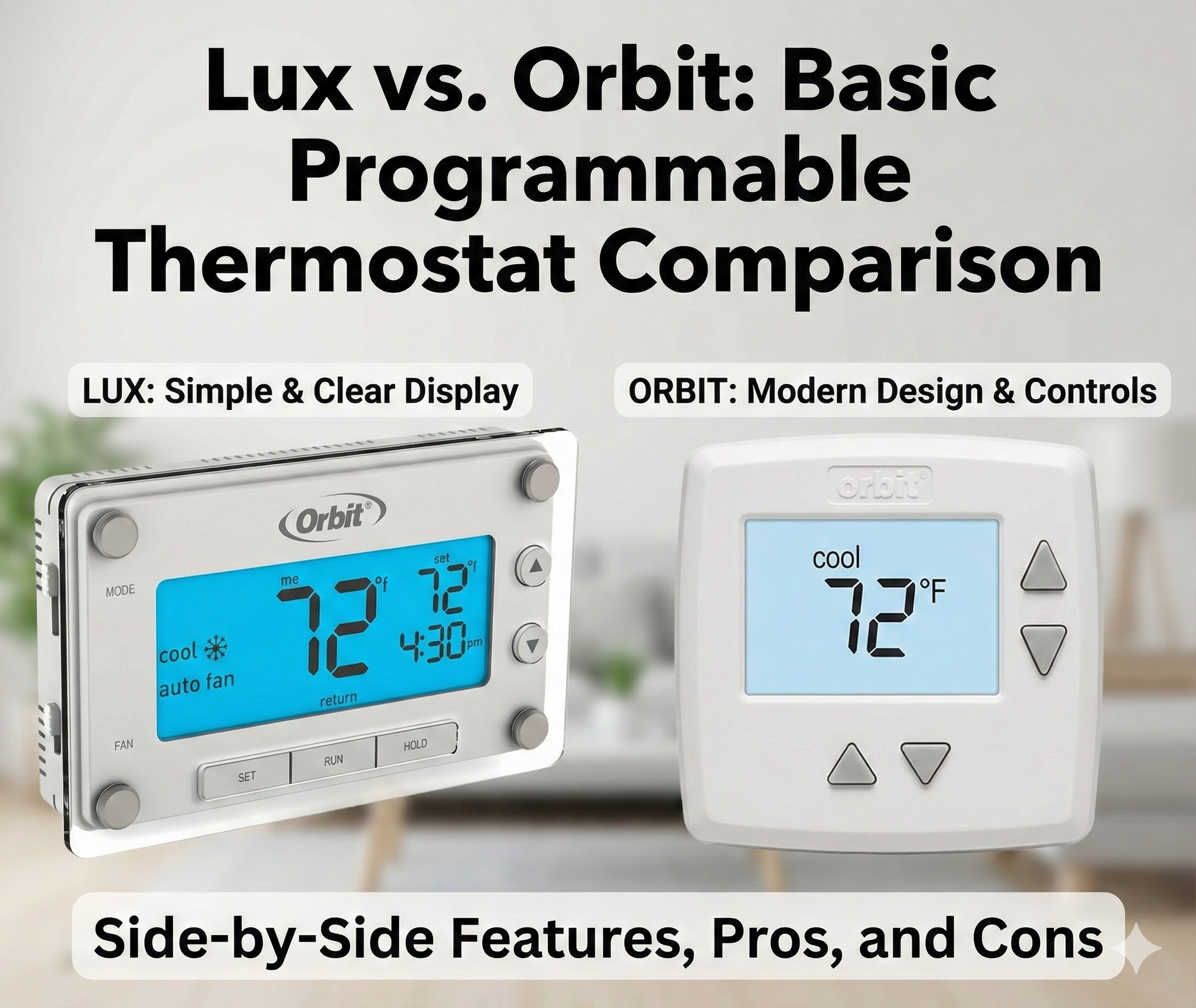
Lux vs. Orbit: Basic Programmable Thermostat Comparison
Not everyone needs a thermostat that talks to Alexa or learns their schedule via artificial intelligence. Sometimes, simple is better. Whether you are a landlord outfitting a rental unit, a homeowner on a strict budget, or someone replacing an aging control in an older home, the “basic programmable” category is where you will likely land.
Two heavyweights dominate this entry-level space: Lux (known for their utilitarian reliability) and Orbit (known for their modern aesthetics and “Clear Comfort” displays). While they may look similar on the shelf, their internal logic, ease of installation, and long-term durability differ significantly.
In this head-to-head comparison, we are stripping away the smart features to focus on the basics: Which thermostat is easier to program? Which saves you more money? And ultimately, which one belongs on your wall?
Quick Comparison: At a Glance
Before diving into the deep details, here is how the most popular models from each brand stack up against each other. We are comparing the Lux TX9600TS against the Orbit Clear Comfort (83521), as these represent the flagship of “basic” programming for each brand.
| Feature | Lux (TX9600TS) | Orbit (Clear Comfort) |
|---|---|---|
| Programming | 7-Day or 5-2 Day | 7-Day Programmable |
| Interface | Resistive Touchscreen | Backlit Display + Physical Buttons |
| Design Aesthetic | Utilitarian / Boxy | Modern / Sleek |
| Power Source | Battery or System Power | Battery (2x AAA) |
| Screen Visibility | Large, Blue Backlight | High Contrast “Clear Comfort” |
| Price Range | Budget-Friendly | Very Budget-Friendly |
If you are looking for something even cheaper than these options, check out our guide on the best budget thermostats under $50 for more alternatives.
Round 1: Design and Build Quality
When you aren’t paying for WiFi chips and high-res displays, the physical build of the plastic housing matters more.
Orbit: The Aesthetic Winner
Orbit’s “Clear Comfort” line is designed to look more expensive than it is. The curved faceplate and large, warm amber backlight give it a contemporary feel that fits well in modern renovations. The buttons are located on the side or bottom, keeping the face clean. However, the plastic can feel slightly thin compared to legacy brands.
Lux: The Utilitarian Workhorse
Lux thermostats, particularly the TX9600TS, prioritize function over form. They often look like traditional thermostats from the late 90s or early 2000s. The casing is boxy, and the touchscreen is the “resistive” type (meaning you have to press firmly), not the glass capacitive touch you are used to on a smartphone. While less pretty, they feel robust.

Round 2: Programming and Ease of Use
The biggest complaint with programmable thermostats is that they are too difficult to program. This is where the battle is won or lost.
Orbit’s Logic
Orbit uses a “Copy” feature that is incredibly intuitive. Once you program Monday, you can simply copy that schedule to the rest of the week with a single button press. This saves a massive amount of time during setup. The text on the screen is large, which is excellent for visually impaired users.
Lux’s Flexibility
Lux offers a distinct advantage with its “Speed Slide” or dial interfaces on older models, but on their touchscreen units, the menu system is straightforward. Lux excels in customization. You can often adjust the “swing” setting (how much the temp drops before the heat kicks on) more easily than on Orbit models. This is crucial for balancing comfort vs. efficiency.
If simplicity is your primary goal and these seem too complex, you might be interested in comparing Honeywell vs Emerson, as both offer robust non-programmable options as well.
Round 3: Installation and Compatibility
Both brands cater to the DIY crowd, meaning installation is generally a 15-minute job requiring only a screwdriver.
No C-Wire Required
A major advantage for both Lux and Orbit in this category is that they generally do not require a C-wire. They run on AA or AAA batteries. This makes them perfect for older homes where modern smart thermostats like the Ecobee Premium would require complex rewiring.
Mounting and Backplates
Lux often includes a larger wall plate to cover the holes left by your previous thermostat, reducing the need for painting. Orbit units are smaller and more streamlined, which looks better but might expose old screw holes, requiring you to patch and paint the wall behind it.

Round 4: Best for Landlords and Rentals
If you own rental properties, your priorities are durability, price, and preventing tenants from driving up utility bills (if you pay them) or breaking the unit.
Lux Wins Here. Many Lux models come with keypad lockouts or temperature limit stops. This allows you to set a minimum cooling temp or maximum heating temp, preventing tenants from setting the AC to 60°F and freezing the coil. Orbit models are more consumer-focused and often lack these specific restrictive features.
For a deeper dive into landlord-specific options, read our guide on the best thermostats for rental properties.
Pros and Cons Breakdown
Here is the summary of what you get with each brand.
Lux Thermostats
Pros
- Highly compatible with almost all HVAC systems.
- Adjustable temperature swing (hysteresis).
- Keypad lockouts available on many models.
- Long battery life.
Cons
- Dated, boxy design.
- Touchscreens require firm pressure (resistive).
- Plastic can yellow over time.
Orbit Thermostats
Pros
- Modern, attractive design (“Clear Comfort”).
- Very intuitive “Copy Day” programming feature.
- Large, easy-to-read backlit displays.
- Generally cheaper price point.
Cons
- Fewer advanced installer settings (swing/limits).
- Buttons can feel “mushy” on cheaper models.
- Less robust casing than Lux.
Are There Better Alternatives?
If neither of these brands excites you, the market is full of strong competitors in the budget space.
- Honeywell Home: The T-series (like the T5 or T3) are legendary for reliability. If you want a slight upgrade, check out our Honeywell T5 review.
- Emerson Sensi: If you want a “basic” look but with hidden smart features (WiFi), the Sensi is the king of hybrid thermostats. Read our comparison of Sensi vs Ecobee to see why.
- Mysa: If you have high-voltage baseboard heaters, neither Lux nor Orbit standard models will work. You need a line-voltage specific unit. See our Mysa review for that specific use case.
Frequently Asked Questions
Do Lux and Orbit thermostats require a C-wire?
Most basic programmable models from Lux and Orbit are battery-powered (AA or AAA) and do not require a C-wire, making them ideal for older homes.
Which brand is better for rental properties?
Lux is often preferred for rentals because many models feature a physical keypad lock or limits on temperature ranges to prevent tenant misuse.
Are Orbit thermostats compatible with heat pumps?
Yes, models like the Orbit Clear Comfort are compatible with multi-stage heat pumps, though you must check the specific wiring configuration in the manual.
Why is my Lux thermostat reading the wrong temperature?
This can happen if the unit is mounted near a draft or direct sunlight. However, most Lux models allow for ‘Temperature Swing’ or ‘Calibration’ adjustments in the user menu to correct the offset.
Final Verdict: Which One Should You Buy?
Choosing between Lux and Orbit comes down to Form vs. Function.
Choose Orbit If: You are a homeowner upgrading a living space and you care about aesthetics. The Orbit Clear Comfort looks great on the wall, is incredibly easy to read, and the “Copy” programming feature makes setup a breeze. It is the user-friendly champion.
Choose Lux If: You prioritize technical control or durability. The Lux TX9600TS allows for finer tuning of temperature swings (saving your HVAC equipment from short-cycling) and includes lockout features valuable for landlords or parents. It is the utility champion.
Regardless of which you choose, moving from a manual non-programmable thermostat to either of these will save you money on energy bills by ensuring you aren’t heating or cooling an empty house.
Ready to upgrade?
Check Best Prices on Amazon