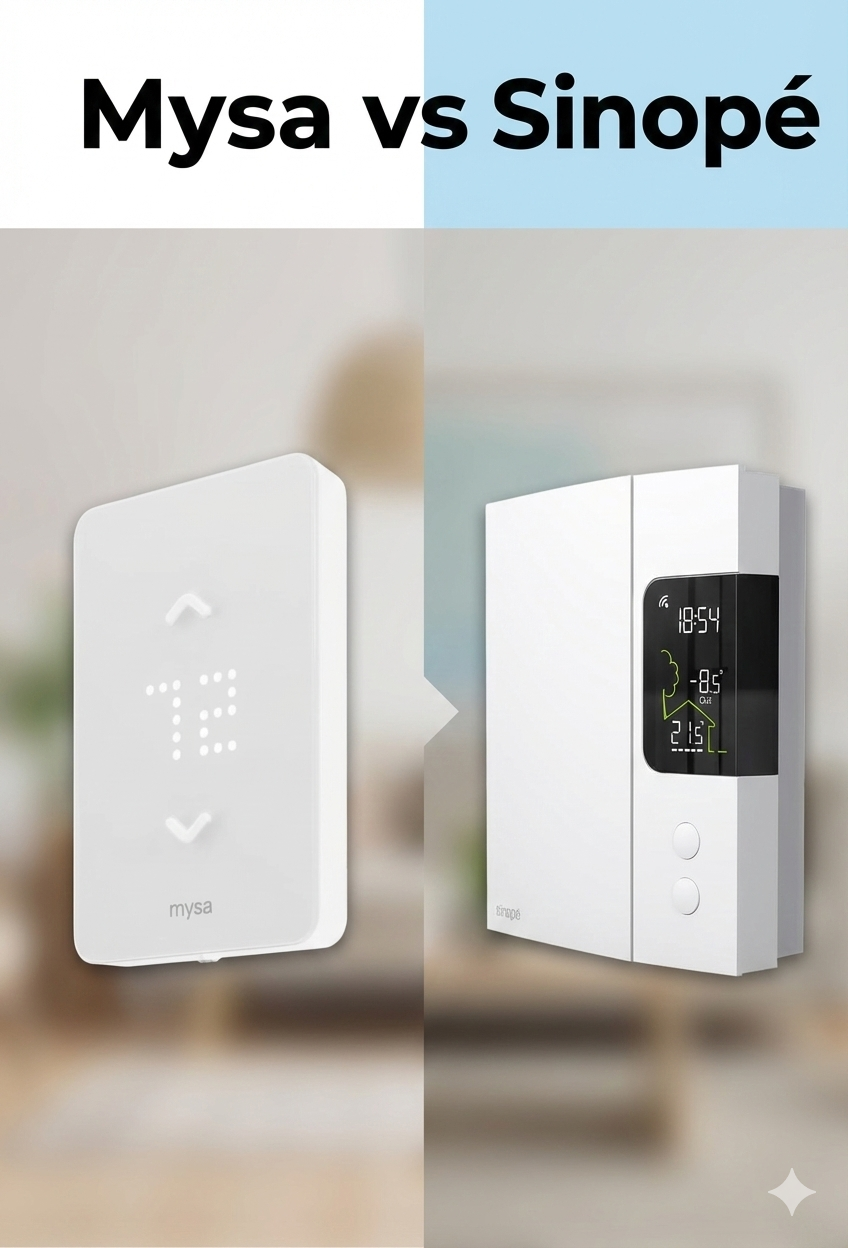
Mysa vs Sinopé: The Battle for Electric Heating Control
For years, homeowners with electric baseboard heating felt left behind by the smart home revolution. While neighbors with central air were showing off their fancy Nest and Ecobee units, those of us with high-voltage heating were stuck with ugly, manual beige dials. That has finally changed.
Enter the two Canadian titans of the high-voltage smart thermostat world: Mysa and Sinopé. Both offer sleek solutions to replace your old line-voltage thermostats, but they take very different approaches to design, connectivity, and ecosystem.
If you are looking for a thermostat for baseboard heaters, the choice usually comes down to these two. In this comprehensive Mysa vs Sinopé comparison, we will break down the wiring, the Wi-Fi protocols, the app experiences, and ultimately, which one deserves a spot on your wall.
At a Glance: Mysa vs. Sinopé
Before we dive into the deep technical details, here is a quick cheat sheet to help you understand the fundamental differences between these two systems.
| Feature | Mysa (V2 for Baseboards) | Sinopé (Wi-Fi & Zigbee Models) |
|---|---|---|
| Best For | Design lovers, Apple HomeKit users, simplicity | Data geeks, Zigbee/Hub users, Whole-home automation |
| Connectivity | Direct Wi-Fi (No Hub) | Choice of Wi-Fi (No Hub) or Zigbee (Hub Required) |
| Display | Minimalist LED Dot Matrix | Backlit LCD with detailed info |
| Ecosystem | Heating/Cooling focused (Baseboard, AC, Floor) | Broad (Lighting, Water Valves, Load Control) |
| Integration | HomeKit, Alexa, Google, IFTTT | HomeKit, Alexa, Google, SmartThings, Hubitat |
| Wiring | Usually 4-wire (Needs Neutral/L2) | 2-wire (conn. dependent) & 4-wire options |
Meet the Contenders
Mysa: The Design-First Disruptor
Based in Newfoundland, Mysa (an Empowered Homes company) burst onto the scene with a clear mission: make high-voltage heating look good. Their thermostats are famous for a sleek, button-less design that blends into modern decor. If you read any Mysa smart thermostat review, you’ll see users raving about how it modernizes a room.
Mysa focuses strictly on HVAC control, offering units for Baseboards (V1 and V2), In-Floor Heating, and Mini-Split Air Conditioners.
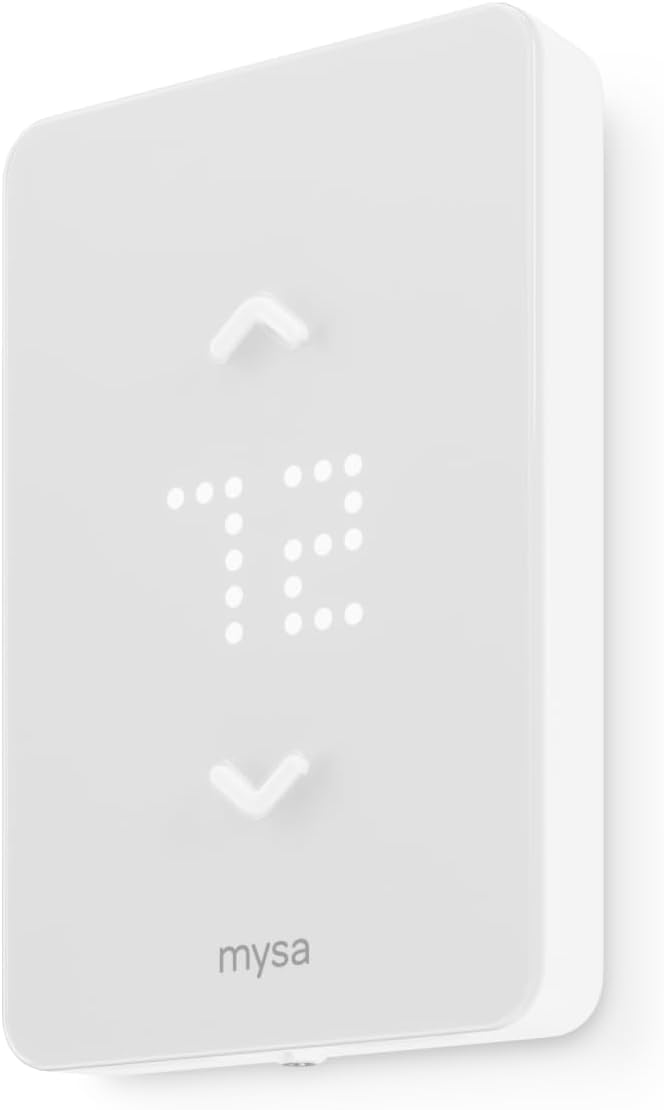
Mysa Smart Thermostat for Electric Baseboard Heaters V2
Minimalist design, direct Wi-Fi connection, and premium build quality.
Check Price on AmazonSinopé: The Engineering Powerhouse
Based in Quebec, Sinopé Technologies takes a more utilitarian, engineering-focused approach. While their thermostats are attractive, they prioritize function and information density on the screen. Sinopé is not just a thermostat company; they manufacture smart light switches, load controllers, and sedulous water leak protection systems.
They offer two distinct lines: the Wi-Fi Series (plug and play) and the Zigbee Series (for advanced home automation hubs).

Sinopé Smart Wi-Fi Thermostat (TH1123WF)
Reliable, detailed display, and no hub required for the Wi-Fi version.
Check Price on AmazonDesign & Display: Form vs. Function
This is arguably the biggest differentiator. Your thermostat lives on your wall, so you have to like looking at it.
Mysa’s Minimalist Approach
Mysa uses a capacitive touch interface with an LED dot-matrix display. When not in use, it can dim completely or show the current temperature in a soft glow. There are no physical buttons. It feels very “Apple-esque” and is designed to disappear into the background.
However, some users find the lack of physical feedback tricky, and the display shows less information at a glance compared to traditional screens.
Sinopé’s Functional Approach
Sinopé thermostats usually feature a backlit LCD screen. They show the set temperature, current temperature, heating status (wattage or percentage), and even outdoor temperature (pulled from the web). They have two physical buttons for raising and lowering the heat.
If you prefer thermostat explained simply with clear data right on the device without opening an app, Sinopé wins here.
Connectivity: Wi-Fi vs. Zigbee
Understanding how these devices talk to your network is crucial for stability.
Mysa (Wi-Fi Only)
Mysa connects directly to your home’s 2.4GHz Wi-Fi network. This is great for simplicity—you don’t need to buy an extra hub. However, if you have 10 baseboard heaters in a large house, adding 10 Wi-Fi devices can congest your router. Are Wi-Fi thermostats worth it? Yes, for smaller setups, they are the easiest route.
Sinopé (Choose Your Adventure)
Sinopé gives you a choice:
- Wi-Fi Series: Like Mysa, connects directly to your router. Easy setup.
- Zigbee Series: Connects to a gateway (like Sinopé’s GT130, SmartThings, or Hubitat).
The Zigbee option is a massive advantage for power users. Zigbee creates a mesh network, meaning each thermostat acts as a repeater for the others, improving signal strength in large homes. It also keeps your Wi-Fi network uncluttered.
Features & Performance
Heating Algorithms (PID)
Both thermostats use Proportional-Integral-Derivative (PID) controllers. Unlike old bi-metal thermostats that swing wildly in temperature (too hot, then too cold), PID controllers pulse the power to the heater to maintain a steady temperature within a fraction of a degree. Both excel here, providing comfort and efficiency.
Geofencing
If you are wondering what is geofencing, it’s the feature that turns the heat down when you leave the house and up when you return.
- Mysa: Has excellent, native geofencing built into the app. It supports multiple users well.
- Sinopé: Geofencing is available, but often relies on integration with Apple HomeKit or their “Neviweb” platform nuances. It is functional but Mysa’s implementation feels more “out of the box” ready.
Energy Charting
Since baseboard heating is expensive, tracking usage is key. How does a smart thermostat save money? By showing you where you are wasting it.
Sinopé is the king of data. Its “Éco Sinopé” feature (especially in Quebec) integrates with utility dynamic pricing to pre-heat your home before peak rates hit. Mysa offers clean, easy-to-read charts that show daily usage and costs, perfect for the average homeowner.
Installation: The High-Voltage Warning
Warning: Unlike Honeywell vs Nest which use low voltage (24V), Mysa and Sinopé handle 120V or 240V. This can be lethal. If you are not comfortable with electrical work, hire a professional.
Wiring Compatibility
Most line-voltage smart thermostats require 4 wires in the gang box (Live, Neutral/L2, and Load). They need a complete circuit to power their Wi-Fi radios.
- Mysa V2: Has become more compact and easier to fit in the box (40% smaller than V1). It supports a wide range of heaters but typically requires that Neutral/L2 connection.
- Sinopé: Also requires similar wiring. However, Sinopé offers a specialized 2-wire version (TH1124) for older installations where only a switch loop exists, though it has limitations on the type of load (must be resistive).
Always check your gang box before buying. If you see only two wires, your options are limited, and you might need an electrician to pull a neutral wire.
Pros & Cons Breakdown
Mysa Pros
- ✅ Stunning, modern design.
- ✅ Excellent, user-friendly app.
- ✅ No hub required.
- ✅ Native HomeKit support out of the box.
- ✅ Mysa for AC and In-Floor creates a unified app experience.
Mysa Cons
- ❌ Large faceplate might not fit tight corners.
- ❌ LED display shows less info than LCD screens.
- ❌ Wi-Fi only (no Zigbee/Z-Wave options).
Sinopé Pros
- ✅ Offers Zigbee models (great for hubs like Hubitat).
- ✅ Detailed screen with outdoor temp and wattage.
- ✅ Physical buttons (better for guests/elderly).
- ✅ Wider ecosystem (water valves, load controllers).
- ✅ Advanced energy management features.
Sinopé Cons
- ❌ Industrial design may not suit all decors.
- ❌ Zigbee models require a hub (extra cost).
- ❌ App (Neviweb) can feel more utilitarian than sleek.
Are There Other Alternatives?
While Mysa and Sinopé dominate the line-voltage market, there are niche alternatives. However, they rarely match the app quality of these two. You might encounter brands like Stelpro (which actually uses the widespread Maestro ecosystem, similar to Sinopé’s Zigbee integration).
If you are looking for low-voltage solutions for a different part of your home, check our guide on Ecobee vs Wyze or Honeywell vs Emerson.
Frequently Asked Questions
Do these thermostats work with fan-forced heaters?
Yes, both Mysa and Sinopé have specific settings for fan-forced heaters. You must enable this in the settings to prevent the heater from short-cycling, which can damage the fan motor.
Can I control multiple heaters with one thermostat?
Yes, as long as the total wattage does not exceed the thermostat’s limit (usually 3800W or 4000W at 240V). You must wire the heaters in parallel. See our guide on thermostat instructions for homeowners for safety tips.
What happens if the Wi-Fi goes down?
Both thermostats will continue to work as standard manual thermostats. They will hold the last set temperature or follow the schedule stored on the device (depending on the model’s memory).
Which is better for a vacation home?
Both are excellent. You can remotely monitor temperature to prevent frozen pipes. If the internet is spotty at the cabin, Sinopé’s Zigbee version might be more robust if connected to a cellular-backed hub, whereas Mysa relies entirely on the local Wi-Fi stability.
Final Verdict: Which One Should You Buy?
In the Mysa vs Sinopé showdown, there is no loser—only a better fit for your specific needs.
Choose Mysa If:
- You prioritize aesthetics and want a device that looks modern and sleek.
- You use Apple HomeKit heavily and want the easiest setup.
- You don’t want to buy a separate hub.
- You want a simple, unified app for baseboards, AC, and heated floors.
Choose Sinopé If:
- You have a SmartThings, Hubitat, or Home Assistant setup (Get the Zigbee version!).
- You prefer physical buttons and a screen with more data.
- You want to expand your smart home into leak detection and lighting with the same brand.
- You live in an area with complex time-of-use electricity rates.
Whichever you choose, moving from a manual dial to a smart thermostat is one of the best energy savings upgrades you can make for an electrically heated home.




 Home
Home
 Info
Info
 Compare
 Reviews
 Shop
Shop